

 Fabian Lainé


Full Guide
Clash of Clans: how to counter the new assembled defenses of August 2026 in attack
In brief
The three new multi-module defenses from August 2026 arrive as early as Town Hall 11 and shake up your attack reflexes. The Hero Eradicator breaks Queen walks, the Firespitter weakens over time, and the Blast Mortar punishes stuck troops: here's how to counter them without messing up.
Since August 1st, all bases from town hall 11 upward can build one of the three new fusion defenses: the explosive catapult, the hero eradicator, and the glowy candle. Supercell has opened up the fusion workshop at a much lower level than usual for the 14th Clashiversary — normally these temporary buildings are reserved for the very last town hall tier.
The result on the attacking side: three buildings nobody yet knows how to read have slipped into bases you knew by heart, and not just at TH17 and TH18. One of the three, the hero eradicator, targets precisely the game's most common opening, the queen entrance (the queen charge). The other two punish equally ingrained reflexes: sending a lone unit ahead to scout, and letting an army bunch up on a wall.
Here's what each of the three actually does, how to spot it before launching, and what needs to change in an attack plan starting this weekend.
First things first: only one is active, and it can change
How the fusion workshop works hasn't changed since it was introduced. Three fusion defenses can be built during an assembly phase, but only one can be active on the village at a time — and Supercell states in black and white that the defender can "switch from one to another at any time." So never assume that an opponent you've already faced will show you the same defense the next time.
Second point to keep in mind: the number displayed on the building isn't a classic level. Each fusion defense is built on three independent modules, each starting at level 1; the number shown corresponds to the sum of all three. A freshly placed defense will therefore display 3, which is its floor, not a sign of neglect. The building's appearance then evolves with the cumulative total of the modules: the more built-up the silhouette, the more work has gone into the defense.
Useful detail for sizing up an opponent: according to community data (Base Drop, August 3, 2026), the maximum level of each module is indexed to the town hall and increases by one tier per level. A TH11 would thus stay capped at level 3 with no way to upgrade anything, while only TH18 would reach the true ceiling. This isn't confirmed by Supercell, but it matches what's observed in war: at a TH11 to TH13, the fusion defense is almost decorative and falls in passing; at a TH17 or TH18 that has leveled up its hit points module, it's a real building that needs to be budgeted for.
Hero eradicator: the one that breaks queen entrances
This is by far the most dangerous of the three. Its in-game description is explicit: it hits both ground and air troops, but deals noticeably more damage to heroes, and its projectiles slow targets down by applying a poison effect.
The figures recorded for the current cycle: range of 9.5 tiles, a firing rate of 0.6 seconds, between 1,600 and 6,000 hit points depending on the modules, and DPS climbing from 145 to 385. Its three modules are hit points, damage per second, and the level of the poison spell applied to the target — already at 3 while the module itself is still at level 1.
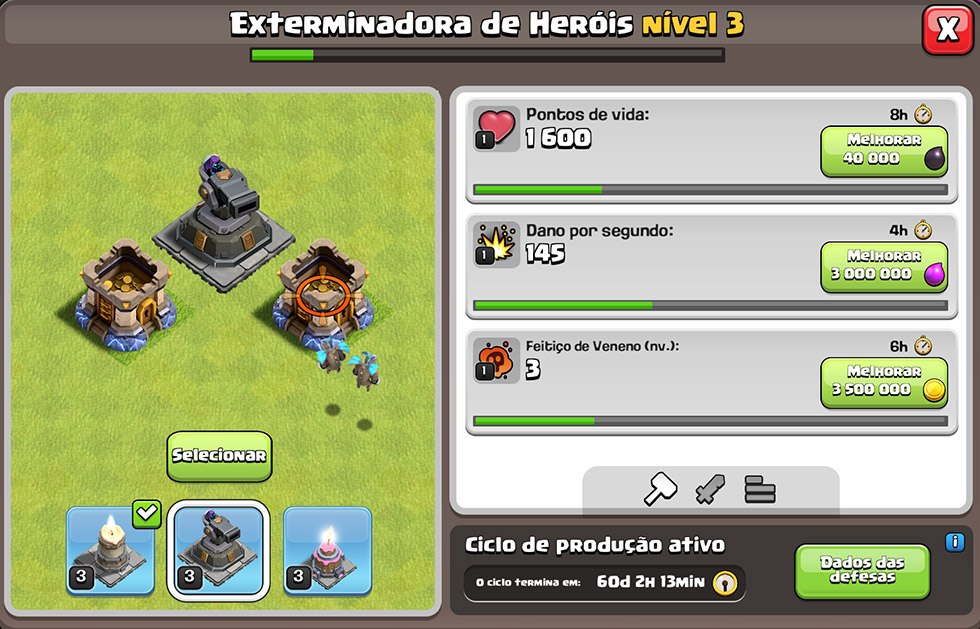
What makes her a pain isn't her raw DPS, it's her targeting priority. She switches back to a hero every time she has to pick a new target: placing a beefy unit next to her to pin her down, the usual reflex against an annoying defense, doesn't work for long. And a slowed-down hero means a wasted ability window.
What you need to do:
- Spot her before choosing your entry side. She's only useful to the defender where heroes pass through, which is rarely dead center: look for her in an edge compartment, on the most-attacked face of the base.
- Plan for one extra freeze spell in your composition if the opponent has placed her. Freezing the Eradicator before the Archer Queen enters her 9.5-tile range costs a spell slot, but it's the price of a clean entry.
- The invisibility spell does the same job and often works better, since it also covers the approach path.
- Failing that, go around: if your hero route can clear the neighboring compartment before she locks onto them, save your spell for something else.
- Don't count on a totem spell to distract her for long: she retargets a hero with every switch.
Ember Candle: it's burning out, let it burn
The candle is the most original bet of the cycle: it's the only defense in the game that loses power as the attack progresses instead of gaining it. It sends flames onto several nearby enemies at once, with a range of 10.5 tiles, a very fast attack speed of 0.5 seconds, and 1,600 to 6,000 hit points.
Its mechanic works in three stages. It starts by hitting up to 6 targets simultaneously, drops to 4 targets in the second stage, then to 3 in the third, before stopping completely. The timing of the shifts depends on the duration module: the second stage kicks in between 60 and 78 seconds of combat, the third between 95 and 132 seconds. The building's model changes visually at each stage, letting you know in real time how much it has left in the tank.
The result is counterintuitive. Against a single target, the candle concentrates all six projectiles on it: that's when it hits hardest. Sending a lone hero to scout a compartment within its 10.5-tile range is the worst possible scenario. Conversely, giving it a crowd dilutes its damage across all targets in range, and an attack that takes about a hundred seconds to reach its compartment finds a defense that's already half burned out.
In short: against the candle, the goal isn't to destroy it quickly, it's to never give it an isolated target. Freeze, here, is a waste — time is already working in your favor.
Explosive Catapult: the trap of stuck troops
The Explosive Catapult has the longest range of the trio at 12 tiles, with a slow attack speed of 3 seconds. It strikes both ground and air, and its shot works in two stages: the projectile lands, then explodes shortly after, dealing area damage. Count on 1,600 to 5,800 hit points and a displayed DPS of 65 to 125, or around 195 damage per shot at the base level, with the explosion adding on top of that.
This delay between impact and explosion is both its strength and its weakness. Troops on the move take little damage: they've left the area by the time the blast goes off. Troops stuck against a wall, on the other hand, take the full hit, and a pack of dragons frozen above a wall section melts in two volleys. Healers, which follow slowly and never move on their own, are the first to go — that's the main risk for an escorted queen entry.
Its other weakness is even easier to exploit: it has a minimum range of 3 tiles. A hero standing right at its base takes absolutely no damage while it fires over the top. If your Archer Queen or your Barbarian King ends up right next to it, there's nothing more to do — the fight is already settled.
What you need to do: keep your army moving, avoid getting stuck within its 12-tile range, and never let a group linger on a wall within its reach. A well-placed Jump spell is worth more than a Freeze spell against this particular defense.
What the cycle changes in your compositions
The change that matters most for attackers can be summed up in one line: all three defenses hit both ground and air. None of them can be bypassed by air. A dragon or balloon composition will therefore run into whichever assembled defense your opponent has, whereas before you could choose an attack path that avoided it altogether.
In practice, the only one of the three that justifies changing your spell lineup is the Hero Eradicator, because it targets the backbone of modern attacking. The Candle Blaster is managed through pacing, and the Catapult through movement. If there's only one rule to remember: check which one is placed during scouting, and only adjust your composition if it's the Eradicator.
Finally, keep in mind that all of this is temporary. An assembly phase lasts about three months according to Supercell, and the workshop displays an in-game countdown to the end of the cycle. The three current defenses will disappear to make way for a new trio — so what you're learning this month has an expiration date. All the more reason to do it right now, while half your opponents haven't figured them out yet.
Share this article
Facing these three new defenses, which one gives you the most trouble on attack?
Frequently asked questions
Why does a multi-module defense show a minimum of 3?
Because it has three independent modules that each start at level 1. The number shown is the sum of the three, so the floor is 3, not an oversight by the defender.
Do I need to freeze the Hero Eradicator before every Queen walk?
Not necessarily. An Invisibility Spell also covers the path and often works better. Otherwise, go around by clearing the neighboring compartment first. But yes, if it's on your main entry axis, an extra freeze in your composition becomes unavoidable.
How can I tell what level my opponent's multi-module defenses are?
The number displayed is the sum of the three modules, and the building's appearance changes visually. The more elaborate the silhouette, the more it's been upgraded. As a rough guide, a Town Hall 11-13 can barely upgrade anything, while a Town Hall 17-18 can push its modules much higher.
Does the Firespitter stop completely at the end?
Yes, it goes from 6 targets to 4, then to 3, then stops. The switch times depend on the duration module, ranging from 60 to 132 seconds depending on the tier. So it becomes decorative after about two minutes of combat.
Does a hero standing right next to the Blast Mortar take damage?
No, it has a minimum range of 3 tiles. If your Queen or King ends up right beside it, that's already sorted: it can't hit them from there.
Key takeaways
- Only one multi-module defense is active at a time, and the defender can switch it before your attack.
- The Hero Eradicator always targets a hero as a priority: freeze it or go around it, don't count on a tank to hold its attention.
- The Firespitter becomes less dangerous over time: send in a group rather than isolated targets to dilute its damage.
- The Blast Mortar explodes after impact: keep your army moving to avoid the combo of stuck troops against a wall.
- All three hit both ground and air, so you can no longer bypass them with a pure air attack.
Comments
No comments yet. Be the first to react!
Leave a comment
Similar guides





Latest articles







Your opinion counts
Rate Clash of Clans
Click a star to rate