



 Fabian Lainé


Full Guide
Palia: the 2026 Foraging guide — trees, wood, planks and rare gatherables
In brief
Foraging in Palia yields far more than it seems: it feeds Carpentry, crafting, and the economy of Kilima Valley's Royal Highlands. This guide explains where to find each type of wood, how to optimize your Flow-Imbued trees for gold farming, and which harvestables are truly worth your time.
Palia's weekly challenges reset on Monday, August 10 at 4:00 AM UTC, or 6:00 AM in Paris. On the Foraging side, that means 100 Foraging Medals to collect by Sunday, including 30 for five magic trees — the challenge that most players let slip week after week, not knowing where to find said trees.
Foraging remains the most underrated skill in the game. It pays little per action, but it feeds into everything else: planks for Carpentry, plant fibers for crafting, spices for Cooking, and since the arrival of the Royal Highlands, a significant share of the Amber Echo you spend there.
Ashura's guild's three weekly challenges
They unlock at Foraging level 10 and reset every Monday at 4:00 AM UTC. Good news: progress on an unfinished challenge carries over from one week to the next, so nothing is lost if you didn't finish yours last week.
| Challenge | Objective | Reward |
|---|---|---|
| Forage Finder | Collect 30 harvestables | 40 Foraging Medals |
| Lumberjack | Chop down 10 trees | 30 Foraging Medals |
| Go with the Flow | Chop down 5 magic trees | 30 Foraging Medals |
Ashura runs the Foraging guild from the Ormuu's Horn Inn, in Kilima Valley. That's where the medals go: Flow-Infused Plank for 3, glowcap for 6, Heat Root for 6, Dragontongue Peat for 8, Dari Cloves for 12, Heartdrop Lily for 20, and the Dowsing Rod for 50 — more on that below.
Which tree gives which wood, and which axe you need
Five tree families, five distinct types of wood. The type of wood depends solely on the species, while the quantity and XP depend on the growth stage.
| Species | Wood obtained | Region | XP (young → mature) |
|---|---|---|---|
| Oak, birch, juniper | Sapwood | Kilima Valley, Bahari Bay | 12 → 24 |
| Pine | Heartwood | Bahari Bay | 12 → 24 |
| Ancient tree | Ancient Wood | The Bahari Wilds | 16 → 32 |
| Lantern Ash | Lantern Ashwood | Royal Highlands | 18 → 36 |
| Flow-infused version | Flow-Infused Wood | Kilima Valley, Bahari Bay | 12 and up → 22 and up |
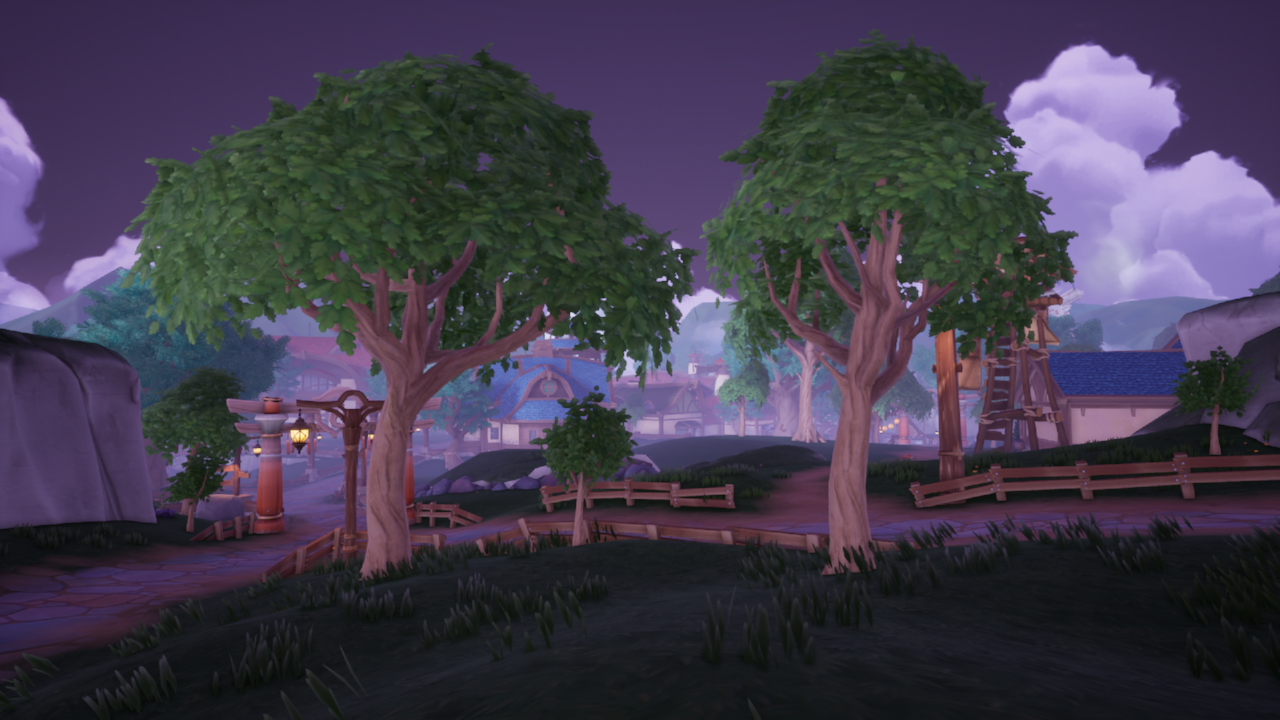
The axe tier determines the size of accessible trees. The Standard axe (level 3, recipe 200 gold coins, then 1 Makeshift Axe + 20 Sapwood Plank + 5 copper bars) unlocks medium trees; the Fine axe (level 6, 1,500 gold coins, 1 Standard Axe + 10 Heartwood Plank + 5 iron bars) unlocks large ones. The Exquisite axe (level 9, 3,000 gold coins, 1 Fine Axe + 5 Flow-Infused Plank + 5 palium bars) doesn't unlock any new size: it simply hits harder, which is exactly what you need against Flow-infused trees. Only mature Lantern Ash trees in the Royal Highlands strictly require it.
Two details that pay off. First, only medium and large trees can drop a seed (Acorn, Samara, Juniper Seed, Pinecone, Ancient Wood Seed, Lantern Ash Seed): there's no point hoping for anything from a young sapling. Second, in multiplayer, any player who has landed at least one hit gets the full loot, and group members who stayed nearby receive the same, with a chance of doubled loot.
Flow-Infused Trees: the only wood truly worth gold
Flow-Infused Wood is worth 11 gold coins per unit, versus just 1 for Sapwood, Heartwood, ancient wood, and Lantern Ashwood. A ratio of eleven to one, for exactly the same action: that's what makes farming Flow-Infused trees essential as soon as you're looking to fund anything other than your axe.
These trees appear individually in Kilima Valley and Bahari Bay, recognizable by the purple and pink glow running up the trunk. They regenerate their health as soon as you strike them: solo, only the Exquisite axe lets you fell a small or medium one, while large ones almost always require two players. Cutting down all the normal trees in an area also increases the chance of seeing a Flow-Infused version reappear there.
The real jackpot is the Flow-Infused Tree groves, exclusive to Bahari Bay. A grove appears at midnight in-game time, roughly once per real-life hour since a day in Palia lasts sixty minutes. A directional sound triggers the moment it appears and can be heard across about a quarter of the map: that's your radar. Two groves can coexist, but not three — so leaving an old grove standing blocks the next one from appearing.

Each grove also spawns a magical creature or an epic insect outside its usual habitat: Azure Chapaa, Large-antlered Sernuk, or Blue-furred Muujin for hunting; Rainbow-tipped Butterfly, Fairy Mantis, Jewelwing Dragonfly, or Ancient Amber Beetle for insects, with a chance of star quality. So a grove is never just about wood.
Finally, a mechanic almost nobody uses: a Flow-Infused tree's XP accumulates. It doesn't depend on the tree's size but on the amount of health removed before it falls. If you hit faster than it regenerates, then let the tree heal before starting again, the total climbs well beyond the base 22 XP of a mature tree. And since this XP is stored on the tree, everyone who can loot it gets the same base amount.
Sawmills and planks: what to refine, what to sell raw
The Basic Sawmill unlocks at level 2 (recipe for 50 gold coins from Ashura) and is crafted at the workbench with 30 Sapwood, 8 flint, and 10 plant fiber. The Heavy Sawmill arrives at level 5 (recipe for 1,000 gold coins, then 1 Basic Sawmill + 30 Heartwood Plank + 4 iron bars + 5 Ceramic) and refines about 53% faster.
| Plank | Ingredient | Basic Sawmill | Heavy Sawmill | Level | Recipe | Value |
|---|---|---|---|---|---|---|
| Sapwood Plank | 1 Sapwood | 1 min | 39 s | 2 | comes with the Basic Sawmill | 1 |
| Heartwood Plank | 1 Heartwood | 2 min | 1 min 18 s | 4 | 500 gold coins | 2 |
| Ashwood Plank | 1 Lantern Ashwood | 2 min | 1 min 18 s | 4 | 500 gold coins | 2 |
| Ancient Wood Plank | 1 Ancient Wood | 3 min | 1 min 56 s | 5 | 500 gold coins | 2 |
| Flow-Infused Plank | 1 Flow-Infused Wood | 4 min | 2 min 36 s | 7 | 2,000 gold coins | 13 |
The math is quickly done. Refining Sapwood earns you absolutely nothing: the plank is worth the same as the log. Heartwood, Ancient Wood and Lantern Ashwood gain one gold coin per unit, which only matters because these planks are used for furniture and quests. Only the Flow-Infused Plank offers a real gain (+2 per unit), but it ties up the sawmill for four minutes: if you have a big stack and little time, sell the raw wood instead.
Going the other way, the blacksmith in Kilima Village sells the Sapwood Plank for 4 gold coins and the Heartwood Plank for 8, which is four times their resale value: save this for construction needs only.
Harvestables: XP depends on rarity, not on the item
Picking a plant requires no tool, and XP depends solely on rarity. Star quality adds exactly 50%.
| Rarity | XP | XP at Star Quality |
|---|---|---|
| Common | 6 | 9 |
| Uncommon | 13 | 19 |
| Rare | 25 | 38 |
| Epic | 50 | 76 |
In terms of gold value, Epics clearly dominate: Dari Cloves (Bahari Bay) and Royal Wisteria (Kilima's Royal Highlands) at 145 gold coins, or 217 at star quality; Elderflower also at 145 in the Bahari Wilds; Heartdrop Lily at 100. Pearls go even higher: the Green Pearl (295) comes from Unopened Oysters in Bahari Bay, the Black Pearl (390) from Elder Clam Mushrooms in the Bahari Wilds. Finally, Fossilized Lantern Resin, a rare drop from wild Lantern Ash, is worth 350 gold coins.
Multiplayer tip: a harvestable already picked by someone else remains available to you for 30 seconds if it's common or uncommon, 2 minutes if it's rare, and 5 minutes if it's epic. So an epic plant spotted on the other side of the area is still very much within reach.
The Dowsing Rod, the item that transforms a farming run
The Dowsing Rod tracks nearby rare and epic harvestables for 15 minutes — including at star quality since patch 0.177 — and displays them as turquoise icons on the map and on the compass. It also detects Flow-Touched trees in Bahari Bay, making it the ideal tool for completing Go with the Flow without wandering aimlessly.
The recipe can be purchased for 2,500 gold coins from the guild at level 8, after which the item is crafted at the workbench using 3 coral, 10 Ceramic, and 5 flint. At level 10, you can also buy it ready-made for 50 Gathering Medals. What it tracks depends on the region:
- Bahari Bay: Glowcap, Dari Cloves, Dragonbeard Peat, Heartdrop Lily, Heat Root, and Flow-Touched trees.
- The Bahari Wilds: Elderflower, Elderwood Lotus, Spudmelons, and large deposits of Infected Essence.
- Kilima's Royal Highlands: Glowcap, Golden Fern, and Royal Wisteria.
Bahari Royal Highlands: Foraging becomes a source of Amber Echo
This is the most significant change to the skill since patch 0.202, and it's still largely flying under the radar: in the Royal Highlands, every harvestable yields Amber Echo. The same plants gathered in another region give none. And when the resource is encased in an amber crystal, the yield jumps significantly.
| Harvestable | Rarity | Amber Echo (free) | Amber Echo (in amber) |
|---|---|---|---|
| Royal Wisteria | Epic | 29 to 35 | 62 to 72 |
| Golden Fern | Rare | 11 to 14 | 27 to 34 |
| Champilux | Rare | 11 to 14 | 16 to 20 |
| Royal Heather | Uncommon | 6 to 8 | 13 to 17 |
| Coral | Uncommon | 6 to 8 | 11 to 15 |
| Dawnspur Lily | Common | 3 to 5 | 9 to 12 |
| Shell | Common | 3 to 5 | 9 to 12 |
Amber crystals can be broken with a pickaxe, an axe, or a bow of any tier; you then need to pick up what was inside them to collect the Amber Echo. A single embedded Royal Wisteria can therefore yield up to 72 Amber Echo and 145 gold coins when sold: no other plant in the game comes close to this yield. Wild Lantern Ash also drop Amber Echo with every chop, provided you've completed the main quest A Stitch in Time — those you plant on your plot, however, give none, and neither does Fossilized Lantern Resin.
425 Renown points, half of which come from a single achievement
Foraging achievements total 425 Renown points, but the distribution is very uneven: Tree Chopper, which requires chopping down and looting 3,000 trees, accounts for 210 of them on its own. Level milestones grant 15 points ("Advanced Forager", level 10), 30 (level 25), and 60 (level 50); the first rare harvest gives 5 points, the first epic 15; "Kilima and Bahari Forage Collector" 15; Elderwood Survivalist 15, and its starred-quality version 60. Separately, Infected Survivalist gives no Renown but 200 Infected Essence.
The XP table is the same as for all skills: 240 points for level 2, then 440, 720, 1,080, 1,560, 2,130, 2,830, 3,720, and 5,000 per level from level 9 onward. Your Focus bonus is added as a percentage to each gain: a stop at the Phoenix Sanctuary before a big chopping session pays off very quickly.
The routine that wraps up the week in an hour
In practice: settle in at Bahari Bay, activate a Dowsing Rod, and make the rounds of the rares and epics it reveals — the 30 harvestables from Forage Finder fall in about fifteen minutes. Follow up with the grove's sound at midnight in-game time: five Flow-infused trees later, Go with the Flow and Lumberjack are done and your 100 medals are in the bag.
The rest is just upkeep: a Heavy Sawmill kept constantly busy with Flow-Infused Wood while you play something else, and detours to the Royal Highlands reserved for amber crystals containing a Royal Wisteria or a Golden Fern.
Share this article
What's your top priority in Foraging?
Frequently asked questions
Where can you find Flow-Imbued trees?
They appear individually in Kilima Valley and Bahari Bay, recognizable by their purple and pink glow. Bahari Bay also features entire groves that regenerate at midnight game time, roughly once every real-world hour.
Which axe do I need to chop down Flow-Imbued trees?
The Exquisite Axe (level 9) is essential solo for small and medium trees, while large ones generally require two players with a Fine or Exquisite axe. Ordinary trees don't require it.
Is it more profitable to refine Flow-Infused Wood into planks or sell it raw?
Refining yields +2 gold per unit, but ties up the sawmill for four minutes. If you have a large quantity and little time, selling the raw wood is more efficient.
Which harvestable yields the most gold?
Pearls dominate: the Black Pearl (390 gold) comes from Elder Clam Mushrooms in the Bahari Bay, the Green Pearl (295) from Unopened Oysters in Bahari Bay. Epic harvestables like Dari Cloves and Royal Wisteria reach 145 gold each.
How can I get more XP from Flow-Imbued trees?
XP accumulates based on the health points removed before the tree falls: hit faster than it regenerates, then let the tree heal before starting again. The total far exceeds the base 22 XP.
Key takeaways
- Flow-Imbued trees yield 11 gold per wood instead of one: that's the key to profitable farming.
- Bahari Bay's magical groves respawn at midnight game time and attract rare creatures outside their normal habitat.
- Refining Flow-Infused Wood into planks pays off, but selling the raw wood remains more worthwhile if you're short on time.
- Only medium and large trees drop seeds: don't waste your time on saplings.
- Harvestable XP depends solely on rarity, not the item itself: epics and pearls far outclass the rest.
Comments
No comments yet. Be the first to react!
Leave a comment
Similar guides






Latest articles







Your opinion counts
Rate Palia
Click a star to rate