



 Fabian Lainé
Full Guide
Moonlight Peaks: Nokturna Card Game Guide — Rules, Deck and 67 Cards
In brief
Nokturna, the card game in Moonlight Peaks, isn't optional: it unlocks a story quest, two achievements, and half of the game's 67 cards. This guide covers the 11 opponents you can face, the essential rules (four crucial keywords), deck-building constraints (20 cards, 60 points max), and the five archetypes that actually work, from Werewolves to Plants to the dumb-but-effective Animal engine.
A month after its release, Moonlight Peaks already has guides on farming, potions, fishing, and romances. Nokturna, the built-in card game, remains the title's big blind spot from Little Chicken. That's a shame: it gates a story quest, two achievements, and it's the sole source of half the game's 67 cards.
In the fiction, Nokturna is the work of Dragan Khazan, a mediocre seer who compensated for his failed prophecies by designing from scratch the card game the whole village is obsessed with. He's the one who gives you your first deck, and he's the one you'll need to beat to advance the museum storyline.
Essential warning: Moonlight Peaks has no French version. The Steam page only lists English, German, Japanese, Korean, and Chinese. All card and ability names below are therefore given in their English client wording, with the explanation in French alongside. Don't look for an official translation: it doesn't exist.
Nokturna is not an optional mini-game
Many players file Nokturna in the same category as pottery or embroidery, i.e. a decorative pastime. That's a mistake, for three concrete reasons.
- The « Museum in the Making » quest tasks you with four artifact errands with the village families. One of them is literally « Defeat Dragan at Nokturna »: without a win against him, no fourth relic, hence no museum, hence no achievements tied to its opening and completion either.
- Two dedicated achievements. « Nokturna Master » requires obtaining every card; « Card Tricks », a secret achievement, requires winning a round by scoring 30 points or more. One is a collection goal, the other a deckbuilding one.
- 67 cards spread across 9 types, a large portion of which can only be obtained by beating the NPCs.
First deck and list of the eleven opponents
Nothing to unlock manually: Dragan comes to introduce Nokturna to you and gives you the Starter Deck, a 56-point deck out of the 60 allowed. It contains two copies each of Almanac, Batling, Omega Wolf, Royal Vampire, Scarlet Count, Scholar, Sleeping Vampire, Waltzing Vampires, Werecub, and Werewolf. A vampires/werewolves deck with no engine whatsoever, to be replaced as soon as possible.
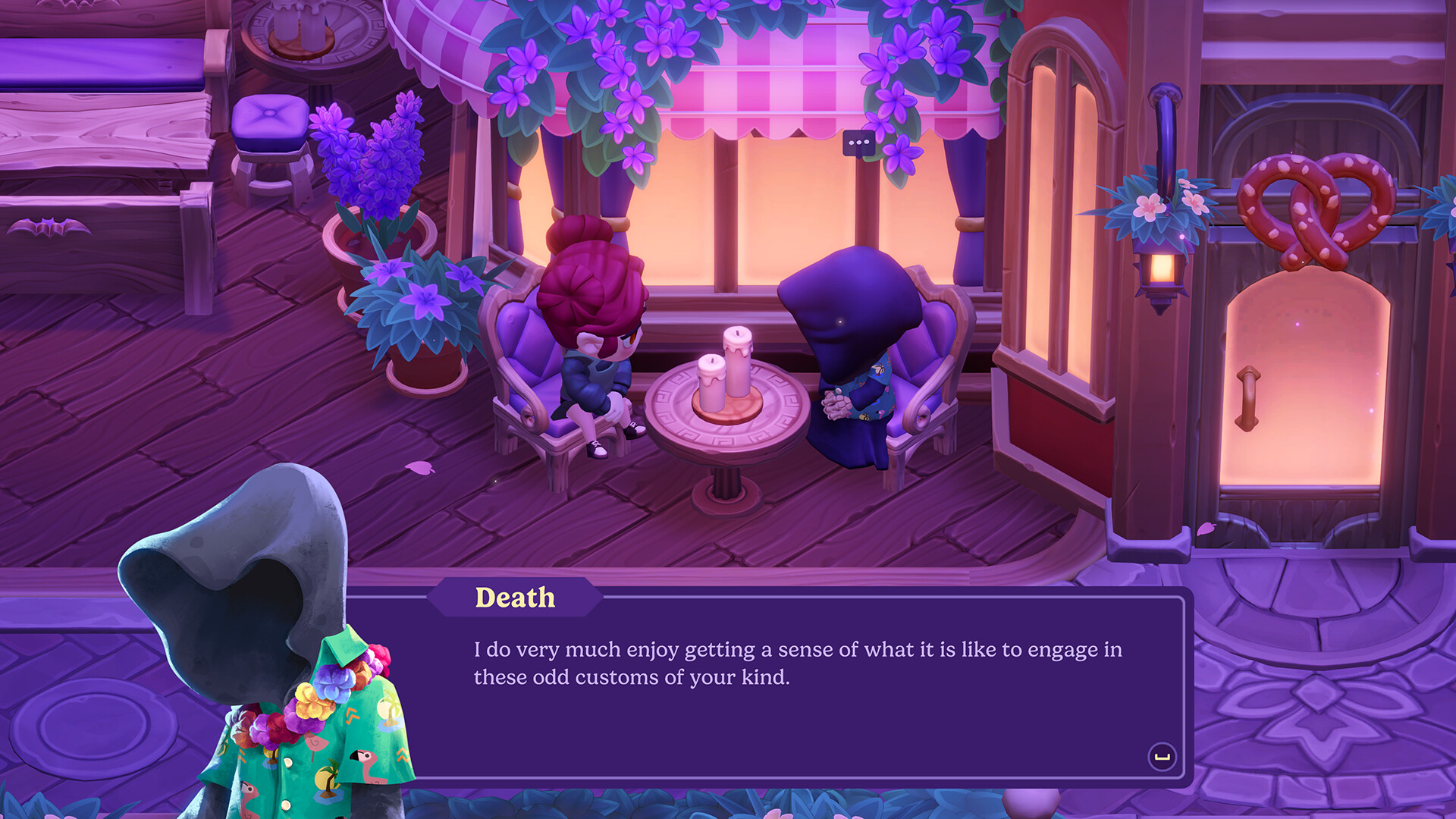
To start a match, talk to a character and choose the Invite option. Eleven NPCs will accept a duel: Death, Dragan, Elvira, Evan, Ludo, Luna, Moon Goddess, Noel, Pumpkin Head, Tae, and Winston. The cast mixes romanceable suitors (Dragan, Evan, Ludo, Tae, Winston), quest figures (Elvira, Luna), and three supernatural entities, including Death in a Hawaiian shirt.
The rules and the four keywords
A match is played as a best of three rounds. Each round lasts three turns, during which each player normally plays one card per turn; whoever displays the highest point total wins the round. You start with five cards in hand and priority alternates from one round to the next. Only one board can be active at a time: playing a new Location card replaces the one occupying the board. In the event of a perfect tie, no winner is declared.
- On Play: effect triggered only once, the moment the card is played.
- Persist: the card stays in play when the round ends. The most cost-effective keyword in the game, since it turns a turn invested in round 1 into free points afterward.
- Elusive: the card cannot be flipped. Life insurance against control cards.
- Friend: the Animals' keyword, which gain a bonus as long as another "friend" is in play on your side.
Then there's the notion of flip, which the game explains poorly. Flipping a card neutralizes it: it remains on the board — Graveyard even gains +2 per card flipped in play — but it stops counting toward the score. It's the main lever of interaction with the opponent's board.
Building a deck: 20 cards, 60 points, and the real trap
The constraints are strict: exactly 20 cards, a maximum of two copies of the same card, a maximum of 60 printed points for the whole deck. Up to 13 decks can be saved, enough to keep one deck per opponent.
The trap is reading this budget as a power constraint. It's the opposite: printed value is not real value. Fourteen cards out of 67 are printed at 0 points, so they cost nothing against the budget, and they do most of the work.
| 0-point card | Type | Effect |
|---|---|---|
| Bubble | Spell | Next card Elusive. Play a card. |
| Time Loop | Spell | Draw a card. Play a card. |
| Enlarge | Spell | Next card +2. Play a card. |
| Fortune | Spell | Look at the top 3 cards. Play a card. |
| Dreamwalk | Spell | Opponent reveals their hand. Play a card. |
| Teleport | Spell | Flips the opponent's Location. Play a card. |
| Wand | Item | Plays the first Spell in your deck. |
| Map | Item | Plays the first Location in your deck. |
| Luck Potion | Item | Doubles your weakest card in play. |
| Fertilizer | Item | Plays your weakest Plant, which gains +3. |
| Mysterious Seeds | Item | Reveals 2 cards, plays each Plant. |
| Death | Deity | Flips all other cards worth 3 or less. |
| Nightshade | Plant | Persist, and gains +5 each round it persists. |
| Vampster | Animal | +10 with another friend, but flips if it isn't the strongest. |
Six of these cards end with "Play a card": they don't use up your turn, they extend it. A competitive deck stacks these free relays to play four or five cards in a round that's only supposed to allow three.
Nine types, but only five families
The game has nine types: Vampire (11 cards), Item (10), Werewolf (10), Aquatic (8), Animal (8), Plant (7), Spell (6), Location (4) and Deity (3). Only five function as archetypes with cross bonuses: Werewolf, Vampire, Aquatic, Plant and Animal. Item, Spell, Location and Deity are support, to be spread across any deck.
Counterintuitively, the Vampire family is the most populated but the poorest in synergies: Batling, Royal Vampire, Scarlet Count, Scholar, Sleeping Vampire and Waltzing Vampires have no abilities. They're raw stats that eat up the whole budget — the exact flaw of the Starter Deck. The three archetypes to aim for are elsewhere:
- Werewolf — Alpha Wolf (+2 per other wolf in play), Wolf Pack (plays your weakest wolf for free), Gravedigger (replays the best wolf from the discard pile) and the Full Moon Location, which draws a card for every wolf played and stays in play between rounds.
- Plant — Greenhouse (+2 to every Plant played, Persist), Gobbler (+1 to every Plant played, Persist), Nightshade (+5 per round persisted) and Watering Can (+2 to all your Plants). The archetype that climbs the highest over a long game.
- Aquatic — pure control: Siren (-3 to opposing cards worth 6 or more), Charm of the Ocean (-1 across the board on the opponent's side), Queen of the Sea and Trident, which takes the combined value of all Aquatics in play.
The "Friends" engine and the Card Tricks achievement
The Animal archetype is the most explosive and the easiest to build. Cheeken is worth 3 points at base, but gains +8 per Cheeklet in play and +3 if another friend accompanies it. With the two allowed Cheeklets, Cheeken climbs to 22 points while each Cheeklet goes from 1 to 2: 26 points in three turns, without a single draw. Cowcula (5), Draculamb (4), Chester (8) and Rabbicula (2) follow the same logic with their +3, and Stoney returns to your hand at the end of the round to be replayed indefinitely.
This foundation is also the best base for "Card Tricks", the secret achievement that requires 30 points in a single round. It falls four points short, to be made up in two ways:
- Chain free relays. Play your two Cheeklets on turns 1 and 2, then a 0-point Spell that replays right after: Enlarge gives +2 to the next card, and two Enlarges chained before Cheeken — or an Enlarge plus a Luck Potion on a Cheeklet — is enough to clear the bar.
- Reach round 3 with a persistent board. A Greenhouse played in round 1 keeps giving +2 to every Plant played afterward, and Nightshade gains +5 per round survived: a third round then starts well above zero.
These figures are calculated from the cards' text. Keep some margin: an opposing Scythe or Silver Dagger can melt your total on the last turn.
Farming cards: one reward per night and per opponent
This is the most misunderstood mechanic, and the one that determines the "Nokturna Master" achievement. Each opponent has one to three decks. Only your first win of the day against them grants a reward, drawn from the deck they just played. Once all the rewards from a deck have been collected, the NPC moves on to the next one, which is tougher. Stringing together ten games in the same night is therefore pointless, whereas one win per night against eleven opponents nets eleven cards.
| Opponent | Cards to earn |
|---|---|
| Ludo | Alpha Wolf, Wolf Pack x2, Full Moon, Howling Wolf, Cowcula, Chester |
| Tae | Glowglammer, Gobbler, Skullfin, Deep Sea, Siren, Map x2 |
| Winston | Wolf Form, Charm of the Ocean x2, Silver Dagger x2 |
| Elvira | Vampster, Luck Potion x2 |
| Dragan | Fortune, Teleport |
| Moon Goddess | Moon Goddess x2 |
| Death | Bubble |
| Evan | Vampire Lord |
| Luna | Greenhouse |
| Pumpkin Head | Sun God |
| Noel | Not documented as of yet |
The priority order follows from the table. Ludo and Tae together drop thirteen cards, including the key pieces of the Werewolf and Plant/Aquatic archetypes. Luna gives Greenhouse, the Location that makes the Plant archetype viable, and Elvira gives Vampster plus two Luck Potions. These are the four opponents to challenge on repeat before all others.
The cards no duel gives you
The rest of the collection is picked up out in the world: Dig Spots, Diving Spots, fishing, and Bat Nooks. The latter are the easiest to forget: elevated nooks, accessible only in Bat Form, which Elvira restocks regularly. There are nine of them, spread across the Cave of Echoes, Misty Shores, the Twilight Catacombs, and the village — including two on either side of the arcade building leading to the Town Hall, and one to the right of Webb of Wonders, against Bloom Boutique. They also contain items required by the museum's collections: a nightly bat-form run progresses both at once.
What the patches changed
Nokturna was one of the hot spots for tech support in July. Patch 1.1.38 on July 10, 2026 fixed a complete freeze during the sequence for obtaining a new card. Patch 1.1.41 on July 15 fixed a far costlier bug: the card reward wasn't granted if you quit the match after inspecting the board at the end of a game. If you played during the first week, check your collection. The latest PC patch to date, 1.1.45 (July 21, 2026), doesn't touch the mini-game but confirms a 1.2 version is in the works; nothing has leaked about possible new cards.
Where to start tonight
Put away the Starter Deck after your first win against Dragan, the one that unlocks the Khazan artifact. Then devote your nights to a single daily win against Ludo, Tae, Luna, and Elvira, in that order: in one week of play you'll have enough to build a full Werewolf or Plant deck, and you'll raise their hearts along the way, since Nokturna remains a social interaction. Finally, keep two or three saved decks running in parallel rather than one universal deck: the 13 slots are there for that, and an opponent who switches to their second deck mid-duel is no longer the same problem at all.
Share this article
Which Nokturna archetype appeals to you most for building your first real deck?
Frequently asked questions
Do you really need to finish the card game to progress in the story?
Yes. The "Museum in the Making" quest requires beating Dragan at Nokturna to obtain the fourth relic. Without that win, the museum stays locked and you lose access to the achievements tied to its opening. It's a mandatory step, not an optional one.
Is the Starter Deck really that bad, or am I just playing it wrong?
It's really that bad. It's a pile of raw vampire/werewolf stats with no engine whatsoever, wasting 56 of the 60 allowed points on generic cards. Replace it as soon as you get your first cards from NPCs.
Which opponent should you beat first to unlock the best cards?
Dragan, since that's the mandatory quest, but as soon as you can, turn to the NPCs who carry archetype cards: Wolf Pack (Werewolves), Nightshade (Plants), or the Animals with their Friend bonuses. Each of the eleven opponents carries different cards.
How do you score 30 points in a single round for the Card Tricks achievement?
The Animal archetype is your best route. Play your two Cheeklets on turns 1 and 2 (the first one climbs to 22 points with the Friend bonus), then chain 0-point Spells that replay for free to stack up cards without burning through your three turns.
Key takeaways
- Nokturna gates the museum quest and two achievements: you can't skip it without blocking narrative progression.
- The 60-point budget is a trap: 14 cards cost 0 points and do all the work, turning turns into free chains.
- Persist is the strongest keyword in the game, turning a round-1 investment into free points over the following rounds.
- Only five archetypes are worth building: Werewolf, Vampire, Aquatic, Plant, and Animal, each with a distinct engine and a different power curve.
- The Animal archetype explodes via the Friend keyword: Cheeken goes from 3 to 22 points with just its two Cheeklets, blowing past the Card Tricks achievement.
Comments
No comments yet. Be the first to react!
Leave a comment
Similar guides
Latest articles




Your opinion counts
Rate Moonlight Peaks
Click a star to rate