



 Fabian Lainé

Economy
Moonlight Peaks: what the August 20 update 1.2.3 changes for your income — Firefly Pollinator, wine, and animal products
In brief
The August 20 update 1.2.3 completely reshuffles your economic strategy: the Firefly Pollinator now consumes 1 Firedrop per night with a reduced range, wine and slow productions yield less, and animal products see their spawn rates and prices readjusted. Several exploits have been patched, but other gathering methods become more profitable thanks to resource rebalancing.
Little Chicken Game Company released the 1.2.3 patch notes for Moonlight Peaks last night, Thursday, August 20, 2026, at 6:08 PM Paris time (4:08 PM UTC). About ninety entries, which the studio describes as "the major 1.2.3 update," including an entire block of economic rebalancing. It's this block that concerns a farm already up and running.
The two-line summary: the Firefly Pollinator has its range reduced from 9 to 8, it now consumes 1 Firedrop per night, and its influence on quality now depends on the number of pollination days relative to the crop's growth time. At the same time, items with long passive production times see their prices drop — wine is named specifically — the spawn rates of animal products and their sale prices have been revised, and honey from Bee Houses as well as Firedrops from Firefly Sanctuaries have been rebalanced.
A clarification that applies to everything below: Moonlight Peaks still has no French version. French remains absent from the languages listed on its Steam page, which are limited to the two Chineses, Korean, Japanese, German, and English; the 1.2.3 update, for that matter, only fixes German and English typos. All item, building, and character names therefore remain in their English form, the one you see on screen.
There was never a 1.2.0: 1.2.3 is the big release
One point to clarify before the numbers. The game's full history of Steam announcements contains no 1.2.0, no 1.2.1, and no 1.2.2: the last PC patch before this one was 1.1.45, released on July 21, 2026, and nothing came out in between. 1.2.3 therefore isn't fixing a previous major version — it is the major version.
Practical consequence: if you haven't relaunched the game since late July, you're taking in all the rebalancing at once, and some of your profitability calculations are a month old.
The Firefly Pollinator now has an operating cost
This is the most structurally significant change for a farm already up and running: the pollinator now has an officially quantified operating cost, and that figure is low. Three entries in the notes cover it.
- Consumption. "Firefly Pollinators now consume 1 Firedrop per night": a pollinator burns one Firedrop each night, two burn two. The notes don't give the pre-patch value.
- Range. It drops from 9 to 8. The unit isn't specified, but 1.2.3 adds a range indicator visible in decoration mode and during interaction, along with a panel explaining what the machine does. No need to count tiles: go check it in-game.
- Quality. The pollinator's influence now depends on the number of days it pollinates a crop and the number of days that crop takes to fully grow. It's now a ratio, rather than a flat bonus.
This last point is the one that changes a routine: a pollinator moved over a plot the day before harvest no longer carries as much weight as one that covered the whole growth cycle. Practical takeaway: place the machine before sowing and avoid shuffling it from one plot to another mid-season.
Our pre-patch data, drawn from the community wiki, gave a 9x9 tile area for 5 Firedrop per night. Absent official confirmation of that earlier figure, treat the 1 Firedrop as the only certain number, and measure range using the new indicator.
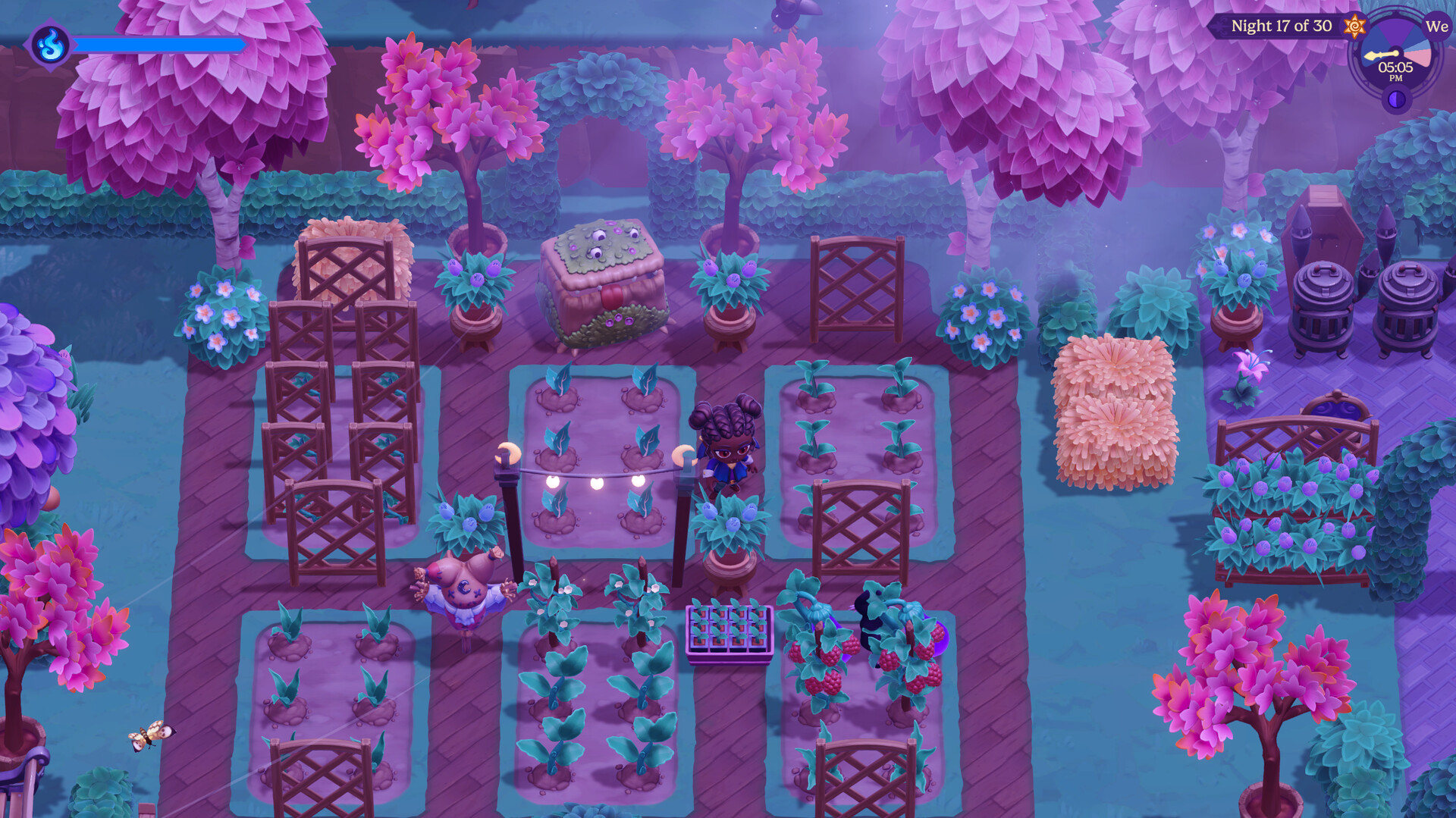
The pollinator doesn't consume in a vacuum. Two other inputs affect the same resource: the Firedrops produced by the Firefly Sanctuaries have been rebalanced, and a bug that caused the Firefly Sanctuary to count surrounding crops multiple times has been fixed. Firedrop production was therefore overvalued; it no longer is, and it now feeds your pollinators.
Firedrop should therefore be treated as a consumable rather than a stockpile: count one per pollinator per night, and adjust your number of Sanctuaries accordingly before expanding the farm.
Same logic on the hive side: the amount of Honey produced by Bee Houses has been rebalanced, and the progress bar on these machines, which used to only fill from the threshold of one Honey per day, now reflects their actual state.
Wine and other slow productions now yield less
The official line is explicit: "Reduced the price of items that take long passive times to produce, like wine." Little Chicken hasn't published the new amounts, but the intent leaves no doubt: items whose value relied on a long passive wait have been trimmed, with wine given as an example.
This is the point that most directly invalidates pre-patch habits: running your grapes through the Keg had until now remained one of the farm's best multipliers. The ratio has changed, and no one will know it without checking for themselves.
Version 1.2.3 conveniently provides the means to redo the math in-game. The recipes for Kegs, Jam Makers, and Mills now indicate the energy and mana their products yield, and the Almanac displays each crop's Energy, Mana, and Mana Extract values. Open it before starting another batch.
Barn: animal produce and complaints reworked
Second economic overhaul: "Rebalanced the spawn rates of animal produce and adjusted their sell prices accordingly." Both parameters move together, spawn frequency and sell price. Any livestock income chart from before August 20, including our own from August 9, needs to be double-checked before deciding on an animal purchase.
Animal social behavior is also changing, and it affects production quality. An animal will now only complain about the other occupants of its barn once every 7 nights, and complaints about missing food or excess compost now take priority. If you were diagnosing your affinities by listening to your animals, expect more than a week per barn cycle.
What becomes more profitable: stone, trees, and dig spots
The rebalancing doesn't only go one way: several changes reduce the time or energy cost of gathering.
- Mining now also yields Stone. The patch notes mention "bronze, iron, and gold ores": breaking a deposit now gives stone in addition to ore. The dedicated trips to feed the Refiner are lightened accordingly.
- Shaking a tree now costs nothing. The energy cost drops to zero. The loot from shaken and chopped trees, as well as from dig spots, has also been rebalanced.
- Wood becomes specialized. Plum and Willow trees now yield Dark Wood, while the Weeping Willow yields Light Wood.
- Gathering gets smoother. Collectible items, including flowers, now appear even when a low-priority plant decoration occupies the spot, and vegetation outside plots, trees included, regrows faster.
- Sugarbones. They now grow to full size everywhere and can only be harvested once fully grown. A bit more waiting, but no more missed harvests.
Exploits closed and leaks plugged
Four fixes directly affect your finances.
| 1.2.3 Fix | Effect on your income |
|---|---|
| Every recipe now requires at least 1 quality ingredient | Negative: free high-quality cooking is no longer possible |
| Crafting and cooking no longer pull a starred ingredient when a regular one is sitting in House Storage | Positive: your quality reserves stop being consumed by mistake |
| Regrowing crops once again require water to reform their produce | Negative: berry rows need regular watering again |
| Upgraded tools can no longer be sold to Chester; those that were have reverted to the bronze tier | Positive: no more high-tier pickaxes sold off by mistake |
Two price changes round out the picture. The Purple Gramophone now costs more at The Howling Hammer, and the red Gramophone is now always for sale at The Broken Lamp: it's no longer a rare find to watch for. Another shopping-related change: purchased accessories and customizations now land in your inventory and can be gifted and sold — a dormant wardrobe turns back into currency, or friendship points. Finally, items from the job board's Lost Item quests can no longer be discarded and can be sold to Chester.
The five things to do this weekend
- Count your Firedrops before nightfall. One per pollinator per night. If your Sanctuaries can't keep up, cut a pollinator rather than let the reserve drop to zero.
- Stop moving a pollinator mid-growth. Place it before sowing and use the new range indicator to line up your plots on it.
- Redo the pricing on your stock. Check the Almanac and the sheets for Kegs, Jam Makers, and Mills, then sell off anything that's no longer worth the processing time.
- Postpone an animal purchase by a week. Take the time to gauge the new spawn rates and sale prices on your current animals.
- Check the cost of house upgrades before stockpiling. The required resources have been rebalanced, with no indication of direction.
Two quality-of-life details finally ease logistics: the default stack size goes up to 100 and Pathways rise to 1,000, freeing up an entire chest. And the HUD now shows the day of the week, while the calendar and end-of-night screen flag full moons—two markers that previously had to be tracked manually.
Share this article
Faced with all these economic changes, how are you organizing your comeback to Moonlight Peaks?
Frequently asked questions
How much does a Firefly Pollinator really cost to run?
Officially, 1 Firedrop per night. Little Chicken hasn't confirmed the previous consumption rate (our records showed 5 per night for a 9×9 area), but this figure of 1 is the only certain one. Set up your Firefly Sanctuaries to produce enough Firedrops before expanding your farm.
Does wine still yield as much as before?
No. Little Chicken has lowered the prices of long passive productions, with wine as an example. The patch notes don't give the new amounts: you'll need to check them in-game in the Almanac and the updated Keg recipes.
Is my pre-August 20 livestock data still valid?
No. Animal product spawn rates and their sale prices have changed together. Any income table from before the patch must be double-checked, including the community wiki's table dated August 9.
Which fixes will directly cost me money?
Three mainly: recipes now require at least 1 quality ingredient (no more free superior dishes), regrowing crops (berries) require watering again, and a bug that was eating up your starred ingredients in storage has been patched. On the plus side, crafting no longer consumes your quality stock by mistake.
What becomes profitable with this update?
Mining now yields bonus Stone (fewer trips back and forth to the Refiner), shaking a tree now costs zero energy, and Plum and Willow trees now give specialized Dark Wood. Dig spots and gathering overall have been rebalanced in your favor.
Key takeaways
- The Firefly Pollinator has a real cost: 1 Firedrop per night, its range drops from 9 to 8, and its quality bonus depends on the ratio of pollination days to growth duration.
- Slow passive productions like wine yield noticeably less — your old profitability calculations are obsolete.
- Animal products have had their spawn rates and sale prices changed: any table from before August 20 must be double-checked before buying an animal.
- Three major economic exploits have been closed: cooking without quality no longer exists, starred ingredients are no longer consumed 'by mistake', and berries require watering again.
- Mining now yields bonus Stone, shaking a tree costs zero energy, and collectible items now appear even under certain plant decorations.
Comments
No comments yet. Be the first to react!
Leave a comment
Similar guides


Latest articles







Your opinion counts
Rate Moonlight Peaks
Click a star to rate