

 Fabian Lainé
Tips
Battlefield 6: the official flight manual for the 4 aircraft — simplified flight controls, NOSA and the 30 meters that cut off lock-ons
In brief
On August 18, 2026, Battlefield Studios published a complete manual on piloting Battlefield 6's four aircraft, detailing controls, weapon systems, and above all two major discoveries: enemy locks become impossible below 30 meters of altitude, and the fighter jet has vector thrust that unlocks three maneuvers named after real aerial techniques.
Battlefield Studios published a complete flight manual on August 18, 2026, released in French: "Aircraft Guide – How to Fly Planes in Battlefield 6 and REDSEC." It appeared under the REDSEC hub on ea.com, rather than the Battlefield 6 one, which is why it went largely unnoticed even though it details the four flyable planes, controls included.
Two pieces of information alone make it worth checking out. The first: enemy systems cannot lock onto your plane below 30 meters of altitude. The second: the fighter jet only changes direction with afterburner engaged, and the studio puts a name to the three maneuvers that this "vectored thrust" allows.
Everything below is playable today, Saturday, August 22: the Top Gun phase has been running since August 18, and update 1.4.2.0, whose patch notes EA dated August 14, brought both two-seater aircraft as well as the new flight assist option.
Default controls, and inverted pitch on controller
One point in the default mapping deserves a second read: on controller, pitch is inverted. Pushing the right stick up points the nose down, causing the plane to descend.
| Action | Keyboard and Mouse | Controller | Effect |
|---|---|---|---|
| Accelerate / Decelerate | O / S | Left joystick up / down | Engine power |
| Pitch down | Down arrow | Right joystick up | You descend, you speed up |
| Pitch up | Up arrow | Right joystick down | You climb, you slow down |
| Yaw left | A | Left joystick left | Horizontal pivot of the nose |
| Roll | Left / right arrows | Right joystick left / right | Wing tilt |
| Afterburner | Left Shift | Left stick (L3) | "Crucial for takeoff" |
Two caveats: this table only documents yaw left, and it places acceleration on the O key. Double-check these two lines in your settings.
Simplified flight controls: four inputs instead of three axes
This is the addition from 1.4.2.0 that will get the most people off the ground. Simplified flight controls work like those for helicopters: instead of manually managing pitch, roll, and yaw, you look in a direction and the plane heads there. The guide is clear: if you enable them, ignore the table above and stick to four inputs — look and turn left, right, look and descend, look and climb, mapped to the arrow keys or the right joystick. The two lateral inputs trigger "an automatic combination of pitch, roll, and yaw."
The studio defuses any pride issue: there's "no shame" in using them, as they're "designed to reduce plane crashes." To find the option in-game, note that the 1.4.2.0 patch notes call it assisted aerial vehicle control.
The WSO seat, and the key that changes place
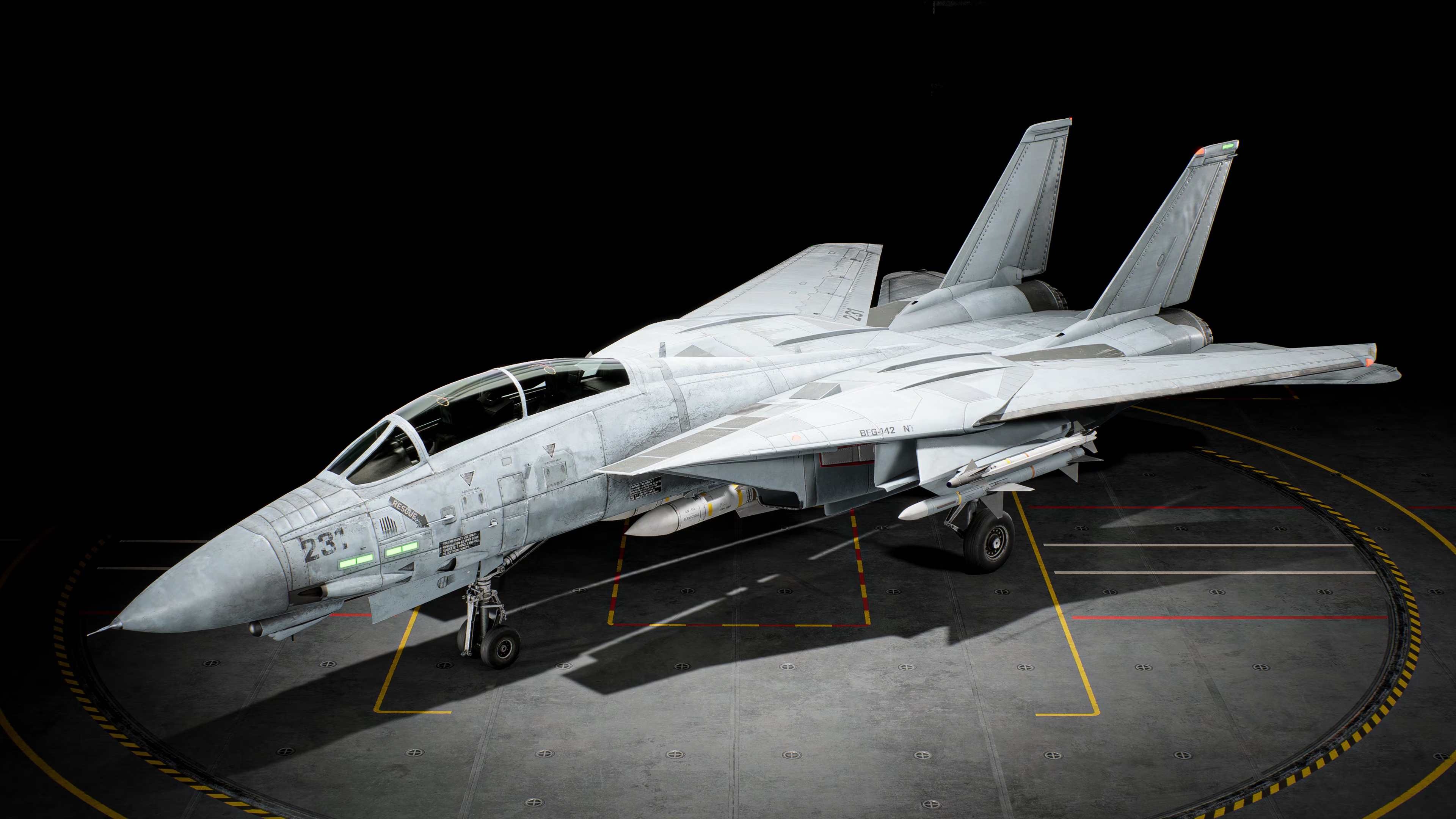
The two new aircraft feature a rear seat held by the WSO, for weapons systems officer. Its value comes down to one line: it fires to the sides and to the rear, so into the pilot's blind spot, and it can freely look around without hindering flight.
The command missing from improvised crews is the seat swap: F1 / F2 on keyboard, D-pad / A on controller, and only if the targeted seat is unoccupied. It lets you take the stick back when the pilot has bailed out, or hand it over without landing.
The 30 meters that break locks
This is the most actionable piece of info in the guide. Enemy aircraft and ground units lock onto your plane's position; the obvious counter is flares, but that resource is limited. The free counter lies elsewhere: "enemy systems cannot lock onto your aircraft's position if you are less than 30 meters above the ground."
This creates tension with the survival rule given a few lines earlier — staying "a few hundred meters above the ground and away from hard surfaces." That's the whole balancing act of piloting in Season 4: high up, you won't crash but you'll be locked on; low down, you're untraceable but a building or a mountain is enough to end the run. Dropping below 30 meters is therefore something done in short windows, when the alert triggers and your flares are spent.
Two additional landmarks complete the maneuver, both at headquarters. Flying low over your own HQ restores part of your lost health, without landing. The enemy HQ is to be avoided: its AI-controlled automatic anti-aircraft guns shoot down a plane "within seconds."
The four aircraft and their weaponry
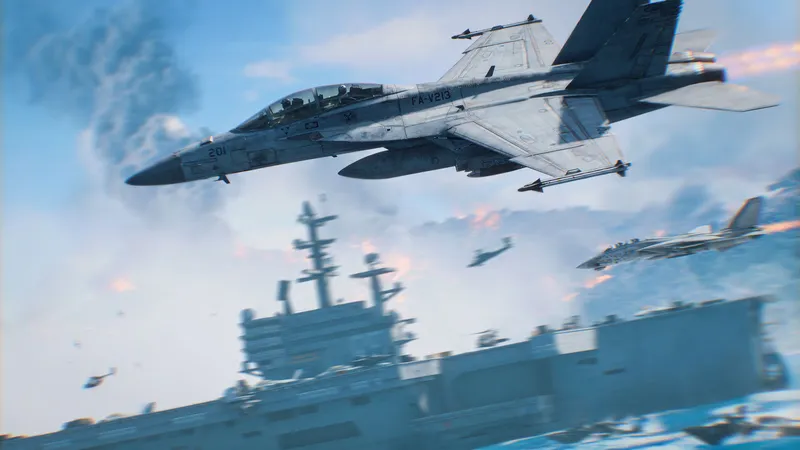
Four jets have been pilotable since 1.4.2.0, but only the F-74A Seacat and the F/A-81F Super Spectre are available in the limited-time mode in Battlefield REDSEC.
| Aircraft | Official role | Feature |
|---|---|---|
| F-74A Seacat (two-seater) | Fleet defense fighter, air-to-air, limited air-to-ground | Variable-geometry wings: high speed or maneuverability |
| F/A-81F Super Spectre (two-seater) | Multirole fighter, air-to-air and air-to-ground | Armor-piercing shells, anti-radiation missile, jammer |
| Attack plane (F-61V / F39-E) | Ground attack, single-seater | High-drag bomb |
| Fighter jet (F-97 Kestrel / Su-57) | Stealth air-to-air fighter, single-seater | Thrust vectoring |
On the Seacat, the pilot mans a 20mm rotary cannon and an auto-lock missile. The WSO carries two anti-aircraft missiles: the primary one tracks its target until impact or until flares deflect it; the secondary one, which can be fired to the sides and rear, works like those of the 9K38 IGLA launcher and can re-acquire a target mid-flight.
On the Super Spectre, armor-piercing shells replace the 20mm rounds: more dangerous against heavy vehicles, but slower — a trade-off, not an upgrade. Its NOSA toggles between IGLA-type missiles and a jammer that locks onto a target, prevents it from targeting and disables enemy air radar; as a secondary, between a precision-penetration bomb and a manually guided missile. One detail for the fighter jet: when a teammate lights up a target with the laser designator or the tracer dart, its missiles lock on faster.
Vectored thrust: three named maneuvers
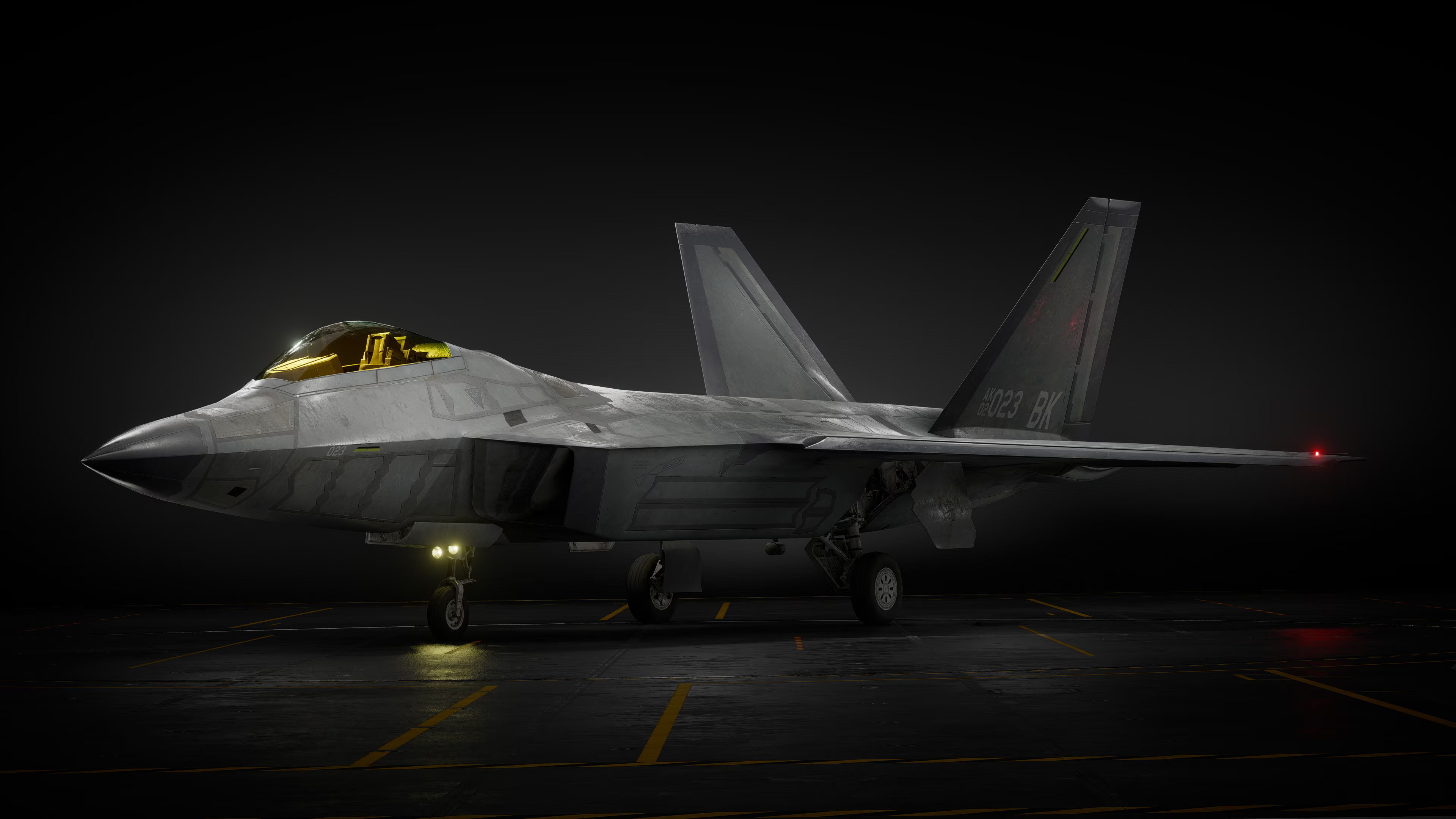
Vectored thrust is presented as a
- Herbst Maneuver — a direction reversal. Reduce throttle, pitch up, engage afterburner to maintain altitude until you're pointing in the desired direction, then throttle back up to stabilize. This is the one that turns the hunted into the hunter.
- Cobra Maneuver — an aerial brake that uses the aircraft's weight to slow down, or even stop movement entirely. It first requires speed, then reducing throttle and pitching up at the same time, before stabilizing with afterburner and pitch control. The guide itself describes it as complex.
- Falling Leaf — pitch up and climb vertically in an abrupt motion, then cut the throttle. During the fall, alternate left and right yaw movements in a vertical stall. Once the threat has passed, full throttle, afterburner, and dive to regain speed.
Both two-seaters share a similar mechanism: applied yaw, reduced throttle, active afterburner, and you trigger throttle separation, which transfers power from one engine to the other. A note on the terminology, because it hampers searching: the same page uses three different forms — "throttle separation" as a section heading, "throttle lever division" and "throttle distribution" in the body text. We're going with the first one.
Where to start if you've never taken off
Here's the order that costs the fewest fuselages.
- Stay in the air. A few hundred meters of altitude, far from hard surfaces, and broad rather than jerky movements: wanting to control everything is what gets you crushed.
- Activate simplified flight controls if the pitch/roll/yaw triad doesn't click, then work on the camera: third person outside of combat, first person or zoom at the moment of firing.
- Break locks: flares held until the projectile arrives, dropping below 30 meters, going around obstacles.
- Do air-to-ground. Beginners rush into air-to-air, whereas ground strafing weighs more heavily. Fly high to aim, then come down fast.
- Then, only then, maneuvers. Herbst first, the most useful when fleeing; Cobra next; the Falling Leaf last, because it deliberately puts you into a stall.
One last piece of advice from the studio: the pilot of a two-seater must announce their maneuvers, as a sharp turn breaks their gunner's targeting lock. And if public servers feel too hostile, EA points to the dedicated aircraft experiences in Portal.
Share this article
As a pilot, do you prefer manually controlling all three axes or letting the plane orient itself automatically?
Frequently asked questions
How do you go below 30 meters without crashing into the terrain?
That's the key trade-off: below 30 meters you're untraceable, but a building or a mountain is all it takes to end you. Wait for the lock warning, dump your flares, then dive in a short window. Flying low over your headquarters also restores health without landing.
Is there any shame in turning on simplified flight controls?
No, zero shame. The studio states it clearly: they're designed to reduce crashes and work exactly like those on helicopters, automating all three axes so you just have to look and turn.
How do you take back the controls when the pilot has bailed out?
Press F1 or F2 on keyboard, or Cross/A on controller, but only if the targeted seat is unoccupied. That's the command most improvised crews are missing.
What's the difference between the Seacat and the Super Spectre?
The Seacat favors air defense with homing missiles, while the Super Spectre is multirole with armor-piercing shells against heavy vehicles and a jammer to lock targets. Both have a NOSA, unlike the single-seaters.
How do you execute the Herbst Maneuver to turn the tables?
Cut the throttle, pull up, engage afterburners to hold altitude until you're pointed in the desired direction, then throttle back up to stabilize. This is the one that turns the hunted into the hunter.
Key takeaways
- Enemy lock-on systems don't work below 30 meters: the free counter to missiles.
- Simplified flight controls drastically reduce crashes by automating pitch, roll, and yaw instead of managing them manually.
- Controller pitch is inverted by default: pushing up makes the plane descend.
- The NOSA (weapons systems officer) in two-seaters fires into the pilot's blind spot, toward the sides and rear, with free look.
- The fighter jet's vector thrust turns the hunted into the hunter thanks to the Herbst Maneuver and the Cobra.
Comments
No comments yet. Be the first to react!
Leave a comment
Similar guides
Latest articles






Your opinion counts
Rate Battlefield 6
Click a star to rate