

 Fabian Lainé

Class
WoW Midnight Patch 12.1 Notes: Release Date & Class Changes
In brief
Midnight's patch 12.1 deeply restructures World of Warcraft: health points increase by 25% at max level, forcing a slower combat pace and less reflexive healing. At the same time, Blizzard is shifting power from big cooldowns to basic attacks to avoid downtime between cooldowns, while seven specializations receive major reworks that require a real relearning before Season 2 begins.
The 12.1 “Ula'tek's Curse” update arrives on Wednesday, August 12 in Europe (August 11 in North America), and Midnight Season 2 kicks off a week later, on August 19. In between, there's a seven-day window where your character has already changed but nothing counts toward the rankings yet: that's where the start of your season is really decided.
Because 12.1 isn't just a balancing pass. Blizzard is touching two foundations at once: maximum-level health increases by 25%, and a good chunk of the power on offensive cooldowns is being pushed back into baseline spells. The way your fights breathe changes, even before we get into talents.
Here's what actually matters in the class notes. The figures quoted come from the latest public revision of the notes, which incorporates the July 31 changes: they may still shift before August 19.
+25% health: the change that affects everyone
At the level cap, character health and creature damage both increase by 25%. Healing consumables are adjusted accordingly, and encounter mechanics will be retuned one by one to account for the new scale.
The damage-taken-to-health ratio stays roughly the same. The healing-to-health ratio, on the other hand, does not: healing specializations receive throughput increases well below 25% — +10% for Discipline Priest (healing and absorbs), +15% for Holy Priest, +18% for Holy Paladin, and only +6% for Restoration Druid. Topping off a health bar will therefore take longer than in Season 1: that's the stated goal, less brutal damage and healing that relies less on pure reflexes.
The logical trade-off: heals and shields outside of healing specializations are bumped up by exactly 25% so they don't become purely decorative. Power Word: Shield for Shadow Priest, Healing Surge, Earth Shield and Healing Stream Totem for Shaman, Impending Victory for Warrior, Living Flame and Verdant Embrace for Evoker, Golden Path and Sanctified Blessing for Paladin: all at +25%. If you play DPS or tank, your self-healing remains proportionally just as effective as before.
Less burst, more sustained damage
The second structural axis is more subtle in the notes, but it shows up everywhere: power from major offensive cooldowns is being shifted into baseline abilities. Blizzard wants to avoid characters feeling weak between cooldown windows.
The most telling examples:
- Elemental Shaman: Tempest loses 20% direct damage, but Chain Lightning and Flame Shock gain 60%, Lightning Bolt and Lava Burst 30% (outside PvP combat). The hero talent Farseer now makes Chain Lightning bounce to 5 targets instead of 3.
- Arms Warrior and Unholy Death Knight: auto attack damage doubled (+100%), balanced by a 15% cut to Execute for the warrior.
- Marksmanship Hunter: auto shots +25%, Multi-Shot +80%, Steady Shot +50%, Kill Shot +45%, Rapid Fire +40%.
- Protection Paladin: Judgment and Consecration see their damage doubled while Hammer of Light and Hammer of Wrath lose 33%.
Practical translation: in Mythic+, the pack you used to take "dry" between two cooldowns is going to melt noticeably faster, and the value of holding your big buttons to line up a perfect pull decreases.
The specs that really need relearning
Seven specializations come out of 12.1 with more than just percentage tweaks. If you play one of them, plan for an evening of relearning.
Unholy Death Knight
The most visible rework. Army of the Dead no longer summons a horde: it summons or reinforces a lesser ghoul to form an unholy army of 8 for 30 seconds, which you then command via Scourge Strike, with two orders depending on the situation — Death Order (the ghouls strike your target with Shadow damage) and Plague Order (they burst into viscera around themselves, with reduced damage beyond 5 targets). Raise Dead is renamed Death Lord: with three active Death's Advance Magi, you sacrifice them to summon their lord for 15 seconds.
Blizzard says it wants to declutter the screen: other players will now only see three lesser ghouls at a time. The specialization loses 11% overall damage, largely offset by auto attacks and by the class set. Good news for dungeons: Outbreak finally keeps its extended duration when you refresh it on a target within 40 yards.
Shadow Priest
Void Bolt drops its cooldown during Voidform and becomes a counted resource: three uses, five if you take Improved Voidform. Its damage drops by 10%, but the specialization gains 8% damage and a new AoE talent, Void Eruption (Dark Ascension?), which detonates your dark apparitions within an 8-yard radius (translator's note: kept literal as "Explosombre" has no confirmed official English name). Ancient Madness is reworked: Mind Blast: Insanity grants 2% haste and 1.5 seconds of Voidform per stack (maximum 5), and the haste persists for ten seconds after leaving the form. Spectral Guise is removed.
Arcane Mage
Arcane Surge becomes a real AoE tool: 2-second cast time, 8-yard range instead of 2, 15-second cooldown, one Arcane Charge per enemy hit, and it's no longer affected by your Arcane Charges. The capstone talent is replaced by Prismatic Trait. Most importantly, Arcane finally gets its own defensive cooldown back, Refractive Images: 10% of damage taken is dealt back to you over 8 seconds, and 30% for 15 seconds after a Mirror Image. Touch of the Magi is removed.
Marksmanship Hunter
Blizzard revisits its own design. Explosive Shot is reworked: a projectile that explodes every second for three seconds within 8 meters, and recasting it now folds in the remaining damage from the previous one. Talents deemed frustrating are cut (Headshot, Double Tap), Fire in the Hole is renamed Precision Volume, and a new talent, Unstable Trigger, allows a second Explosive Shot within three seconds. The key point for high-level play: prestige talents no longer guarantee Aimed Shot's critical strike, which greatly reduces the weight of Aimed Shot modifiers in your damage.
Restoration Druid
Two iconic buttons are changing in nature. Innervate no longer makes your spells free for eight seconds: it now regenerates 25% of the target's maximum mana over the same duration. And Abundance no longer stacks: as long as five Rejuvenations are active, your Regrowth gains 50% critical strike chance and costs 50% less mana — a clear threshold instead of an unreadable stacking effect. Add to that Tranquility, which now plants roots absorbing the equivalent of 60% of your health, Incarnation: Tree of Life, which casts Regrowth on three injured allies upon transformation, two new talents (Lacis, Flash of Clarity), and the removal of Nature's Splendor.
Devastation Evoker and Assassination Rogue
For the Devastation Evoker, Heightened Fury is removed and merged into Growing Fury. At rank 3 of the prestige talent, the end of Dragonrage no longer leaves you empty-handed: it transforms into Unleashed Flame, an instant cast at 25 meters that guarantees a critical strike, castable four times before Dragonrage comes back off cooldown.
For the Assassination Rogue, everything revolves around energy and Envenom. Rank 1 of Relentless Strikes is reworked so that refreshing Envenom late becomes the correct way to play, rather than deliberately letting it expire: +10% damage and 2 energy returned per combo point spent. Added to this are an Unstable Poison talent (+18% on Envenom, duration reduced by 2 seconds) and a Garrote that silences the target for 5 seconds. The latest revision raised the spec's overall damage to +19%, up from +9% in the first version of the notes.
PvP: slows get put through the wringer
The PvP throughline of 12.1 can be summed up in one sentence: players need to be able to reposition. Slows applied automatically as part of a rotation are being lowered almost across the board — Thunderstorm goes from 40 to 30%, Weakened Blows from 70 to 50%, Earthbind Totem from 50 to 30%, Frost Storm from 30 to 20%, Mind Flay: Insanity from 70 to 50%, Concussive Shock from 90 to 70%, Darkmoon Deck: Shadow Dagger from 30 to 20%.
The Balance Druid gains a level 42 passive, Stellar Protection: if Moonfire or Sunfire is dispelled, the target receives Stellar Flare and you recover 12 Astral Power — the same logic as for the Elemental Shaman, no longer forcing a spec to spend a PvP talent just to protect its baseline effects. Finally, following the battlegrounds against bots, 12.1 adds arenas against bots to learn the format before facing real opponents.
The interface is part of the class notes too
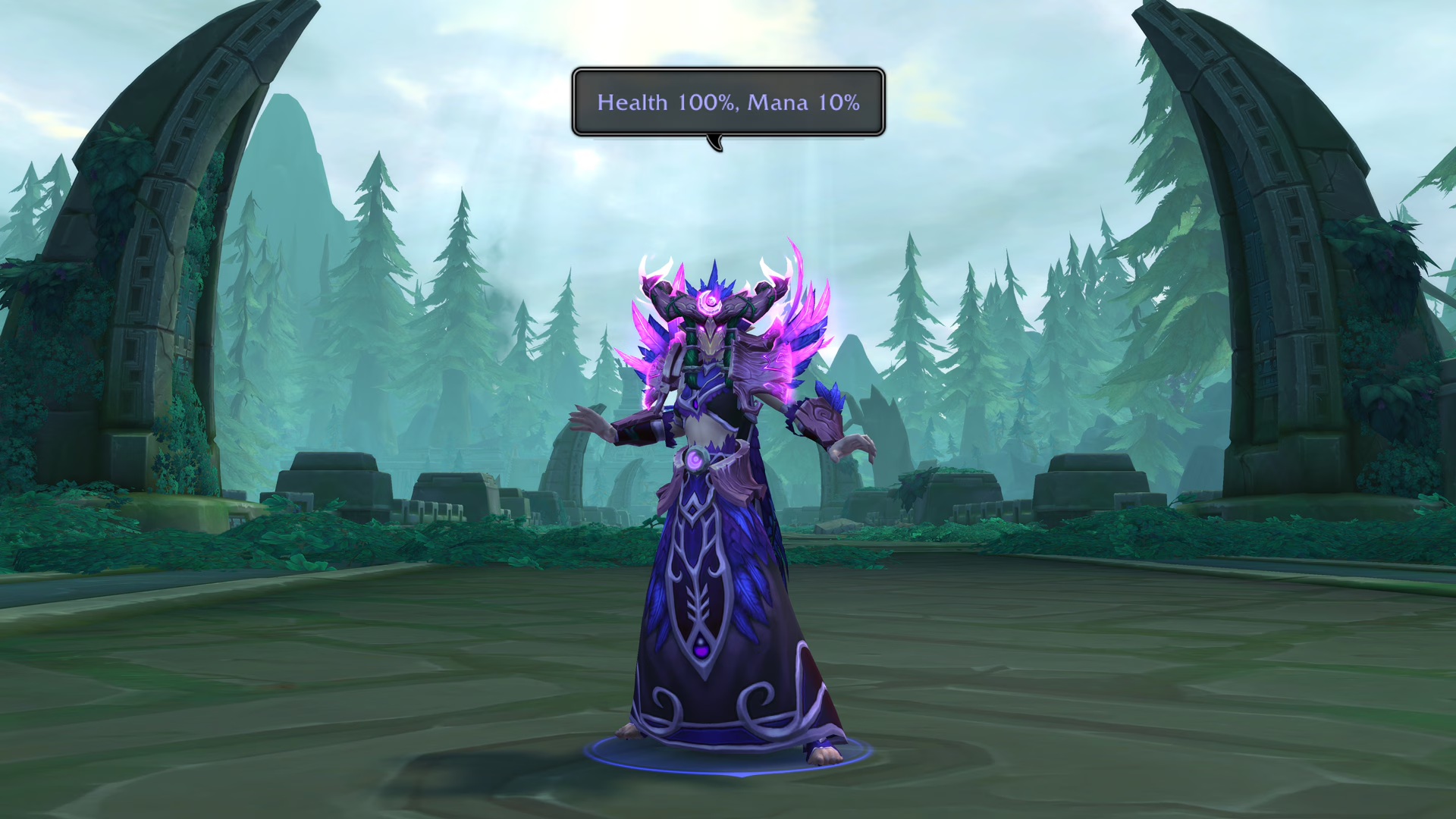
Two additions change life in dungeons. First, a visual and audio indicator for a missed interrupt: when someone uses their interrupt while the target isn't casting anything, text appears above the monster. No more kick rotations where nobody knows who just wasted theirs. The cooldown manager, meanwhile, now tracks trinkets, potions, and racial abilities, and you can ping it to let the group know your big button is ready.
Don't forget the Season 2 class set
Any read of the class changes remains incomplete without the set bonuses, since they arrive at the same time as the season. Each specialization has a 2-piece and 4-piece bonus in the Venom Abyss, with six tiers depending on the source: raid gear (Veteran level), Normal (Champion), Heroic (Hero), Mythic (Myth), Gladiator via PvP conquest points, and Elite starting at a 1,800 rating in 3v3 arena or solo Blitz battleground. A practical point that's often overlooked: in Season 2, an item converted into a set piece via the Catalyst keeps the secondary stats of the original item. So it's very much in your interest to choose carefully which base item you convert.
What's left to do before Wednesday
The week of August 12 to 19 is a gift: the content is here, but the season isn't yet. Use it to rebuild your bars, redo your talent trees, and run the Altar of Hooks over and over while keys don't count yet. On the PTR, Blizzard has also set up a training dummy dome letting you hit 1, 2, 3, or 5 targets with armor comparable to Season 2 raid bosses: if it makes it to live realms as is, it'll be the place to validate your new rotation before the 19th.
One last piece of advice: don't trust the simulation rankings published this week. With a power shift of this scale and values still being revised in late July, the gaps between specializations will shift after the season's first balance patches. Pick the specialization whose new playstyle you enjoy: that's the one criterion no patch will ever invalidate.
Share this article
How do you feel about this patch: slower, more tactical, less reflexive?
Frequently asked questions
Why are health points increasing but not healing at the same proportion?
Blizzard is deliberately trying to slow down the pace of combat and punish purely reflexive gameplay. Damage taken remains proportional (it's also going up by 25%), but topping off a health bar will take longer, forcing tactical decisions rather than pure reaction.
I play Arms Warrior. Auto-attacks doubling — is that really a buff or a scam?
It's a real buff to gameplay cohesion. Your packs melt better between two Executes (which lose 15%), and you no longer find yourself just waiting around for a cooldown. But in terms of raw damage, it's a nerf — Execute was your main nuke.
Do I absolutely have to redo all my talents if I play Restoration Druid?
Yes and no. Innervate no longer granting free heals is a major overhaul. Abundance no longer stacking changes your resource management. You'll need to test seriously, but your underlying bones stay the same — you'll just play differently to hit the same targets.
Is the seven-day gap between the patch and the season really necessary?
Absolutely. If you play one of the seven reworked specs (Unholy Death Knight, Shadow Priest, Elemental Shaman, etc.), you're going to get wrecked in season Mythic+ from day 1 if you haven't tested. Use those seven days to understand your new combos and new rotations.
My spec isn't among the seven major reworks. Do I still need to watch out for anything?
Yes: the 25% increase in health points changes kill and survival thresholds, which can impact your defensive or offensive talents. Also test how your gameplay feels with the new burst/sustain balance.
Key takeaways
- Health points go up by 25%, but specialization healing largely lags behind (Restoration Druid gets only +6%): healer mains are really going to suffer.
- Offensive burst is trimmed in favor of sustained damage: Warrior's auto-attack doubles, Shaman's Chain Lightning gains 60%, but big cooldowns lose 15 to 33% of their power.
- Seven specializations are changing gameplay: Unholy Death Knight, Shadow Priest, Arcane Mage, Marksmanship Hunter, Restoration Druid, Devastation Evoker, and Assassination Rogue all require a real testing session.
- Between the August 12 patch and the season start on August 19, you have seven days to test the changes without any impact on rankings: this is critical for adjusting your main before it counts.
- Defensives for certain specializations are being reinforced or created from scratch: Arcane Mage gets back Prismatic Barrier, Protection Paladin doubles its Judgment damage.
Comments
No comments yet. Be the first to react!
Leave a comment
Similar guides




Latest articles







Your opinion counts
Rate World of Warcraft Midnight
Click a star to rate