


 Fabian Lainé
Crafting
Pokémon Pokopia: the electricity guide — the 4 generators, their kits and the 10 wiring range blocks
In brief
Pokémon Pokopia enforces strict electricity management: four distinct generators supply between 5 and 30 units, each device consumes one, and current only travels up to 10 blocks maximum. Without a relay, a powerful but isolated generator remains useless.
In Pokémon Pokopia, a device that stubbornly refuses to switch on is almost never bugged: it's simply not powered. Surveillance cameras, 3D printers, street lighting — all of it runs on an electrical grid that the player must generate themselves, then route to the machines. The game explains none of this chain anywhere, and it's the classic mid-game wall.
The sizing comes down to one line: no device can be powered beyond 10 blocks from a conductor, and each one consumes one unit, and the game's four power sources supply 5, 10, 20, or 30 depending on their type and placement. A well-placed Wind Generator can power thirty devices on its own, where a Small Generator tops out at five.
All that's left is to carry that power to its destination, at the Electric Pole or the Wireless Transmitter, with a range capped at 10 blocks. Here are the four generators, the exact material makeup of their kits, and how to wire everything together.
One unit per device: the only calculation to make before placing anything
Count your machines before your generators. The rule is uniform: a connected device consumes one unit of electricity, with no distinction between big and small consumers. Five devices can therefore run on a Small Generator, twenty require at least a Water Generator, and thirty can run on a single Fire Generator — or on a single Wind Generator, provided it's built up high.
For heavily equipped towns, the 2.0.0 update on August 5, 2026 raised the cap on placeable power generators from 64 to 128, excluding Fire Generators — the latter don't count toward the limit. The cap is no longer an issue; floor space is.
From 5 units for the Small Generator to 30 for the Fire Generator: the four sources
Three sources out of four are buildings, built from a kit using materials and Pokémon labor. The fourth, the Small Generator, is a simple placeable item with no prerequisites whatsoever: a stopgap solution, not a way to power a town.
| Source | Type | Requirements | Output |
|---|---|---|---|
| Wind Generator | Building (Wind Generator Kit) | None, runs automatically | 10 units at low altitude, 30 units at high altitude |
| Water Generator | Building (Water Generator Kit) | A nearby water source | 20 units |
| Fire Generator | Building (Fire Generator Kit) | Fuel | 30 units |
| Small Generator | Placeable item | None, runs automatically | 5 units |
The Wind Generator is the interesting case: its output triples depending on where you place it. A fair caveat, though — our source doesn't put a number on the thresholds for “low” and “high” altitude — no block count is given, so you'll need to test it on your own terrain. The same caution applies to the Fire Generator, guaranteed to have the best output but the only generator that requires upkeep: the exact list of fuels it accepts isn't documented.
15 minutes of building, 2 Pokémon, and a 2×2 block footprint: what's in the kits
The three generator-buildings share the same construction profile: 2 Pokémon, Construction specialty, 15 minutes of work, a 2 × 2 footprint. Only the materials change. To this we add the Charging Point, the fourth building linked to electricity.
| Construction | Materials | Workforce | Specialty | Duration | Footprint |
|---|---|---|---|---|---|
| Wind Generator Kit | Wood × 5, Fabric Thread × 5 | 2 Pokémon | Construction | 15 minutes | 2 × 2 |
| Hydro Generator Kit | Wood × 15, Stone × 5 | 2 Pokémon | Construction | 15 minutes | 2 × 2 |
| Fire Generator Kit | Iron × 15, Sea Glass Fragments × 5 | 2 Pokémon | Construction | 15 minutes | 2 × 2 |
| Charging Point | Iron Ingot × 10, Poké Metal × 10 | 2 Pokémon | Construction | Delivered "Tomorrow" | 4 × 4 |
The reading is clear: the Wind Turbine is by far the cheapest, ten materials in total and no terrain requirements. It's the first to build, even if it means setting up two. The Hydro Generator triples the wood cost, the Pyro Generator switches to metal, and the Charging Station is in a league of its own: twenty advanced materials, a 4 × 4 footprint, and construction announced for "Tomorrow" instead of being delivered right away. Plan for it a day ahead.
Vocabulary note, useful when searching: the French client reserves "recette" for cooking and uses "method" for item designs. Here, what you're looking for is called a kit.
Kits can be bought in shops, found floating on the water's surface, or given to you as gifts
A kit isn't crafted from nothing, it's obtained. Three cumulative routes: buying it at the shop, recovering it from the water's surface, and receiving it as a gift from a Pokémon. Get into the habit of searching bodies of water, it's the easiest source to miss.
Two construction requirements then apply to any building. The ground must be flat, with no holes and no obstacles, including vegetation: a single forgotten bush is enough to block placement. And a Pokémon specialized in Construction is required as site foreman — with Cheffelina, thanks to her Construction Work specialty, filling this role while also reducing construction time.
Electric Pole and Wireless Transmitter: 10-block range, and the mistake that leaves an appliance unpowered
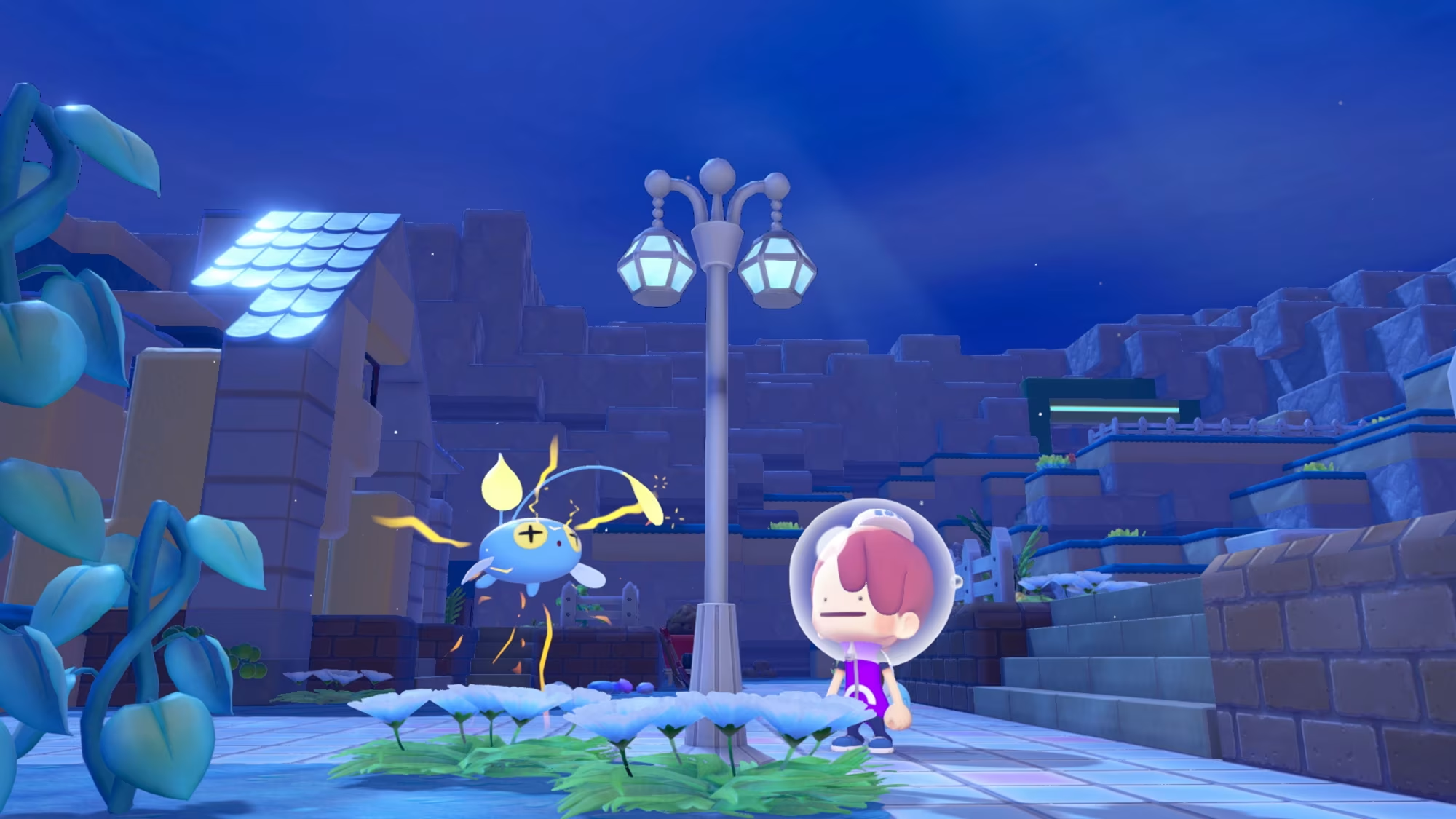
Producing isn't enough, you also need to conduct. Two devices handle this, the Electric Pole and the Wireless Transmitter, both subject to the same hard limit: the electrification range is 10 blocks maximum.
The beginner's mistake happens exactly there. You build your Wind Turbine up high for the 30 units, you install your machines down in the town, and you're surprised they stay inert. Current doesn't cross distance on its own: beyond 10 blocks, you need to relay it, pole after pole or transmitter after transmitter. A generator perfectly placed for its output, but isolated from its town, is useless.
In practice, sketch out the network before building: measure the distance between the production point and the cluster of devices, divide by 10, and you have the number of relays. Our source doesn't specify whether a pole or a transmitter itself consumes a unit — when in doubt, keep some margin on your total.
Electrification from Pokémon is intermittent: never make it your main source
Some Pokémon produce current thanks to their Electrification specialty. Tempting, but tricky: this production is intermittent. It helps out, it supplements, it doesn't replace a generator.
This same specialty, however, has an essential use: as labor. The Sand House requires Construction, Watering and Electrification; the Big Sand House adds Recycling to that; the Poké Ball House requires Labor and Electrification for Concrete × 10, Glass × 10 and Poké Metal × 10, in 15 minutes over a 3 × 3 footprint; the Yellow Cabin requires Construction and Electrification. Two projects step up a notch by requiring two Electrification Pokémon: the Yellow House and the Elegant Café. The Abandoned Power Plant, meanwhile, combines Grinding, Construction, Electrification and Flying, requires 15 Pokémon and spans 33 × 31. So keep two Electrification Pokémon on hand.
What we don't know yet: how electricity behaves underwater
One point of honesty to finish. The reference documentation for this guide dates from March 22, 2026 and hasn't been updated since. However, the 2.0.0 update introduced Diving, the seabed, and underwater construction. Nothing currently indicates how electricity behaves underwater, or whether a generator suited to the seabed exists. We won't extrapolate: this aspect is unverified.
No deadline on this topic, and that's just as well: these values belong to the base system and don't depend on any ongoing event. For your next session: count your devices — one unit each —, build a Wind Turbine for five Wood and five Fabric Thread aiming for height to triple its output to 30 units, level the ground before starting the project, assign it to Cheffelina, and measure the distance to the machines: beyond 10 blocks, you'll need one more relay.
Share this article
What's your electricity strategy for starting out in Pokémon Pokopia?
Frequently asked questions
How many units of electricity does each generator produce?
The Small Generator produces 5, the Aero Generator produces 10 at low altitude or 30 at high altitude, the Hydro Generator produces 20, and the Pyro Generator produces 30. All other devices consume one unit.
What's the easiest generator to get at the start?
The Small Generator, a simple item you can place without construction, kits, or advanced materials. It's a stopgap, but enough to get started with five devices.
Why isn't my powerful generator doing anything despite good output?
Current only travels up to 10 blocks maximum. Beyond that, you need to relay it with an Electric Pole or a Wireless Transmitter between the generator and your devices.
Can I rely on Electric-type Pokémon to power my town?
No, this specialty produces current intermittently: it helps out or supplements, but never replaces a real generator. However, it remains mandatory as labor for certain constructions.
How many materials are needed to build each building-generator?
The Aero Generator requires 5 Wood and 5 Fabric Thread. The Hydro Generator requires 15 Wood and 5 Stones. The Pyro Generator requires 15 Iron and 5 Sea Glass Fragments. All three take 15 minutes with 2 Construction Pokémon.
Key takeaways
- The Aero Generator offers the best cost-benefit ratio with just ten materials, and triples its output at altitude.
- A connected device consumes one unit of electricity, regardless of type: count your machines before sizing your generators.
- Current stops dead at 10 blocks, so you need to relay it with poles or transmitters, otherwise your machines stay off even with enough production.
- The three building-generators share the same profile: 2 Pokémon specialized in Construction, 15 minutes, a 2 × 2 footprint.
Comments
No comments yet. Be the first to react!
Leave a comment
Similar guides



Latest articles




Your opinion counts
Rate Pokémon Pokopia
Click a star to rate