



 Fabian Lainé

Full Guide
The Sims 4 Horse Ranch: raising and competing with horses
In brief
Horse Ranch turns The Sims 4 into a genuine horse breeding and equestrian competition simulator. Between strategic training, barrel racing, adorable mini goats, and artisanal nectar production, this pack opens up a rich endgame set in the world of Chestnut Ridge, inspired by New Mexico.
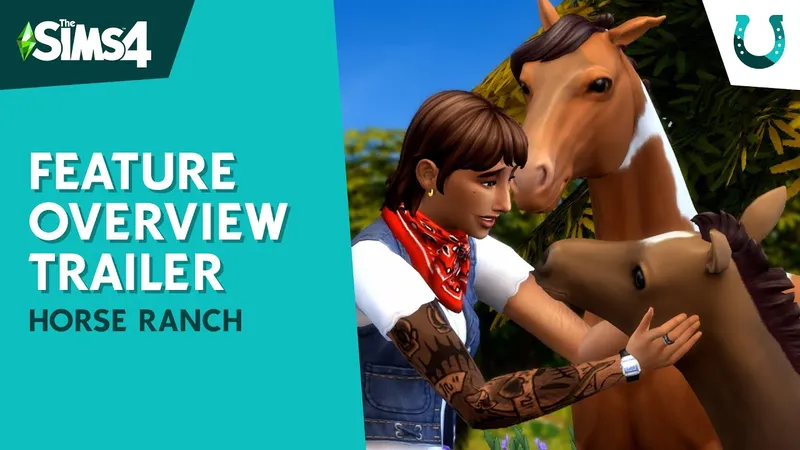
Released on July 20, 2023, The Sims 4 Horse Ranch is the twelfth expansion pack for Maxis's famous life simulator. It finally brings horses, requested by the community since The Sims 3 Pets, and offers a total immersion in the culture of the American Great West. Between horse breeding, equestrian competitions, artisanal nectar-making and adorable mini goats to milk, this pack opens up an entirely new area of gameplay. Here's our complete guide to mastering Chestnut Ridge and turning your Sim family into accomplished ranchers.
Chestnut Ridge, a world inspired by New Mexico
Chestnut Ridge is the new world delivered with the pack. Inspired by the wide open spaces of the American West and particularly by neighboring New Mexico, it alternates desert expanses and huge grassy plains ideal for galloping with your steed. The atmosphere blends rustic cabins and modern farms, under the warm light typical of the southwestern United States.
The world features 13 lots spread across three neighborhoods, one rental, one bar and one nightclub — enough to settle several generations of rancher families.
The three neighborhoods of Chestnut Ridge
Each neighborhood has its own personality and role in ranch life:
- New Appaloosa: the social heart of the world, with The Oak Barrel (bar) and The Rusty Horseshoe (nightclub). This is also where the official equestrian center is located.
- Rider's Glen: a greener residential neighborhood, with the vineyard estate and several cozy properties perfect for a young couple starting out.
- Galloping Gulch: the wildest one, with Big Sky Front as a rental and vast lots perfect for a working ranch.
Create-a-Horse: breeds, ages and customization
Create-a-Sim is enriched with a dedicated tab: Create-a-Horse. It offers 35 breeds reproducing the major real-world breeds (Appaloosa, Mustang, Andalusian, Friesian, Percheron...) and the editor even allows mixing two breeds.
The first horse will contribute the mane and tail color; the second will contribute the body and limb color.
You then adjust the coat, mane, tail, muscle tone, and you can add makeup or body paint to mark your mount. Three ages coexist: foal, adult and elder horse — all integrated into the household's normal life cycle.
Horse traits
Horses are considered full-fledged Sims: they occupy a place in the household and appear in the portrait bar, but they cannot be directly controlled. Their AI decides their actions based on their traits.
At creation, you choose 3 traits from a list of 11. Here are the most notable combinations:
- Bold: unshaken by bad weather or danger, it succeeds more often at obstacles and barrels.
- Stubborn: hardheaded, it progresses more slowly in training and fails more often in competition.
- Energetic: full of energy, it quickly excels in sport but struggles to develop its temperament.
- Skittish: spooked by the slightest thing, it takes longer to tame.
- Clever, Gentle, Playful, Friendly, Independent, Hardy, Champion and Needs Affection round out the panel.
Choosing the right combination of traits is already about thinking ahead to the horse's competitive career — and to the genetic value it will pass on to its offspring.
Training your horse: the four equine skills
Each horse develops 4 skills of its own, capped at 10 just like Sims' skills:
- Temperament — worked on through positive interactions (brushing, cuddling, rewarding).
- Agility — developed through barrel training.
- Jumping — trained using jumping obstacles set up on the lot.
- Stamina — improves during long horseback rides.
A community board set up on the ranch also lets you schedule automatic training sessions: very handy for keeping the horse busy all day without micromanaging. A well-trained horse quickly gains value and attracts buyers at the equestrian center.
Horseback riding and developing your Sim's equestrian skill
On the Sim's side, a new Horse Riding skill (10 levels) gradually unlocks trotting, galloping, tricks, and more complex commands. Children and teens can also ride under supervision, with animations and speeds adapted to them.
Once your Sim becomes an expert rider, they can head to the Chestnut Ridge equestrian center to assess their horse's skills and prepare it for championships.
The horse then becomes a genuine means of transportation in Chestnut Ridge's open world — faster than walking, and infinitely more immersive than a taxi.
Equestrian competitions
Horse shows are the heart of the pack's endgame. You can sign up either at the New Appaloosa ranch or via the community board placed at home. Registration is open from 7 a.m. to 7 p.m.
The game offers four main disciplines:
- Barrel racing — a speed course around three barrels, for agile horses.
- Endurance racing — a long course that puts physical condition to the test.
- Show jumping — a series of jumps, reserved for horses trained on the bar.
- Western style — a mixed event that rewards elegance and rider skill.
An ultimate horse show championship then brings together the best riders in an all-styles competition.
Barrel racing, show jumping, and rewards
Each discipline comes in four difficulty levels, with entry fees and winnings that rise progressively:
- Level 1: §100 entry fee
- Level 2: §250
- Level 3: §500
- Level 4: §1,000
- Ultimate championship: §2,000
Winnings rise accordingly: winning a level 4 event brings in around §3,000, and the championship can go up to §6,000 for first place. On top of that, you get trophies to display in your living room and a growing reputation within the equestrian community.
Breeding: giving birth to a foal
Since horses can't be directly controlled, breeding happens through the Sim who encourages them. First have them interact regularly — sniffing each other, grazing together, greeting one another — to raise their relationship bar.
Once the relationship is high enough, your Sim can select the Encourage to Breed With... option on the mare. Gestation lasts a few in-game days and results in the birth of a foal. The foal inherits a combination of its parents' traits and colors, and it can develop its own traits as it grows up.
This is where most of the strategic breeding happens: crossing a Champion stallion with a Smart and Sturdy mare can produce a formidable foal at the championships, whose resale value will skyrocket at the equestrian center.
Mini goats and mini sheep: the new companions of the ranch
The pack also introduces two adorable new miniature animals that round out the pastoral picture:
- Mini goats: they can be milked regularly, and their milk can be sold or used in cooking.
- Mini sheep: they can be sheared to collect wool, which sells for a good price.
Both are housed in pens with feeders and water troughs, and your Sims can invite them to take part in cute little activities that boost mood. They bring in Simoleons while adding a very appealing cottage-core vibe to players' screenshots.
Nectar and the Nectar Making career: ranch craftsmanship
The pack revives a cult mechanic from The Sims 3: nectar production. A nectar maker (§350) lets you extract juice from fruits, vegetables... or even potatoes or even trash for the more experimental Sims.
Your Sims can also age nectar in racks to multiply its resale value.
The Nectar Making skill has 5 levels that progressively unlock new recipes, including special versions for vampires, werewolves, or spellcasters if you own the corresponding packs. Growing your own ingredients maximizes your margins.
The Nectar Making career (Professional Nectar Maker) opens up alongside it: your Sim climbs the ranks by selling their production and developing their recipes. It's an ideal activity for homebody Sims who want a passive source of income at the farm, alongside equestrian competitions.
Going further
Once you've mastered the basics of Horse Ranch, several avenues open up to deepen your experience:
- Combining Horse Ranch with Cottage Living to create a complete homestead — the synergy between chickens, cows, horses, and orchards turns your lot into a truly self-sufficient operation.
- Optimizing breeding across several generations — meticulously selecting inherited traits to create a bloodline of champions that will dominate the ultimate championship.
- Building a luxury nectar business — aging rare nectars for several seasons and reselling them for top dollar with the help of the Entrepreneurial reward trait.
With Horse Ranch, Maxis delivers one of the richest packs of The Sims 4 generation, blending The Sims 3 nostalgia with resolutely modern gameplay. Wide open spaces, championship ribbons, and vintage nectars await.
Share this article
Would you rather throw yourself into fierce equestrian competition or cultivate the cozy ranch vibe with strategic breeding?
Frequently asked questions
How long does it take to train a horse to the maximum level?
It depends on the initial trait and how much time you invest in training sessions, but expect a few days of gameplay to raise a skill to 10 using the community board that schedules automatic training. A Spirited horse will progress faster than a Skittish one.
Do purebred horses earn more than mixed breeds?
No, it's mainly skills and traits that determine value at the equestrian center. A well-trained mixed breed with Champion traits can outperform a poorly trained purebred.
Can you ride a horse as a child, or do you need to be a teen/adult?
Children and teens can ride under supervision with adapted animations and speeds, but only young adults and older can access official competitions and progress in horseback riding.
What's the better long-term payoff: racing or breeding?
High-level breeding is more profitable: crossing two champions produces a foal you can resell for several thousand Simoleons at the equestrian center, far beyond what competition winnings bring in.
Do mini goats and sheep require a lot of upkeep?
Minimal: one milking or shearing session per day is enough, along with basic feeders and water troughs. It's more profitable for the effort involved than simply ignoring them.
Key takeaways
- Horses are created with 35 real breeds and 11 distinct traits that directly influence their competition performance and genetic value.
- Four equestrian skills to develop — Temperament, Agility, Jumping, and Stamina — turn your mounts into true champions within just a few days of gameplay.
- The four equestrian disciplines (barrel racing, endurance, jumping, western style) lead up to an ultimate championship that pays out up to §6,000 and real social recognition.
- Strategic breeding between stallions and mares creates hereditary foals whose value can skyrocket if you cross the right traits.
- Mini goats, mini sheep, and artisanal nectar production round out the gameplay beyond racing for a genuinely rustic and profitable countryside fantasy.
Comments
No comments yet. Be the first to react!
Leave a comment
Similar guides





Latest articles








Your opinion counts
Rate The Sims 4
Click a star to rate