


 Fabian Lainé

Full Guide
Subnautica 2: The Tadpole Guide, Endgame Submarine — Building, Piloting, and Optimizing (July 2026)
In brief
The Tadpole is the essential endgame submarine of Subnautica 2, a successor to the Cyclops but revolutionized by its interchangeable hulls. This guide covers unlocking fragments in the deep biomes, the full crafting chain, setting up the Tadpole Dock, and optimizing modules to explore fearlessly beyond 600 meters.
Since the early access launch of Subnautica 2 on May 14, 2026, and the arrival of the Adaptive Measures update (1.1) in early July, one question keeps coming up among the CICADE colonists: which vehicle should you use to go truly far, truly deep, on the ocean moon of Proteus? The answer comes down to one official term from the English version: the Tadpole. It's the direct heir to the Cyclops from the original Subnautica, a habitable, modular submarine capable of housing up to four teammates in co-op. This guide covers everything you need to know to unlock it, build it, outfit it, and pilot it without ending up as a Leviathan's appetizer.
The Tadpole: the direct heir to the Cyclops
Contrary to what pre-launch rumors suggested, the 2018 Cyclops was not resurrected as-is in Subnautica 2. Unknown Worlds chose instead to build on the lessons learned from the Seatruck in Below Zero by designing a brand-new vehicle with interchangeable hulls, called the Tadpole. This is the submarine that plays the role of endgame flagship: a habitable cockpit, cargo space for an exosuit, docking for a mini exploration submersible, and above all the ability to configure it based on the targeted biome. Think of it as the Cyclops the franchise had always wanted to make, but able to reinvent itself between dives.
In practical terms, the Tadpole occupies the same tactical slot as the Cyclops: it's your mobile base, your supply shuttle, your living quarters when you're too far from the Tadpole Dock to make it back before Proteus's polar night falls. It's nothing like the taxi the Seatruck could be; we're talking about a vehicle over thirty meters long, able to withstand heavy pressure and manage its own power production.
Unlocking the blueprints: which biomes to visit, which fragments to scan
As in the first Subnautica, you don't build a submarine out of nothing. You first need to find its fragments and scan them with the Scanner Tool. Since Adaptive Measures, version 1.1 has redistributed the wrecks and rebalanced access difficulty, clearly drawing on the progression logic of the 2018 Cyclops: three distinct modules to scan, scattered across three biomes of increasing depth.
- Hull Fragment — on cargo wrecks between 220 and 320 meters, often in silt-covered canyons near secondary thermal vents.
- Bridge Fragment — on deeper drilling rig wrecks (400-500 meters), typically at the edge of the phosphorescent caves.
- Engine Fragment — in Alterra engineering sanctuaries located beyond 550 meters, with at least one Leviathan patrolling nearby.
Each fragment must be scanned three times to complete the full blueprint. Always keep track of your scans in the PDA log, as this will save you from going back to scan a copy that's already been logged by a teammate in co-op. A recurring tip from the community since June: equip your Prawn (or the Tadpole's heavy hull, more on that below) with a spotlight module before descending below 400 meters, since visibility on Proteus drops off faster than it does on Planet 4546B.
Materials: preparing the hull and electronics
Once you've got the three blueprints in hand, it's time to build. The Tadpole demands a serious refining chain; it's not uncommon to spend three to four hours gathering resources, especially if you're playing solo. Here's the parts list a clean run requires, drawn from the current recipes at the scientists' bureau:
| Component | Raw materials | Where to prioritize scouting |
|---|---|---|
| Plated titanium sheets | Titanium, Diamond | Shallow reefs (titanium) + limestone caves (diamond) |
| Advanced circuits | Gold, Silver, Copper | Veins in the phosphorescent caves |
| Reinforced kyanite | Kyanite crystal | Deep thermal vents (400 m+) |
| Synthetic fiber | Creature blood, Raw ruby | Bio-luminescent kelp groves |
| Ionic battery | Alien cell, Copper | Alien sanctuary ruins (400-500 m) |
Useful reminder: the 1.1 update slightly lightened titanium costs but toughened up the kyanite recipes. Stock up generously on the latter, as it's also required to upgrade the Tadpole's hull past 800 meters.
Construction: Vehicle Fabricator or Tadpole Dock?
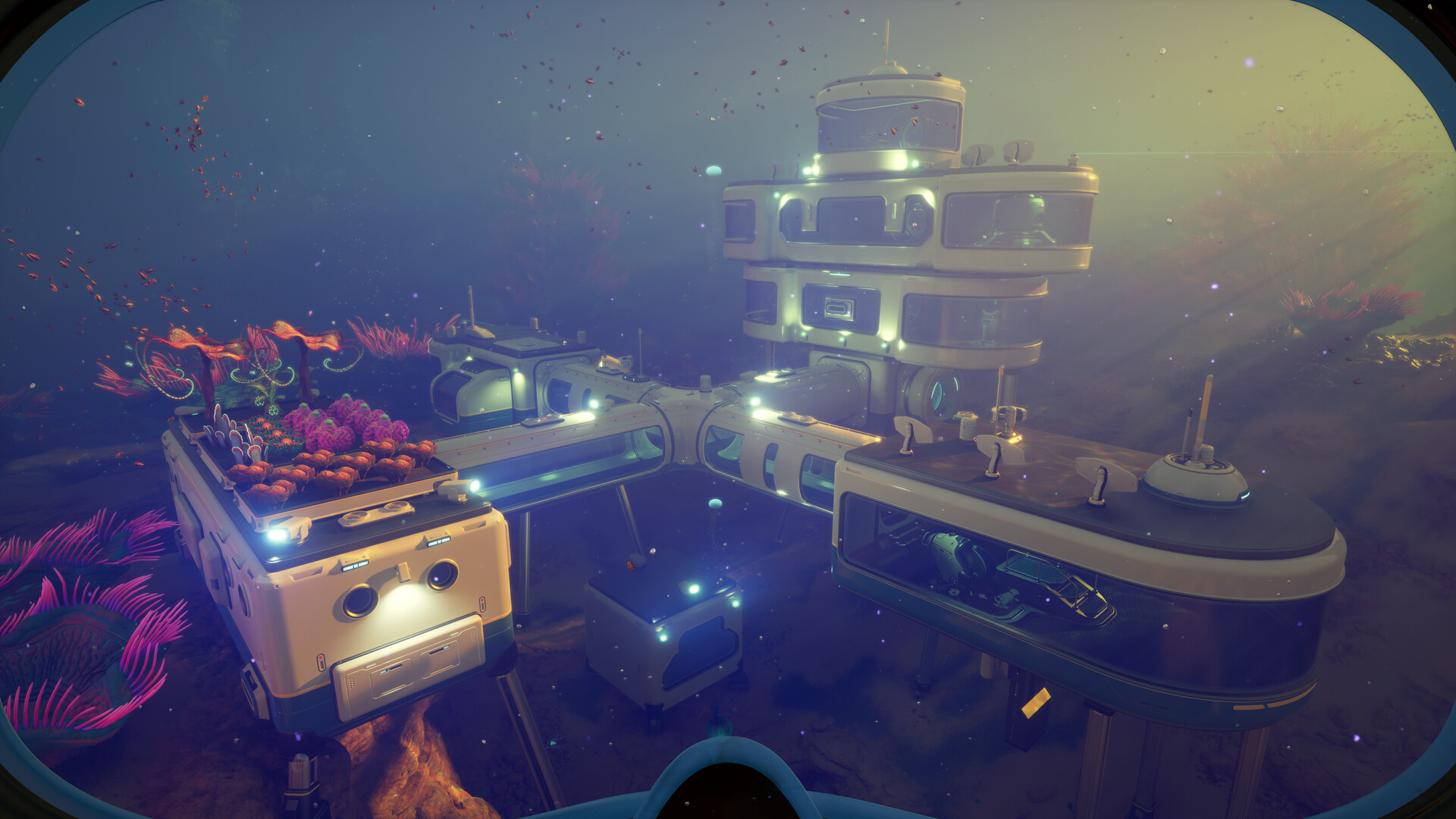
Two structures let you bring your vehicle to life. The Vehicle Fabricator is the classic station, the one also used for the Prawn exosuit and the small exploration submersible. It needs to be placed in a room (Multipurpose Room or T-Compartment preferred) powered by at least three Power Transmitters. For the Tadpole, however, the recommended route remains the Tadpole Dock, a new structure introduced in early access and designed to accommodate a submarine of this size.
The Tadpole Dock offers three decisive advantages over the generic fabricator:
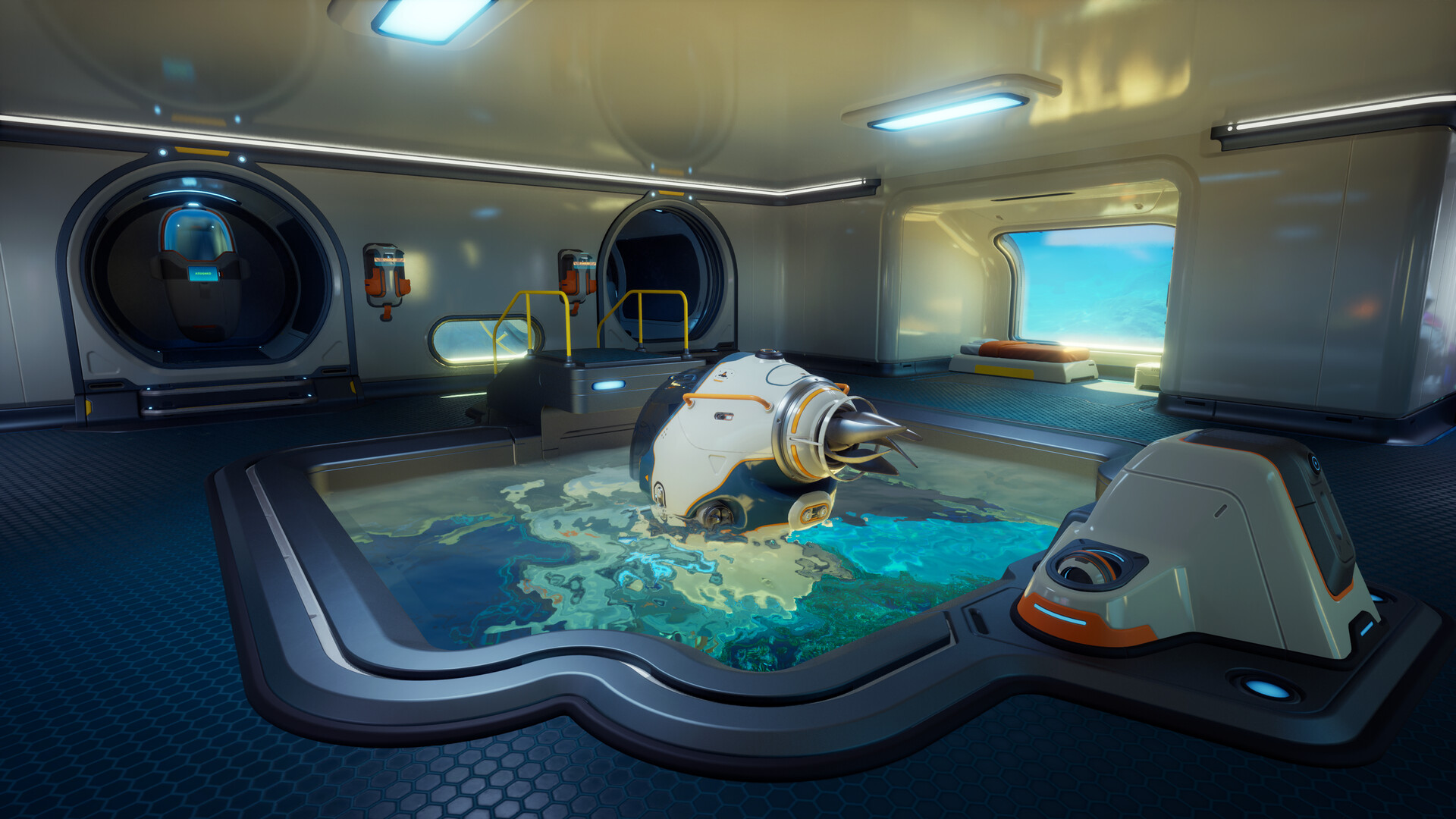
- Automatic recharging of energy cells as long as the submarine is docked, provided the base has a positive net power output (Solar Panel, Hydroelectric Turbine, Bioreactor, or Thermal Plant).
- Partial hull repair while docked, up to 80% of the damage bar.
- Direct access from inside the base, which avoids having to re-suit up to board the sub between runs.
Note that the Tadpole Dock requires an outdoor platform: it cannot be inserted into an existing Moonpool. Make sure you have flat ground and enough clearance on the sides, otherwise the build will refuse to snap into place.
Interchangeable chassis: the real 2026 revolution
This is the new feature that sets the Tadpole apart from the 2018 Cyclops. Instead of a single tube, the Subnautica 2 submarine is made up of a fixed cockpit and a modular rear chassis. Since the Adaptive Measures update, three configurations are available at the Tadpole Dock:
- Explorer Chassis — the lightest, maximum energy autonomy, docking for two small submersibles. Perfect for mapping and asymmetric co-op.
- Cargo Chassis — extended storage lockers, mobile fabrication station, but slower and more power-hungry. The configuration to favor for supplying a remote base.
- Predator Chassis — reinforced hull, priority docking for the Prawn exosuit, integrated thermal generator. This is the endgame chassis, the one for descents below 600 meters.
You can switch chassis in about thirty seconds at the Dock, without rebuilding the submarine. This flexibility completely changes the progression loop: where the Cyclops forced a permanent compromise, the Tadpole allows for several playstyles within the same save.
Essential modules: sonar, silence, thermal, decoy
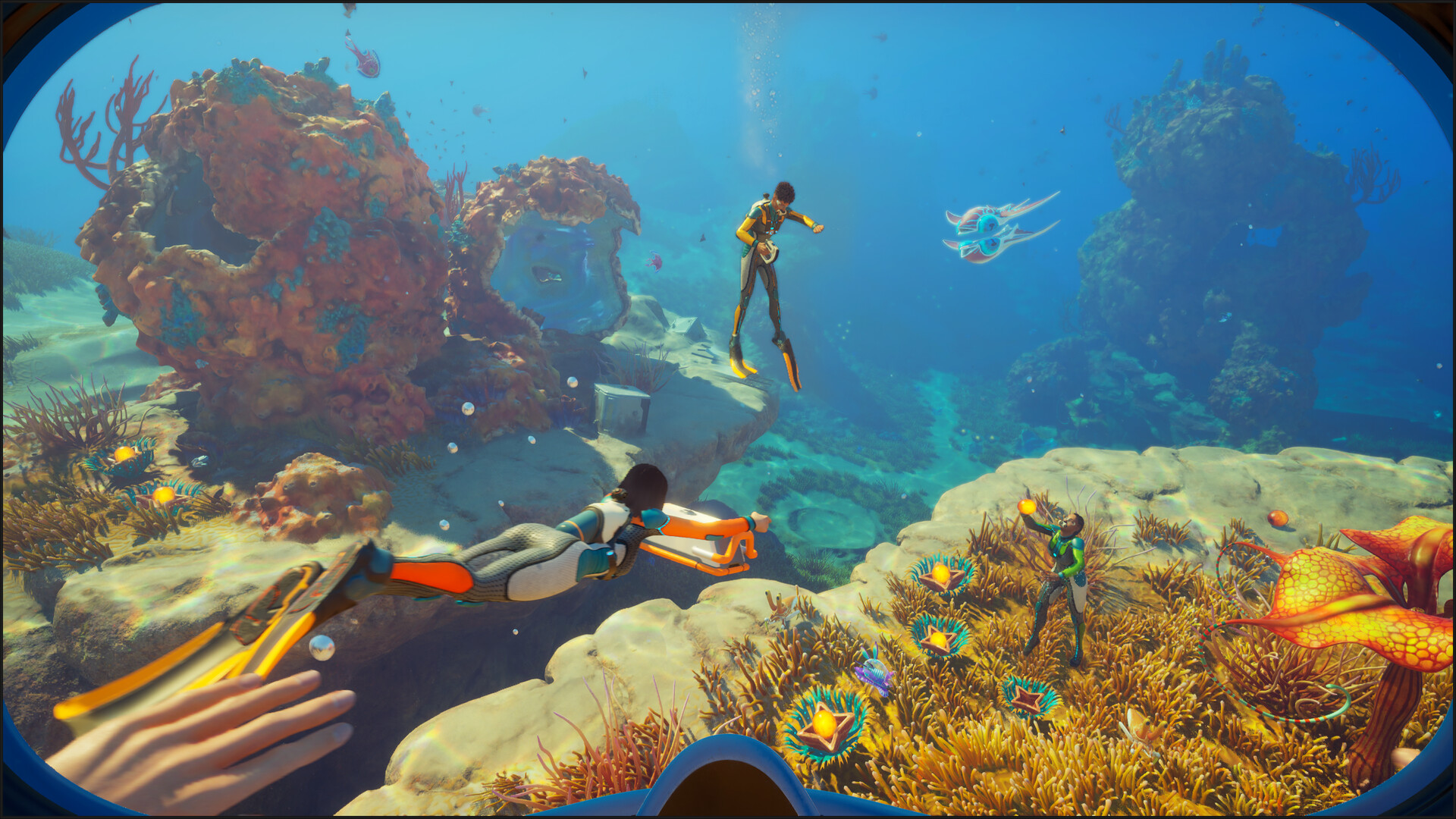
The Tadpole's modules are crafted at the Habitat Builder, then placed in the dedicated slots at the piloting station. Six are available as of July 2026 and are well worth the detour, all more or less direct descendants of the old Cyclops upgrades.
- Long-range sonar module — essential in the deep zones where light disappears. Mapping pulse every three seconds, range of about 250 meters. Careful: every ping attracts sonar-sensitive predators, so switch it off when approaching a Leviathan.
- Acoustic silence module — the equivalent of the Cyclops's Silent Running. Halves the sound signature, at the cost of severe energy consumption. Switch it on as soon as a hostile contact appears on sonar.
- Thermal generator module — slowly recharges energy cells near thermal vents. Vital for any campaign beyond 500 meters, where Solar Panels become useless.
- Stealth mode module — partial optical camouflage, projected from the hull. Three minutes of continuous autonomy, with a two-minute recharge time. Complements acoustic silence against a hunting Leviathan.
- Decoy module — drops a sonar beacon that attracts predators for twenty seconds. Every pilot's best friend when stuck in a narrow passage.
- Ion shield module — costly to unlock, it absorbs one impact charge then recharges over five minutes. Reserved for endgame dives.
Managing energy: thermal vents and Thermal Plant
A well-built Tadpole never stalls from running dry, provided you understand its energy budget. The submarine has six energy cell slots; it's recommended to start with four Ion Batteries plus two empty slots, to balance weight, cost, and autonomy. Upstream, the home base must produce enough to recharge the submarine within a reasonable time.
The winning trio remains, as of mid-2026, the Thermal Plant placed on an active thermal vent, paired with a Bioreactor to absorb the surplus biomass collected, and backed up by a pair of Hydroelectric Turbines in a sea current. Solar Panels remain useful for a secondary base placed at shallow depth, but don't count on them beyond 200 meters. The onboard thermal generator module completes the setup by letting the Tadpole recharge on its own during a pause near a vent.
Piloting in hostile zones: Leviathans, storms, and currents
Subnautica 2 introduces a new ocean current mechanic that can literally carry the Tadpole several hundred meters. It's both a boon (fast, zero-energy travel) and a trap (drifting into a hostile biome). Three rules to engrave in your PDA:
- Always read the current before diving. An indicator in the top right of the cockpit shows direction and intensity; in the red zone, the submarine can no longer maneuver freely.
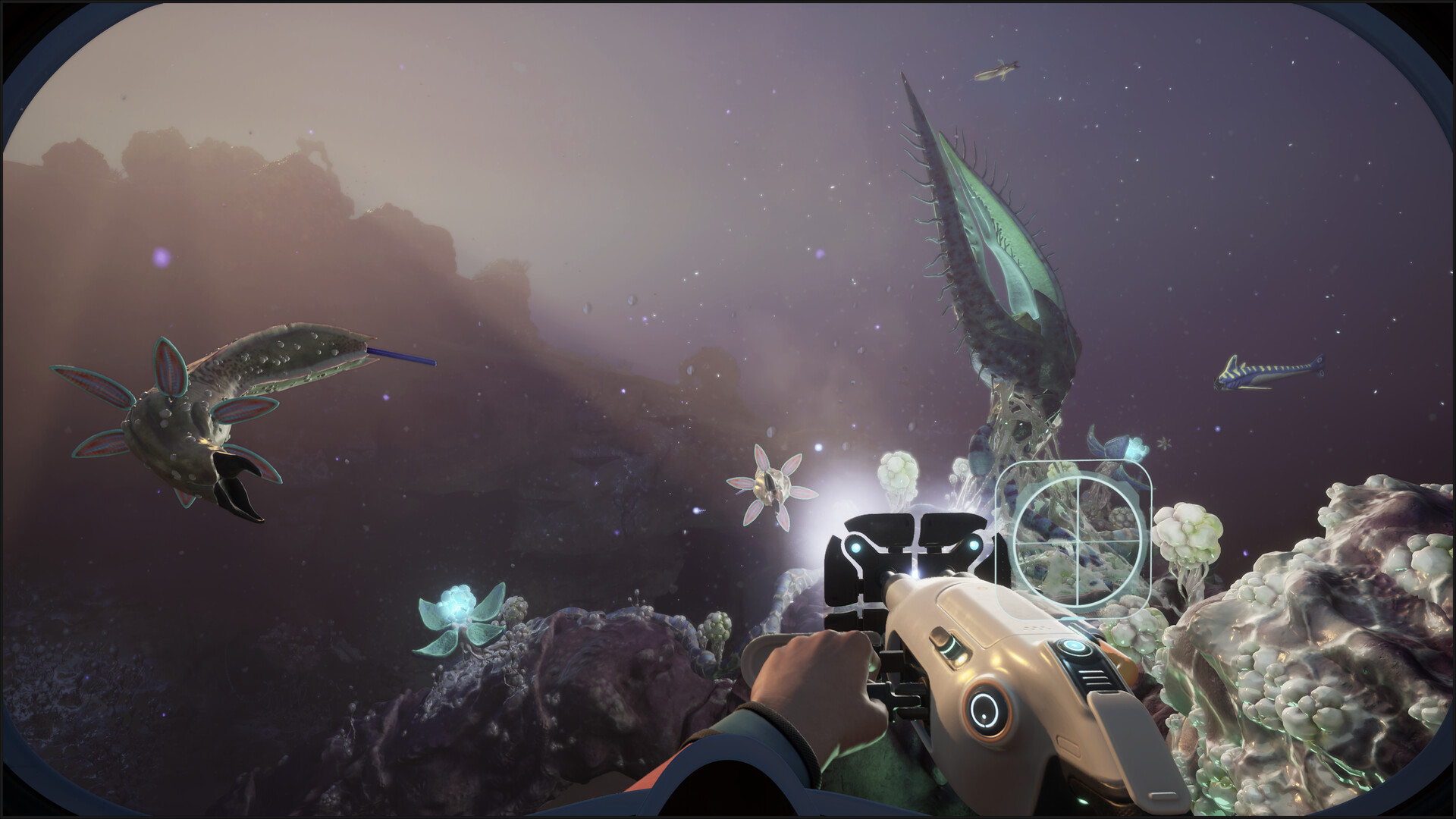
- Cut propulsion when approaching Leviathans. Proteus's endgame creatures, different from the iconic Reaper and Ghost Leviathan of the first saga, react to sound and vibrations. A Tadpole gliding silently goes almost unnoticed, while a Tadpole accelerating at full throttle signs its own death warrant.
- Plan a backup option. Always carry a Prawn exosuit in the Predator frame to evacuate if the hull drops below 30%; a small exploration submersible will serve the same purpose for a simple drift issue.
Three mistakes not to make solo or in co-op
A year and a half of community beta followed by three months of early access have highlighted the same recurring blunders. Here they are, so you can avoid losing your submarine needlessly.
- Placing the Tadpole Dock on an unstable slope. The submarine weighs several tons; a poorly anchored support ends up tearing apart at the first underground storm. Choose a stabilized platform, ideally backed against a rock wall.
- Sailing without assigning roles in co-op. With four players, disaster looms if no one handles the energy cells or damage control. Assign a pilot, a mechanic, a scanner operator, and a gunner/decoy operator — especially beyond 500 meters.
- Ignoring PDA alerts. The PDA never announces a fire or a leak for nothing. In case of a compartment fire, cut propulsion, grab the extinguisher, and seal the bulkheads before losing half your hull.
Conclusion: the submarine that redefines the progression loop
The Tadpole isn't just the Cyclops bis, it's a vehicle that capitalizes on twelve years of Unknown Worlds' learning. Its interchangeable chassis system finally makes you want to redo the tech tree to test out a new configuration, its compatibility with four-player co-op opens up scenarios impossible in solo play, and its visual kinship with the Cyclops will reassure veterans. All that's left is to keep an eye out for the next waves of updates: Unknown Worlds has announced new modules and a fourth chassis for autumn 2026, which should further broaden the range of possible roles. In the meantime, build yours, decorate the interior, and above all: turn off the sonar when a Leviathan gets close.
Share this article
For your first endgame run, which Tadpole hull appeals to you the most?
Frequently asked questions
Do you absolutely need to unlock the Tadpole to keep progressing in the late game?
Technically no, but honestly yes. The Prawn Suit and smaller submersibles can theoretically get the job done, but the Tadpole remains the only true mobile base capable of housing an entire crew and descending confidently beyond 550 meters without constant energy stress.
Which hull should you choose to start?
Start with the Explorer to master piloting and map things out without pressure. Once you're comfortable, switch to the Predator for the real descents: the reinforced hull and built-in thermal generator make all the difference.
How long does it take to gather all the Tadpole's materials?
Expect three to four hours of methodical gathering solo, longer if you spend time exploring without a clear goal. In co-op, splitting up tasks can cut that time in half.
The Acoustic Silence Module uses a lot of energy; should you keep it on all the time?
No. Save it for critical situations: approaching a Leviathan, crossing hostile territory. Running it continuously will drain your batteries within minutes—it's an energy sink.
Can you move the Tadpole Dock after building it?
No, it's locked to its initial position. Choose the site carefully: somewhere clear, relatively close to a resource source, and at a moderate depth to make rotations easier.
Key takeaways
- The three Tadpole fragments are hidden at 220-500 meters in Alterra wrecks; scanning each one three times is mandatory.
- Reinforced kyanite is the material bottleneck—stock up generously, as it's also required for hull upgrades.
- The Tadpole Dock is essential for automatic recharging, partial repairs, and direct access from your base.
- The three hulls (Explorer, Cargo, Predator) can be swapped in thirty seconds and redefine the progression loop.
- The Sonar Module and Acoustic Silence are essential below 400 meters; silence is your best friend against Leviathans.
Comments
No comments yet. Be the first to react!
Leave a comment
Similar guides
Latest articles








Your opinion counts
Rate Subnautica 2
Click a star to rate