


 Fabian Lainé
Full Guide
The Sims 4 Cats & Dogs: complete pack guide
In brief
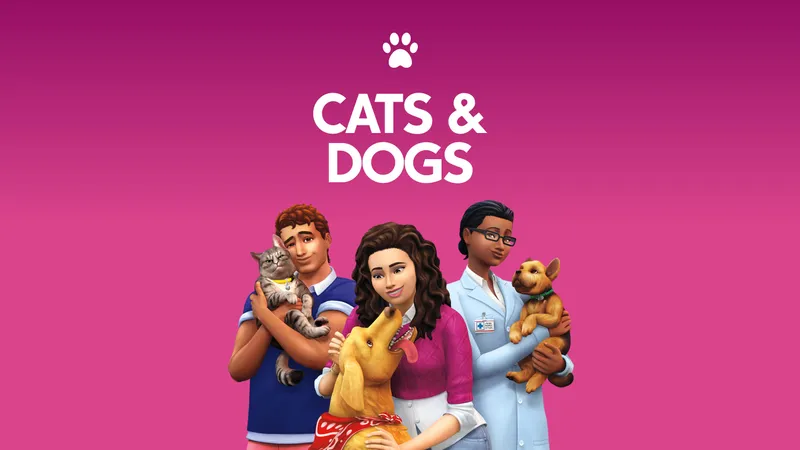
The Sims 4 Cats & Dogs turns pet management into genuine gameplay, going well beyond simple decoration. Between the sophisticated pet creator, personality traits that shape autonomous behaviors, and authentic daily care, this pack puts four-legged companions back at the heart of your household.
Released in November 2017, The Sims 4 Cats & Dogs remains, nearly a decade later, one of the most beloved expansion packs in the community. It doesn't just add animals to the game: it opens up an entire coastal world, Brindleton Bay, brings gameplay back to the extended family, and introduces a creation tool that has nothing to envy in the Sims' CAS. For players coming back to the game or still hesitating to take the plunge, here's a complete guide detailing everything the pack offers around the pets themselves, deliberately leaving aside the veterinarian career, which deserves its own article.
A pack that breathes new life into animal simulation
Since The Sims: Unleashed in 2002, the franchise had never handled the question of the four-legged companion so well. Cats & Dogs puts the animal back at the center of the household without turning it into a mere decorative object. Cats and dogs are full-fledged family members: they occupy a slot in the household (up to eight members total, animals included), they age, form bonds, develop obsessions, and leave an emotional mark when they pass away.
The big difference from the old Sims 3 system: animals aren't directly controllable. You guide them through interactions on your Sim or through commands, but their behaviors remain autonomous. This reinforces the illusion that they lead their own lives, with their quirks, their mischief, and their bursts of affection.
Adopting, creating, or inheriting: four paths to a companion
The pack opens up four ways to welcome an animal into your home. Each corresponds to a different play style:
- Create A Pet (CAS Pet): create your dog or cat from scratch when creating the household, at no cost.
- The gallery: download an animal shared by the community and add it directly to your household.
- The adoption service: from the computer or phone, browse a list of available animals and adopt one for a modest fee.
- The stray: form a friendship with a stray cat or dog encountered in Brindleton Bay, then invite it to join the household.
The stray route is particularly delightful for a narrative-driven game: it requires patience, several visits, a few treats offered, but the resulting bond is incomparable.
Create-A-Pet: a workshop deeper than it appears
The pet creator is probably the pack's technical showcase. It mirrors the structure of the classic CAS while reinventing it for animal body types. You first choose the species (dog or cat), then the size for dogs (small, medium, or large), and finally a breed from a generous list. The breeds in the game aren't just simple labels: they're preconfigured sets of proportions, muzzles, ears, tails, and coats that you can then adjust to your liking.
Sculpting the body
Just like with Sims, you can act directly on the body via click-and-drag: muzzle length, ear size, eye shape, leg thickness, back curvature. Each parameter is independent, allowing for both faithful recreations and whimsical creations.
Painting the coat
The major innovation remains the paint tool. The coat is built up in layers of patterns (spots, stripes, bibs, socks) that you stack like in graphic design software, with free choice of colors via a color wheel. This lets you recreate a classic tabby, a complex calico, or invent an entirely original pattern. Outfits (bandanas, collars, coats, costumes) round out the look.
Mixing breeds
A dedicated tab finally lets you cross two breeds in a single click: the game generates a hybrid by interpolating morphology and coat. It's an excellent starting point for players who don't want to spend three hours in the editor.
Animal traits: personality at the heart of gameplay
Each animal has up to three traits, chosen from a list specific to each species. These are what determine day-to-day autonomous behavior: what excites them, what stresses them out, what triggers mischief. Traits aren't just decoration: a Vocal cat will genuinely meow more often, an Active dog will demand walks, an Independent companion will refuse insistent cuddles.
On the cat side, the list explores the classic feline register: Curious, Lazy, Affectionate, Skittish, Mischievous, Hunter, Territorial, Playful, among others. On the dog side, we find Loyal, Clever, Adventurous, Stubborn, Cheerful, Active, Hunter, Troublemaker, with a few symmetrical equivalents to the feline version.
A well-chosen trio of traits literally changes life at home: an Active + Adventurous + Cheerful dog will demand to go out every day and will transform your routine, while a Lazy + Independent + Aloof cat will practically live its own life.
Obsessions and personalized voice
Beyond traits, two mechanics bring personality into the game. Obsessions appear randomly: your dog becomes obsessed with a cousin, your cat won't let go of a plush ball, complete with dedicated animations. The voice can be adjusted during creation, from deep to high-pitched, with several timbres, which avoids the uniform herd effect in large households.
Daily care: feeding, playing, bathing, brushing
Like Sims, animals have needs, but the interface is simplified to avoid overload. The game distinguishes:
- Hunger: water bowl and food bowl (economy kibble, gourmet, or homemade). Don't forget to fill the bowl, or else escapes and food theft will happen quickly.
- Energy: cushions, baskets, couches... animals sleep anywhere, but real bedding improves their mood.
- Bladder: litter box for cats, outdoor trips for dogs. A dog that isn't taken out enough will relieve itself in the house, without warning.
- Affection: human contact remains a resource: playing, cuddling, brushing, talking. Sims with the Animal Lover trait get an emotional bonus.
- Fun: suitable toys (balls, cat trees, strings), walks, runs at the park.
Grooming and hygiene
The pack introduces two specific interactions to master. Bathing takes place in the bathtub for dogs (cats hate water, except for special traits): brace yourself for a soaked bathroom. Brushing, on the other hand, is done on the ground with the dedicated tool: it keeps the coat clean, removes fleas, and increases affection. A neglected animal will see its mood drop, its fur will visibly become tangled, and it may develop skin problems.
Veterinary illnesses: the basics to know
Even though we won't go into detail about the veterinarian career, every pet owner needs to understand the health system introduced by the pack. Your companions can get sick: repeated sneezing, lethargy, incessant scratching, shedding, shaking, refusal to eat are all warning signs. The game offers around twenty ailments of varying severity, from the common canine cold to more serious inflammations that, if ignored, can put the animal's life at risk.
The vet isn't just for emergencies: regular vaccination visits significantly reduce the risk of falling ill. Consider an annual visit for young pets, and more frequent visits for older ones.
In practice, when a symptom appears, there are two options: treat it at home with the appropriate items (basic medications available for purchase) or take the pet to the Brindleton Bay clinic. Diagnosis is then made on an exam table, followed by appropriate treatment. The cost is moderate for simple ailments, higher for surgical procedures, but always remains lower than the emotional trauma of a household losing its pet.
Brindleton Bay: the new coastal world
It's impossible to talk about the pack without mentioning Brindleton Bay, the brand-new world that comes with it. This New England-inspired harbor village is a rare setting in The Sims 4: cliffs, pebble beaches, shingled cottages, lighthouses and stranded boats create a strongly marked, melancholic atmosphere. The world is divided into four districts, each with its own function.
- Sandy Plaza: cultural and social hub, with a dog obstacle course, a monument to companions and a veterinary clinic.
- Whiskers Wharf: the waterfront, popular with stray cats, fishermen and tourists.
- Cavalier Cove: upscale residential area with large buildable lots, hiking trails and sea views.
- Dead Grass Isle: a small foggy island housing the Brindleton Bay lighthouse and an old pet cemetery, whose supernatural atmosphere will delight fans of the occult.
Brindleton Bay isn't reserved for players who own pets: it's a fully playable world in its own right, with several empty lots for building and an extra helping of coastal scenery that no other base pack provides.
Dog or cat: the fundamental differences
The pack treats both species symmetrically... up to a point. Here are the concrete differences to keep in mind before choosing:
The dog
- Can be trained: your Sim develops the Dog Training skill by teaching tricks (sit, lie down, roll over) and correcting bad behavior.
- Requires regular walks: without outings, it becomes anxious, barks and misbehaves.
- Can find items during walks, including collectibles and food.
- Variable sizes (small, medium, large), with distinct animations for each build.
- More emotionally dependent, builds bonds more quickly.
The cat
- More independent: litter box, naps and solitary interactions, less need for constant attention.
- Can hunt rodents and birds and bring back gifts home, sometimes useful for the collection.
- Climbs on furniture, sleeps in unlikely places, and benefits from specific climbing animations.
- No training, but unique feline interactions such as rubbing against legs or purring.
- More resistant to loneliness, ideal for a household of very busy Sims.
As a general rule, the dog reinforces family and outdoor gameplay; the cat fits better with introverted households and small apartments. Of course, nothing prevents you from having both, within the limits of the household size.
To go further
Cats and Dogs opens the door to many other topics that we cover in dedicated guides:
- Becoming a veterinarian and running your clinic: the complete career
- Brindleton Bay in building mode: coastal house ideas
- The Sims 4: pack compatibility with Eco Lifestyle, Cottage Living and Outdoor Retreat
Share this article
Your biggest challenge with a pet in The Sims 4 is more likely to be?
Frequently asked questions
Can I really create a unique pet, or is it just cosmetic?
Create-A-Pet is genuinely comprehensive. You sculpt the morphology (muzzle, ears, paws), paint the coat with layers of patterns and colors, and can even crossbreed two breeds. It's much more than cosmetic: every visual pet can be completely different.
How can I get a pet without going through adoption?
Four options: create your pet at household creation at no cost, download a pet from the community gallery, adopt one via computer or phone for a modest fee, or befriend a stray encountered in Brindleton Bay and then invite it to join your household. This last option takes patience but creates a stronger narrative bond.
If I neglect my pet, what really happens?
The consequences are visible and punishing. A poorly cared-for pet will see its mood drop, its fur become visibly matted, it can develop skin problems, relieve itself in the house, or even fall ill. It's not just an abstract meter.
Do personality traits really change behavior, or is it just text?
Traits genuinely govern the AI. A Vocal cat will meow frequently, an Active dog will demand daily walks, an Independent pet will refuse cuddles. That's what gives your companions real, autonomous life.
Do I have to pay a vet every time my pet gets sick?
Not necessarily. You can treat minor ailments at home with basic medication. But for an accurate diagnosis or surgery, the Brindleton Bay clinic is essential. Costs remain moderate compared to real-life emergencies.
Key takeaways
- Create-A-Pet rivals the classic CAS with morphological sculpting, layered coat painting, and breed hybridization.
- Pet traits truly govern behavior: an Active dog will demand outings, while an Independent cat will live its own life.
- Four ways to bring home a pet: creation, gallery, adoption, or befriending a stray in Brindleton Bay.
- Daily care (hunger, energy, affection, fun) requires discipline, but neglect has visible consequences.
- Illnesses and vet visits add a layer of realism: regular vaccinations and symptoms to watch for.
Comments
No comments yet. Be the first to react!
Leave a comment
Similar guides
Latest articles





Your opinion counts
Rate The Sims 4
Click a star to rate