



 Fabian Lainé

Full Guide
Sims 4 Parenthood: successfully raising a teen
In brief
The Growing Together... wait, the Parenthood pack profoundly transforms teen upbringing in The Sims 4 by introducing a Parenting skill to develop, five character values to instill, and unpredictable emotional phases. Far more than a cosmetic pack, it's a genuine lineage system where every parenting choice becomes permanently etched into the Sim's future personality.
Since May 2017, the Parenthood game pack has remained one of the most understated yet deepest additions to social life in The Sims 4. No new world, no occults, no flashy career: just a small Parenting skill mechanic, five character values to keep an eye on, and a series of unpredictable behaviors that shake up the family. As a result, this is a pack aimed first and foremost at players who like to follow a lineage across multiple generations, with a real challenge once high school age hits. Here's how to raise a teen without ending up in tears in front of the screen, what chores are actually for, how to survive a rebellious phase, and why the Super Parent aspiration is one of the most demanding goals in the base game.
What the Parenthood pack really changes
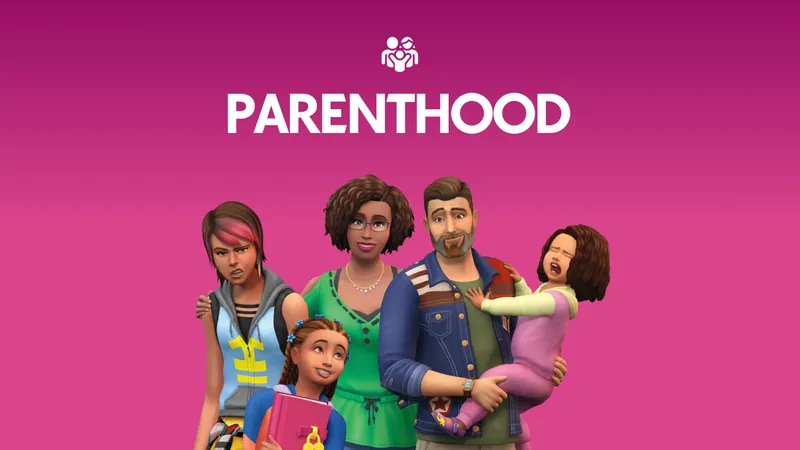
Released on May 30, 2017 on PC and Mac, Parenthood is the fifth game pack in The Sims 4 series. It adds virtually no new clothing or worlds, but it deeply transforms the way your Sims care for their toddlers, children, and teens. Technically, everyone can get something out of it: toddlers get their first character values, children bring school projects home, and teens start going through emotional phases that didn't exist before. Unlike other more visual expansions, this one is judged over the long run. You don't buy Parenthood for your first evening in front of the screen, you buy it for the third generation of a lineage, when you want to create real differences between children in the same family.
The Parenting skill, your number one tool
Unlocked as soon as an adult Sim takes care of a child, the Parenting skill has ten levels. Each tier opens up new interactions, from simple encouragement at level 1 up to time-outs, structured punishments, and finely tuned handling of emotional meltdowns as you progress. In practical terms, the higher your parent's Parenting skill, the more effectively their actions influence their offspring's character values. A Sim with low skill will get a lot of refusals when trying to get their teen to do homework; a high-level Sim will more often slip into the mode of a parent who knows how to handle things.
The cheat code to test the mechanic in fast-forward does exist: after enabling cheats with Ctrl+Shift+C then testingcheats true, the command stats.set_skill_level major_parenting X (X between 1 and 10) instantly maxes out the bar. Use it for testing, avoid it in a regular playthrough if you want to feel the progression.
Tip from longtime players: max out the Parenting skill on just one parent and let the other one play the cool parent. Your teens will keep richer memories of it, and key moments will be less predictable.
The five character values to pass on
The whole logic of the pack rests on five gauges that fill up positively (green) or negatively (red) through interactions. They're visible in the child or teen Sim's panel:
- Manners: table manners, saying thank you, behavior in public.
- Responsibility: homework done, chores handled, respecting house rules.
- Empathy: comforting a sibling, noticing other people's emotions.
- Emotional Control: handling sadness, anger, or fear without blowing up.
- Conflict Resolution: also called conversation ethics in some guides, this value measures the ability to defuse an argument rather than pour fuel on the fire.
Every failed or successful interaction shifts the meter one way or the other. Letting a teen skip their homework without reacting drops Responsibility; scolding them too harshly without explaining sends Manners plummeting. Key moments, those pop-ups that appear regularly, often force an agonizing choice: gaining one value while partially sacrificing another.
When the teen becomes an adult: the traits that lock in
Once the transition to young adult is made, the values lock in permanently and turn into a lasting personality trait. A full Manners meter grants the Good Manners trait, an empty one gives Rude; Empathy unlocks Compassionate or Insensitive; controlled Emotions lead to Emotionally Stable or Unstable. In other words, what you've sown over sixteen seasons of play ends up carved in stone for the rest of the Sim's life.
Grumpy, mischief, rebellious: surviving the teen phases
Teens in the Growing Together pack cycle through temporary emotional phases that transform their autonomous interactions. You might see them hit your favorite Sim like a summer downpour: without warning.
- Distant: the teen tenses up whenever a family member approaches, isolates themselves in their room, and refuses most social interactions.
- Mischief (Troublemaker): they enjoy being mean to other Sims and gain a positive moodlet every time they pull a prank.
- Rebellious: more frequent arguments with parents, swearing, procrastinating on homework. This is the most visible phase and often the longest.
- Mood swings: four-hour bouts of sadness or anger that appear without warning and completely derail a homework evening.
The pack doesn't include a true running-away mechanic in the strict sense (teens won't move out against your will), but a teen stuck in a prolonged rebellious phase will systematically refuse chores, stay out past curfew, and drive parental stress all the way up to an open crisis. French-speaking modders have in fact released several mods to add a genuine runaway feature triggered by an accumulation of negative values.
The phases aren't punishments in disguise: they exist to create scripted drama. A player in a hurry can try to end them early by talking to the teen about what they're going through; a roleplay-focused player will let them play out to tell the story of a real adolescence.
Chores, curfew, and punishments: setting boundaries
The family board that comes with the pack is the household's command center. It's probably the most useful object in the pack, best placed in the kitchen or near the entrance.
The family board step by step
Here you can set:
- A curfew set to 7pm, 9pm, or 11pm. The board's color changes as the time approaches to warn teens.
- A list of chores to check off: dishes, making the bed, taking out the trash, watering plants, feeding pets.
- Weekly rewards for kids who complete their tasks, chosen from a list (allowance, outing, toy).
On the discipline side, as the Parenting skill level rises, the parent unlocks Time Out, which keeps the teen in place for thirty minutes, followed by the long-term punishment. This lets you ban one or more privileges from a list (TV, computer, phone, outings, friends, music, toys) for a day, renewable. Be careful though, an over-punished teen will see their Manners meter drop instead of rise: it works just like in real life, a matter of balance and consistency between both parents.
Rewarding, enforcing a phase, defusing crises
A parent well rated by the pack isn't the one who punishes the most, it's the one who interacts the most. The key positive actions to remember for a teen:
- Encourage after a good grade or a finished school project.
- Talk about a mood swing to shorten the crisis and gain Empathy along the way.
- Calmly correct rather than scold violently, so as not to break the Manners you're in the process of building.
- Enforce a phase: an option unlocked at the top of the Parenting skill, which lets you force a phase to stop all at once if you'd rather steer your household's life than endure it.
Alongside this, a parental stress meter exists on the adult's side: repeated refusals, crises, and arguments make it climb. A stressed parent misses key moments, yells more easily, and damages the very values they thought they were defending. The workaround: alternate parental figures in a household with two adult Sims, or increase the number of relaxing moments for the main parent (bath, meditation, an outing without the kids).
The Super Parent aspiration, the final exam
The pack introduces a dedicated aspiration, Super Parent, which structures the entire playthrough around a long-term goal. It consists of four successive tiers combining children's school achievements, exemplary behavior, and progression of the Parenting skill up to level 10. Its final reward is the Role Model trait: a Sim marked Role Model more easily passes on their skills and values to their entire lineage. It's one of the rare traits in the game with a cross-generational effect, making it an obvious choice for legacy players.
Succeeding in this journey requires starting early: right from the birth of the first child. Values are built in the cradle, not at fifteen years old in-game. If you start the aspiration when your teen is already in full rebellious phase, you'll struggle for several in-game weeks before seeing the first bar turn green. The best advice from every French-language guide has remained the same since 2017: Parenthood is played through anticipation, never reaction.
To go further
- Raising a toddler without crises in The Sims 4: which traits to activate right from Create A Sim.
- The teen careers from City Living and Growing Together that speed up character values.
- Combining Parenthood with the Growing Together pack to multiply life phases and shared memories.
Share this article
Faced with a rebellious teen, would you rather…
Frequently asked questions
At what Parenting skill level can I really start influencing my teen?
From level 1 you get access to encouragement, but it's really from level 5-6 onward that you unlock time-outs and truly effective structured punishments. To master emotional phases and defuse crises with finesse, aim for level 8-10.
If my teen consistently refuses to do chores and homework, what's the solution?
This is often a symptom of a prolonged rebellious phase or very negative character values. Before punishing, ask them about what they're going through to lower their mood swing, then initiate a calm discussion to explore the conflict. If the phase persists, the "Force a Phase" option (unlocked near the top of the Parenting skill) lets you stop it outright.
Do character values affect relationships between siblings?
Absolutely. A teen with high Empathy will naturally comfort a sad sibling, while an Insensitive teen will act harshly. These interactions strengthen or damage sibling bonds, creating very different family dynamics depending on your parenting approach.
Can you actually avoid the rebellious phase, or is it inevitable?
It's not a certainty, but it's highly likely if values are poorly balanced or if parental stress rises too much. A parent with a solid Parenting skill and regular interactions can significantly shorten it, but the natural story arc of a teen in this pack almost always includes at least one crisis.
Key takeaways
- The Parenting skill is your main tool: the higher it gets, the more effectively your interactions influence your teen's character values.
- The five values (Manners, Responsibility, Empathy, Emotional Control, Conflict Resolution) turn into permanent traits once the Sim transitions to young adulthood.
- Teen phases (Distant, Rambunctious, Rebellious, Mood Swings) create real drama: they're not bugs but scripted mechanics that need to be handled intelligently.
- The family bulletin board is the pack's most useful object: curfews, chores, rewards, and punishments are all centralized there to establish a coherent framework.
- Rewarding and talking things through yields far better results than harsh punishment: an overpunished teen will see their Manners drop instead of rising.
Comments
No comments yet. Be the first to react!
Leave a comment
Similar guides

Latest articles








Your opinion counts
Rate The Sims 4
Click a star to rate