



 Fabian Lainé

Economy
Rust: high external wall upkeep after Power Trip — 20% per day, what your compound really costs
In brief
Since Power Trip on August 6, 2026, the high external walls of your compound cost you 20% of their build price every day via the Tool Cupboard. A small solo perimeter guzzles around 3,800 Stone daily, a large clan compound can reach 12,500 Stone — numbers that explode fast and need to be anticipated before you place the first wall.
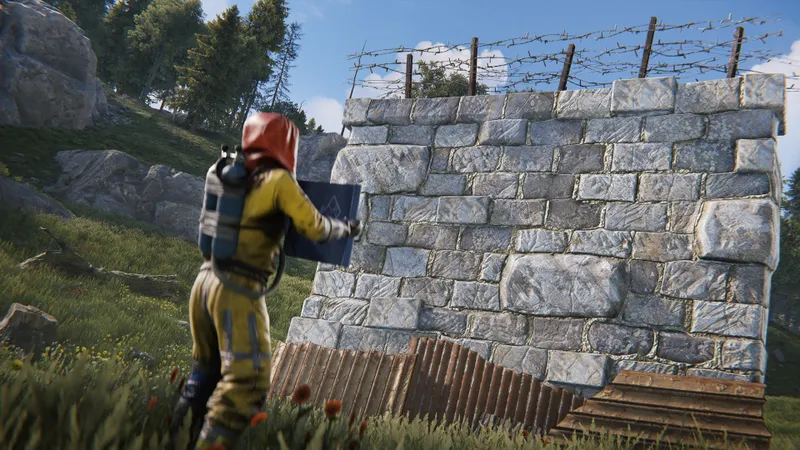
Since the Power Trip update on August 6, 2026, your compound is no longer free. High External Walls and Large External Gates now weigh on the upkeep bill of the Tool Cupboard, at a fixed rate of 20% of their building cost, every day.
Translated into resources: a perimeter of twenty walls and two gates swallows up roughly as much stone per day as a small, complete stone base. Five days after the forced wipe of August 6, the compounds slapped down in Thursday's euphoria are reaching the end of their first cupboard fill, and the bill is about to come due this week.
Below, the piece-by-piece calculation, what it looks like on real perimeters, and the trade-offs to weigh before planting the next wall — because a high wall, once placed, can't be picked back up.
What Facepunch exactly changed
The official devblog is explicit about the intent: for as long as anyone can remember, players have locked down huge chunks of the map by spamming deployables — pillars, tool cupboards, high walls. Facepunch has therefore decided to make the perimeter cost something. High walls now get a fixed upkeep cost of 20%, a value deliberately placed in the middle of the range applied to building blocks, which runs from 10% for a small base to 33% for a very large one.
The nuance matters: your base pays a percentage that climbs with the number of blocks. Your high walls, on the other hand, pay 20% regardless of the size of the build next to them. A solo player with a 2x2 and thirty walls around it therefore pays, on their perimeter, double the rate applied to their base.
Until now, a high wall placed within the radius of a tool cupboard cost nothing at all and didn't decay: Corrosion Hour's item sheets still documented it that way not long ago. It's that free ride that's disappearing.
Facepunch cites two intended effects. First, to make external cupboards — those TCs set off to the side purely to legitimize a perimeter — a hassle: they now need to be filled, and often. Second, to clean up the map, since a compound whose owners have been raided will stop being fed and will eventually collapse on its own.
On community servers, the value can be controlled via an admin command, decay.high_wall_upkeep, set to 0.2 by default. If you play somewhere other than official servers, the question to ask staff is simple: what is this variable set to on your server?
The math: how much each piece costs per day
The 20% applies to the building cost. Here are the official recipes, taken from the French item sheets extracted from the game files:
- Wooden High External Wall: 4,000 Wood for 3 walls, roughly 1,333 Wood per wall (Workbench Level 1 required).
- Stone High External Wall: 4,000 Stone + 1 Metal Fragments... wait, actually as listed: 4,000 Stones + 1 Sheet Metal for 3 walls, roughly 1,333 Stone per wall (Workbench Level 2 required).
- Wooden Large External Gate: 3,000 Wood + 2 Gears for one gate.
- Stone Large External Gate: 3,000 Stone + 5 Gears for one gate.
| Element | Building cost (per unit) | Upkeep per day at 20% |
|---|---|---|
| Wooden High External Wall | ≈ 1,333 Wood | ≈ 267 Wood |
| Stone High External Wall | ≈ 1,333 Stone | ≈ 267 Stone |
| Wooden Large External Gate | 3,000 Wood | 600 Wood |
| Stone Large External Gate | 3,000 Stone | 600 Stone |
An honest clarification on these figures: Facepunch announces the rate, not the table. The values above are the direct conversion of the official upkeep cost. They match the measurements previously carried out by Corrosion Hour, which had measured the addition of a wall and then a gate on a test 2×2: 134 units per wall and 300 per gate, i.e. exactly the 10% tier. With the rate now fixed at 20%, these measurements are doubled.
Two practical lessons drawn from these same measurements: upkeep is deducted from the primary resource only — Wood or Stone — and not in Gears or Metal Sheets, which are only used for crafting. And the order of magnitude deserves to be laid out plainly: a high stone wall costs you nearly the build price of a brand-new Stone Wall (300 Stone) every single day. Every day.
What this looks like over a real perimeter
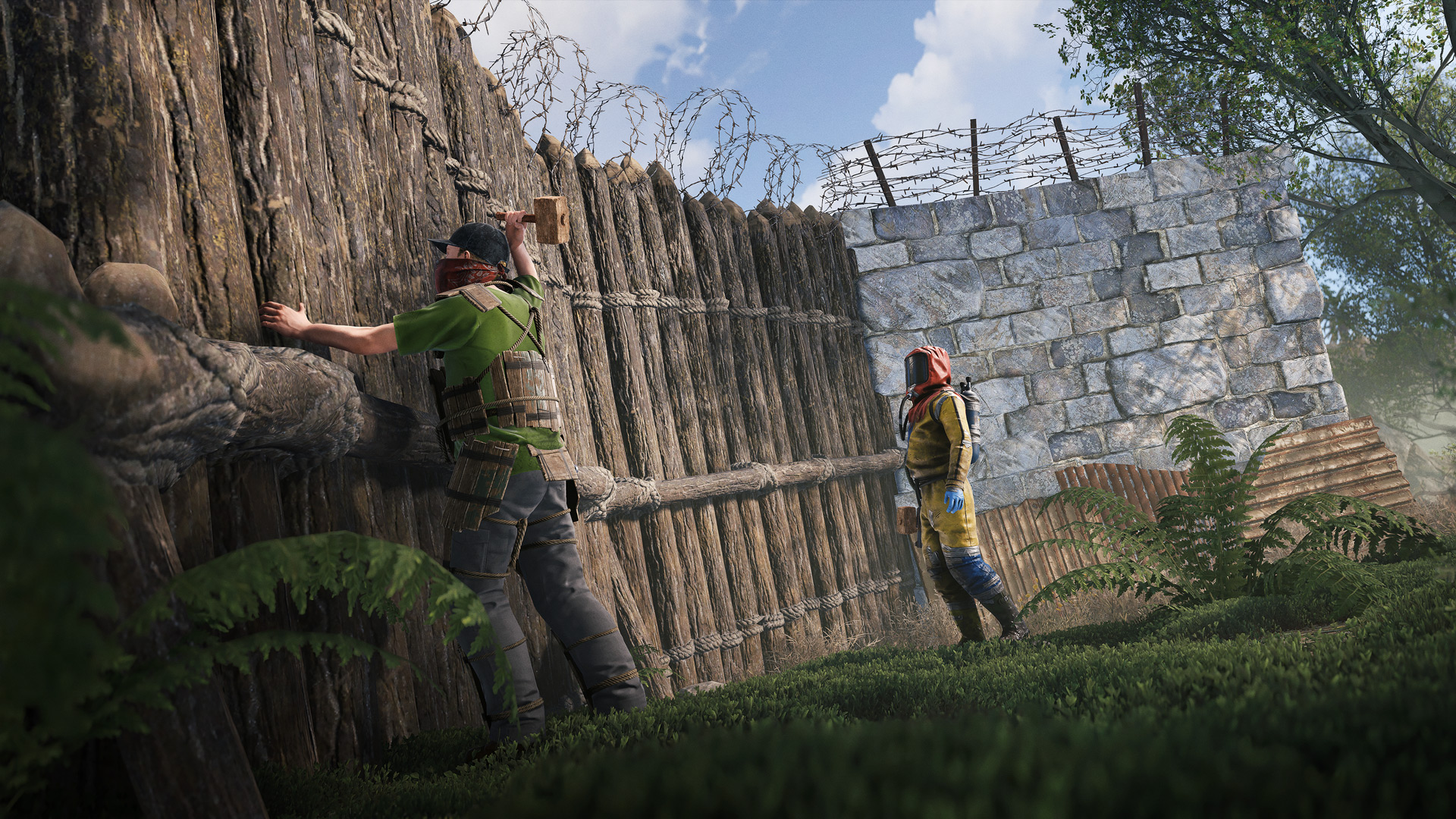
Count your walls, multiply, and compare to what you actually farm in one session:
- Small solo compound, 12 walls and 1 gate: roughly 3,800 Stone per day.
- Duo or trio compound, 24 walls and 2 gates: roughly 7,600 Stone per day.
- Large clan perimeter, 40 walls and 3 gates: roughly 12,500 Stone per day.
And these amounts come on top of the upkeep of the base itself, whose percentage already climbs with the number of blocks. On a large compound, the perimeter can end up costing more than the building it protects — which is precisely the intended effect.
The consequence for your routine: the tool cupboard consumes continuously, it doesn't charge everything at once at midnight. The stock you leave inside therefore needs to cover your offline time, not your playtime. A player who logs in for three hours a day needs to plan for twenty-four hours of coverage, not three.
External tool cupboards are no longer a free trick
The classic move was to place a secondary tool cupboard off to the side to cover a large perimeter without touching the main TC. Facepunch is explicitly targeting this practice: multiplying tool cupboards doesn't split the bill, it mainly multiplies the number of supply points you have to refill manually.
The alternative — keeping walls outside a cupboard's radius — doesn't work either. Outside of coverage, a high wall starts decaying after 8 hours in the open, losing 500 hit points. You stop paying, but you don't keep your wall either.
Wood or stone: with equal upkeep, the real deciding factor
Both versions have the same build cost, and therefore exactly the same daily upkeep. The choice doesn't come down to the bill, but to three points:
- Fire. Wood burns, stone doesn't. On a compound meant to last the whole wipe, stone remains the standard.
- Access to the blueprint. The high wooden wall is unlocked for 60 Scrap at the research table and can be crafted right from the tier 1 workbench; the stone version requires 120 Scrap and the tier 2 workbench, plus one Metal Sheet per batch of three.
- Repair. Restoring a nearly destroyed wall with a hammer costs up to 2,000 Wood for the wooden version, and 1,998 Stone plus 102 Metal Fragments for the stone version.
The high wooden wall therefore still has a real role: the temporary perimeter of the first forty-eight hours, the one you accept losing. Beyond that, it costs the same upkeep as a wall that won't go up in smoke.
Five habits to avoid emptying the cupboard for nothing
- Count before you place. Every wall removed from the plan saves roughly 267 units per day, for the entire duration of the wipe.
- Tighten the perimeter. A compound that hugs the base's walls costs half as much as a compound that swallows up the hill. The blocking wall placed "just in case" now costs you every single day.
- Know that a high wall can't be picked back up. The hammer only allows you to demolish it within ten minutes of placement, with the cupboard's authorization. After that window, you need explosives or you simply have to abandon it. The mistake is then paid for in upkeep, until the end of the month.
- Keep your stocks separate. The cupboard's Stones aren't the same as the workbench's. On a stone compound, set aside a dedicated crate for TC resupply and don't dip into it for crafting.
- Check the variable on your server. On community servers,
decay.high_wall_upkeepmay have been lowered, or even set to zero: in that case, all the calculations in this article change completely.
The other budget line of the compound: the turret at 25 High Quality Metal
The same update raised the cost of the Auto Turret, which goes from 10 to 25 High Quality Metal, on top of which you still need a Targeting Computer and a CCTV Camera. A compound defended by four turrets therefore requires 100 High Quality Metal, compared to 40 before August 6th.
The trade-off is clear: a shorter perimeter with two well-placed turrets costs noticeably less, both in upkeep and in high quality metal, than a large, poorly covered perimeter. The sprawling thirty-five-wall compound with a single turret at the entrance has, since Thursday, become the worst cost-to-protection ratio in the game.
What this will change on the map this week
The next visible effect isn't in your cupboard, it's on the map. Compounds whose owners were raided on Thursday or Friday are no longer being fed: their walls will decay and, one by one, free up the access points and spots they were blocking. Old blocking walls planted across a road or against a monument are, likewise, on a countdown.
Two things to do before the end of the week, then. Go back over the orphaned perimeters in your area to grab the base spots that are opening up. And above all, get the hammer back out at your own place to actually count the walls you're maintaining: on most compounds thrown together in a hurry last Thursday, a third of them aren't protecting anything.
Share this article
Facing these new upkeep costs, what will your strategy be?
Frequently asked questions
How much exactly does a high stone wall cost per day?
About 267 Stone per day. A stone gate costs you 600. Multiply that by the total number of pieces in your perimeter to get your daily bill.
Can external cupboards split the upkeep cost?
No. Stacking more Tool Cupboards doesn't reduce the total bill for the perimeter, it just creates more points that need manual restocking. That was exactly the effect Facepunch was going for — to break this trick.
Can I remove a badly placed high wall?
Only within the 10 minutes following its placement, with authorization from the Tool Cupboard. After that, only explosives work, or you have to abandon it and pay its upkeep until the end of the wipe.
Wood or stone for the perimeter, which one to choose?
Daily upkeep is identical. Stone resists fire and lasts the whole wipe, wood burns but is easier to unlock early — it's mostly a matter of timing and intent.
How do I stockpile enough resources for the Cupboard to last 24 hours?
The Cupboard draws resources continuously, not all at once at midnight. You need to plan for your full offline time, not just your play hours. Also separate your stockpiles: set up a box dedicated to the TC so you don't dip into it while crafting.
Key takeaways
- High external walls and gates now cost 20% of their build value every day, with no exception for size
- A stone wall costs you around 267 Stone per day, a gate 600 — multiply that by your entire perimeter
- External cupboards are no longer free: stacking more of them doesn't split the bill, it just creates more points to refill manually
- A placed high wall can only be removed within the first 10 minutes; after that, explosives are your only option
- Wood and stone cost the same in upkeep; the real choice comes down to fire resistance and blueprint access
Comments
No comments yet. Be the first to react!
Leave a comment
Similar guides




Latest articles








Your opinion counts
Rate Rust
Click a star to rate