

 Fabian Lainé
Areas
Minecraft 26.3: where to find the Amber Forest, the new autumn biome, and what to bring back from it
In brief
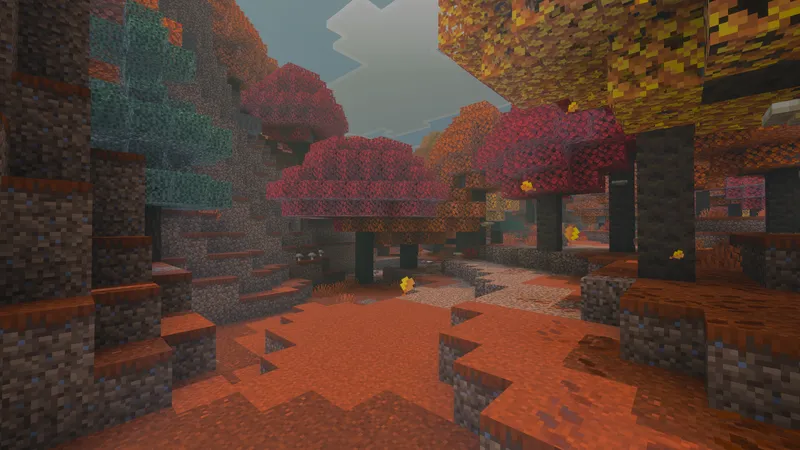
Amber Forest, the new autumn biome in Minecraft 26.3, generates near Plains and Ice Spikes thanks to its bright orange colors and near-black water. It provides poplar, a complete wood type with tri-colored leaves, and above all polypore, a mechanical mushroom that halves fall damage.
Minecraft's 26.3 update, the third game drop of the year, has been in public testing since June 23, 2026. Its seventh snapshot was released on August 4, and Mojang is still targeting the third quarter of 2026 for the final version. On the content side, everything revolves around a single structural addition: a new surface biome, with autumn colors, announced at the Minecraft Live on May 30, 2026.
This biome bears the English name dappled forest. In French, two labels have been circulating for two months — "forêt tachetée" from the French-speaking wiki, "forêt panachée" from part of the community press. Neither is the game's actual wording. In the fr_fr.json language file that the launcher downloads with snapshot 7, the biome's translation key reads "Forêt ambrée".
Here's how to find this Forêt ambrée, how to recognize it from a hundred blocks away, and above all what to bring back from it — because it contains far more than a pretty backdrop.
"Forêt ambrée": what the French client actually says
This point will shape all your online searches over the coming weeks. The official translation files shipped with snapshot 7 give Dappled Forest for dappled forest; the French-speaking wiki page, meanwhile, is still flagged as a conjectural translation.
The rest of the vocabulary, however, is stable and consistent with what you'll see in-game:
- Peuplier (Poplar) — the biome's tree, with its Poplar Log (Poplar Log) and its Poplar Leaves (Poplar Leaves) in red, orange, or yellow.
- Shelf Mushroom (Shelf Mushroom) — the flat fungus that grows on trunks (shelf mushroom). The term is drawn from actual mycology, not an invention.
- Red Shrub (Red Bush) — the small decorative undergrowth plant.
- Leaf Litter (Leaf Litter), Coarse Dirt (Barren Dirt), Brown Mushroom (Brown Mushroom) — blocks already present in the game, which the biome uses extensively.
Where to look for the Forêt ambrée: its neighbors give it away
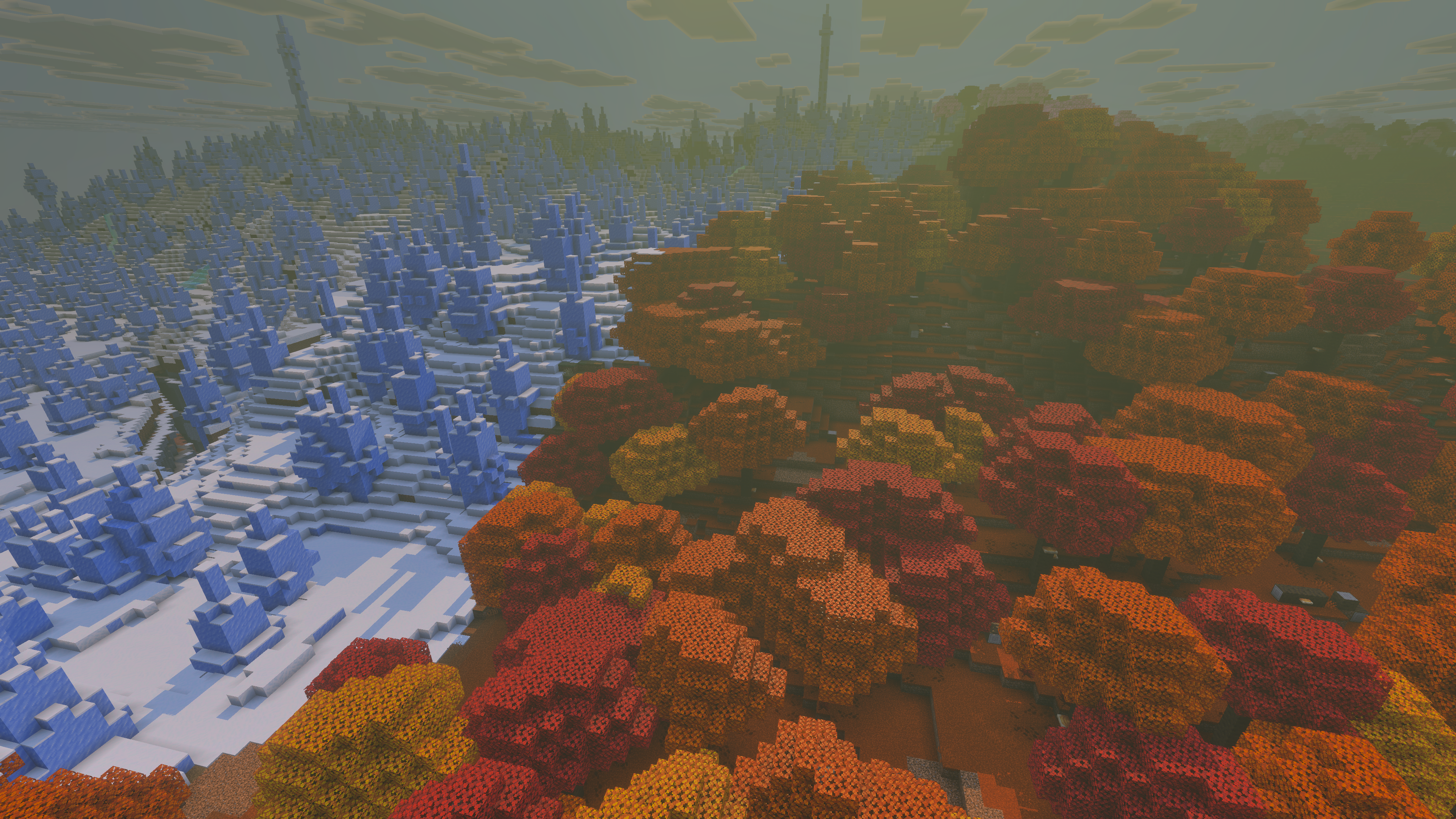
The Forêt ambrée generates in cold regions, with very low humidity, and at high values of the weirdness generation parameter — a term that is neither translated nor displayed in the client, but which governs the distribution of biome variants. This combination has a direct and very exploitable consequence: the biome never touches another forest biome. There's no point, then, in following spruce forests or taigas hoping to stumble upon it.
The biomes that actually border it are few:
- Plains and Sunflower Plains;
- Frozen Peaks (ice spikes);
- Cherry Grove.
It also readily appears on flat terrain near Windswept Gravelly Hills, along the coasts of a Cold Ocean, or at altitude close to Frozen Peaks. Another useful detail on the ground: it is often separated from Plains by a river or a mountain valley, which explains why you sometimes pass right by it without seeing it.
Its size is unpredictable: from a micro-biome of a few trees to a forest several hundred blocks wide. On-foot exploration will therefore miss the small occurrences; favor an elytra or scouting from a peak.
The command that saves you three hours of boating
If you're testing the snapshot in a scratch world, commands will save you a considerable amount of time. If the Commands option is enabled on the world, /locate biome minecraft:dappled_forest returns the coordinates of the nearest occurrence. The internal identifier remains dappled_forest: it's the displayed name that's translated, not the technical key.
In pure survival, first spot a large Plains or an Ice Spikes field, then follow its edge: that's where the biome slips in.
Spotting it from afar: three visual cues
The biome's graphical signature isn't limited to the color of the leaves.
- The grass is orange. The biome's tint is a saturated orange that applies to grass, low plants, and even sugar cane. Foliage tinted by the biome — a lone oak, an acacia — also turns bright orange.
- The water is almost black. It's the darkest and most opaque body of water in the game. An Amber Forest lake can be spotted from a distance just from that.
- Underwater fog is white and twice as dense as elsewhere — counterintuitive after such a dark surface, and worth keeping in mind before diving in.
One difference between editions deserves a warning: tree density is much higher on Bedrock than on Java. Enough, at times, that the ground stays in shadow and hostile mobs spawn in broad daylight. On Bedrock, you don't enter this biome bare-handed.
Poplar: a complete wood set, but a color you don't get to choose
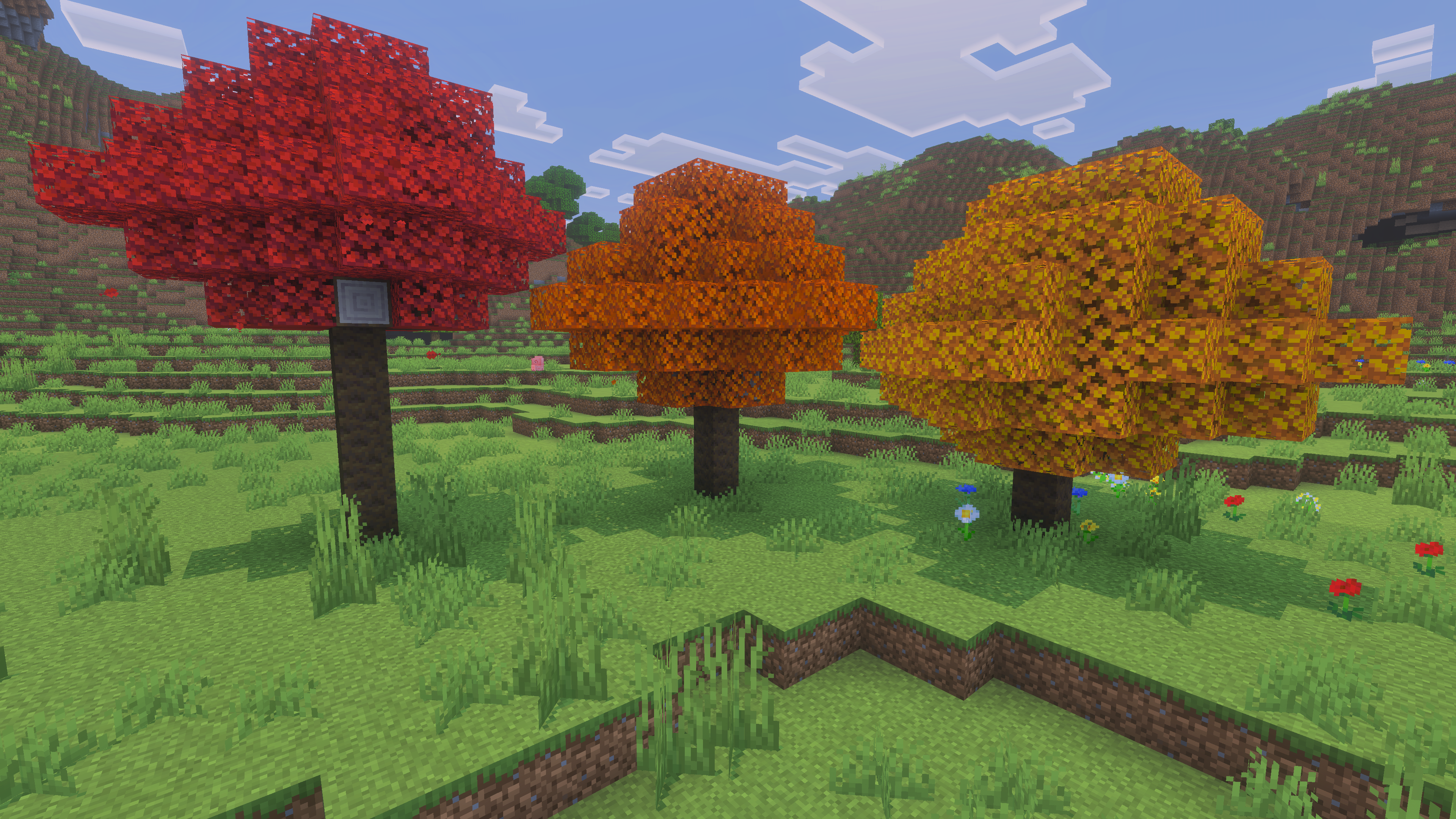
Poplar brings a complete light wood type, distinct from both cherry and pale oak:
| Category | Blocks and items |
|---|---|
| Base | Poplar Log, Stripped Poplar Log, Poplar Wood, Stripped Poplar Wood, Poplar Planks |
| Building | Poplar Stairs, Poplar Slab, Poplar Fence, Poplar Fence Gate, Poplar Door, Poplar Trapdoor |
| Mechanisms and storage | Poplar Button, Poplar Pressure Plate, Poplar Bookshelf |
| Signage and transport | Poplar Sign, Poplar Hanging Sign, Poplar Boat, Poplar Chest Boat |
| Plant life | Red, Orange, and Yellow Poplar Leaves, Poplar Sapling |
The trap for builders lies here: a Poplar Sapling gets its color at random among the three when it grows. There's no separate red, orange, or yellow sapling. If your project calls for twenty blocks of yellow leaves, don't rely on planting one: harvest the leaves directly from natural trees with Shears, which guarantees the color of the harvested block.
Otherwise, the sapling behaves like the others: a light level of at least 9, room above it, Bone Meal to speed things up, and a base of dirt, grass block, Coarse Dirt, podzol, mycelium, Rooted Dirt, moss, farmland, or mud.
One last point, very profitable early in a playthrough: fallen trees are more common with aspens than with any other tree species. Each felled trunk yields 4 to 7 logs that can be collected without an axe, and the stump is 75% covered in Vines. Free wood and vines, right at hand.
The Bracket Fungus: the block that cushions falls
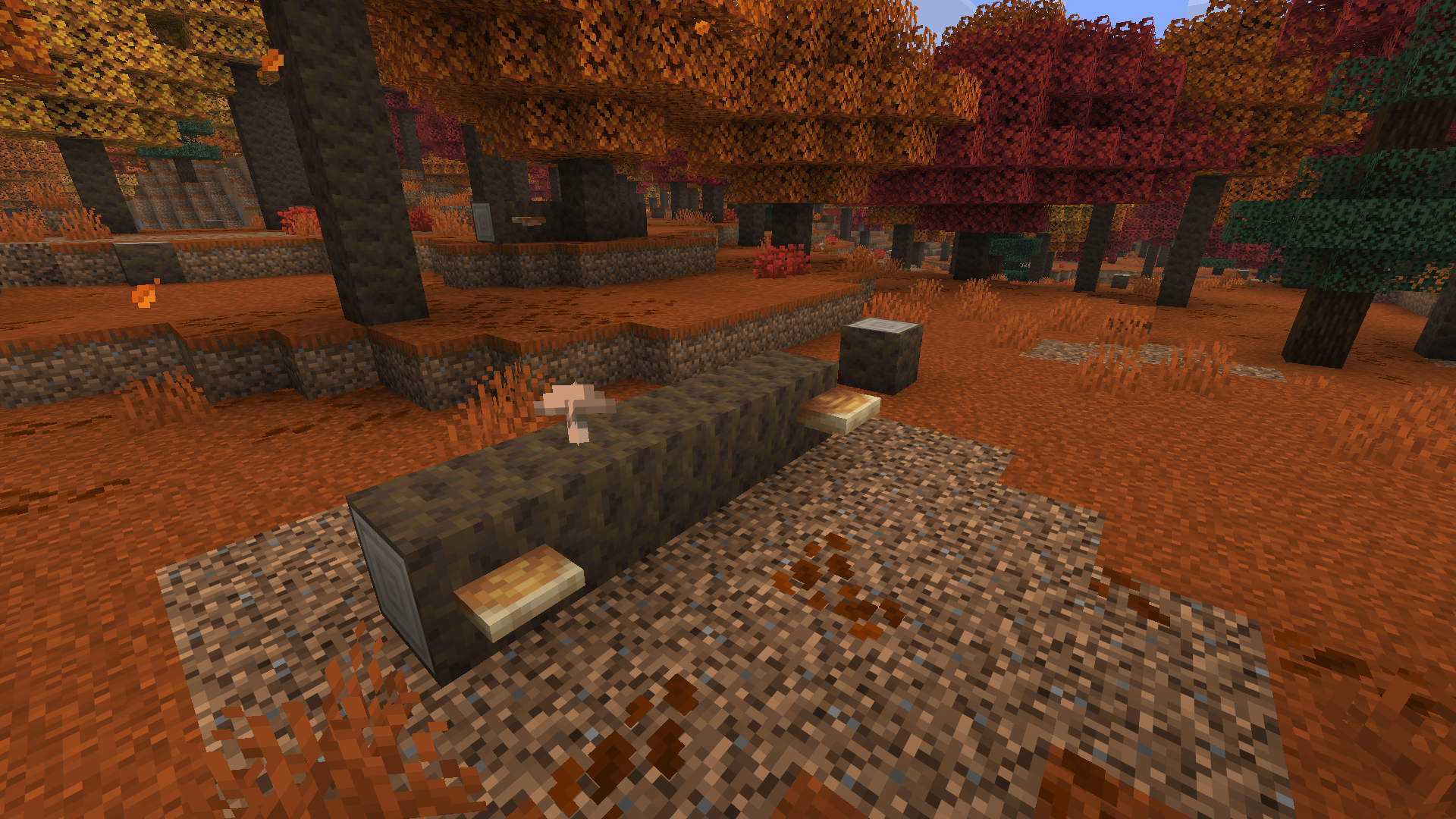
This is the biome's real mechanical surprise. The Bracket Fungus grows on all aspens, standing or fallen, in two sizes. It breaks instantly by hand and can always be harvested: the large version yields two.
Here's what you need to know to use it:
- Bounce. Any living entity that falls on it bounces back up to 75% of its fall height. As with a bed, fall damage isn't cancelled out, but the fall distance is reduced by 50%: you take half the normal damage. Enough to secure the base of a tall build or set up a course without slime blocks.
- No light requirement. Unlike red and brown mushrooms, the Bracket Fungus can be placed and survives on any full side face, regardless of lighting. For interior decoration, that's a freedom no other mushroom offers.
- Guided growth. Using Bone Meal on a small Bracket Fungus turns it into a large one. It never grows on its own.
- Composting. 65% chance to raise the composter by one level, i.e. roughly 5.94 Bone Meal per stack of 64.
- Trading. The Wandering Trader offers 3 for 1 Emerald. It's the only way to get some without setting foot in a Pale Garden... wait, an Amber Forest.
Red bush, leaf litter, and the rest of the ground
The Red Bush is purely decorative, but it has a property builders will make good use of: using Bone Meal on it grows another one on an adjacent block. So bringing just a single tuft home is enough to dress up an entire clearing. In the composter, it raises the level 30% of the time (roughly 2.75 Bone Meal per 64 units).
The ground also mixes Barren Dirt, Leaf Litter, and Brown Mushrooms, with a few fir trees breaking up the orange monotony. Two structures generate there: the Abandoned Camp and the Ruined Portal.
Wildlife: cold-climate variants without setting foot in the snow
Passive mob spawns in the Amber Forest, on Java, break down as follows: Sheep (weight 12), Chicken and Pig (10), Cow (8), Fox (8), and Rabbit (4), plus Bats and Glow Squids in the water.
The real interest lies elsewhere: farm animals appear there in their cold variant. Be careful, the client doesn't change their name — they're still called Chicken, Pig and Cow, only the texture differs. For a farmer who wants these skins without shipping to a snowy taiga, the biome becomes a handy resource.
On the hostile side, nothing exotic: Creepers, Skeletons, Spiders and Zombies dominate, with a few Endermen, some Witches and Zombie Villagers, and Slimes in slime chunks.
Playing it today, and one precaution
On Java, open the launcher, go to the Installations tab, create an installation by checking the option to show development versions, and select the most recent 26.3 snapshot; Mojang releases one per week, usually on Tuesday. On Bedrock, go through a Preview version of the 26.40 branch and enable the "2026 Update 3" experiment when creating the world.
The precaution here is far from theoretical: don't build anything permanent in a snapshot world. Terrain generation is still evolving from one test version to the next, and there's no guarantee that an Amber Forest spotted today will exist at the same coordinates in the final 26.3. Note the seed, do your palette tests, save a copy of your worlds — and save your real projects for the release.
One last word about your upcoming searches: the French guides published in June all talk about a "spotted forest". Their content remains valid, but it's "Amber Forest" that appears in-game — a label that could still change before the final version, like any string of text in a version under development.
Share this article
What will you prioritize looking for in the Amber Forest?
Frequently asked questions
How do you find the Amber Forest without commands?
Look for a large Plains or an Ice Spikes field, then follow its edge — the biome often slips in there. From the air on elytra, the visual contrast with the Ice Spikes and the black water makes it easy to spot.
Do poplar saplings keep their color as they grow?
No. A sapling gets its color at random when it grows up. To guarantee a specific shade, harvest the leaves directly from natural trees with shears.
Does polypore replace slime blocks for cushioning falls?
Partially. It reduces damage to 50% and bounces you back up to 75% of the height, like a bed, but without any light restrictions — ideal for decoration.
Can you get polypore without exploring an Amber Forest?
Yes, the Wandering Trader offers 3 for 1 Emerald, which is the only alternative.
Key takeaways
- Amber Forest is its official English name, not "speckled forest" or "variegated forest"
- It generates in cold terrain near Plains and Ice Spikes, never directly adjacent to another forest biome
- Poplar offers a complete wood set, but its leaves get their color at random — harvest with shears to control the shade
- Polypore bounces and reduces fall damage to 50%, with no light restrictions, useful for decoration as well as safety
Comments
No comments yet. Be the first to react!
Leave a comment
Similar guides
Latest articles




Your opinion counts
Rate Minecraft
Click a star to rate