



 Fabian Lainé

Crafting
Minecraft Wool Slabs & Cushions: Release Date and New Blocks
In brief
Snapshot 7 of Minecraft 26.3 wraps up the most generous decorative update in years: concrete stairs and slabs are finally available in all sixteen colors, along with cuttable wool, interactive cushions, consumable straw beds, and a complete autumn poplar set. Ready to test now on Java and Bedrock ahead of the official release planned for Q3 2026.
Released on Tuesday, August 4, the seventh snapshot of Minecraft version 26.3 closes out the list of new additions to the third drop of 2026 with a gift builders have been asking for since 2017: concrete stairs and slabs in all sixteen colors in the game. Add the wool cuts that arrived earlier in the cycle, the cushions, the straw bed, and the entire poplar wood set, and 26.3 stands out as the most generous update for decoration in years.
Everything below can be tested right now: on Java via snapshots (in a dedicated world copy, just to be safe), on Bedrock via the Minecraft Preview app with the drop's experimental features enabled. The official release is still slated for the third quarter of 2026, with no precise date as of this writing.
This guide covers the new construction- and decoration-oriented blocks and items: exact recipes, available colors, pitfalls to avoid — including a real change in cushion behavior around sculk introduced by snapshot 7 — and what you should be stocking in your chests today to be ready on release day.
Concrete: 32 cuts and over nine years of waiting
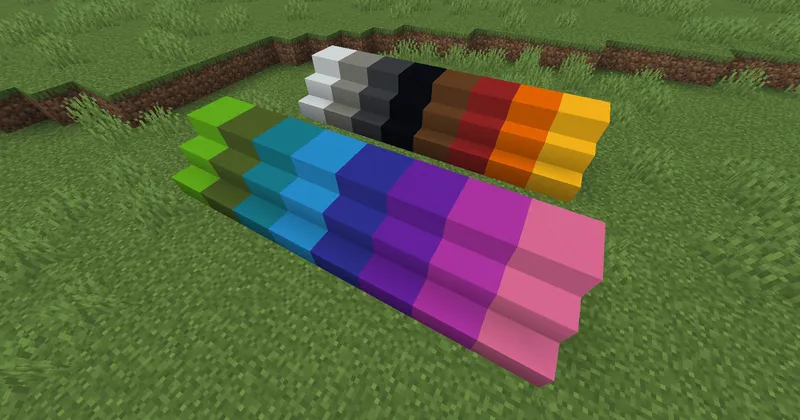
Concrete arrived in Minecraft with 1.12, in June 2017. It will have taken more than nine years for its stair and slab variants to see the light of day: snapshot 7 adds, all at once, 16 concrete stairs and 16 concrete slabs, one per color. The recipes follow the classic crafting table pattern:
- Concrete stairs: 6 concrete blocks of the same color arranged in a staircase pattern yield 4 stairs;
- Concrete slab: 3 concrete blocks aligned in a row yield 6 slabs.
Warning: no stonecutter. Unlike the usual mineral blocks, concrete does not go through the stonecutter in this snapshot. This difference isn't trivial for stairs: at the stonecutter, one block yields one stair, whereas at the crafting table six blocks only yield four. So plan for about a third more raw material than you're used to with stone or copper.
The production pipeline itself doesn't change: 4 sand + 4 gravel + 1 dye yield 8 concrete powder, which then needs to be solidified on contact with water. One important point: the cutting recipes only accept hardened concrete, not the powder. Solidify first, cut afterward — an automatic solidifying station (powder pushed by a piston against a water source) really comes in handy here.
In terms of uses, these 32 blocks finally unlock flat roofs with cornices, contrasting baseboards, colorful outdoor stairs, and half-height gradients that made modded palettes so well regarded. Since concrete remains the block with the most uniform look in the game, its slabs work particularly well for modern builds and patterned floors.
Wool also gets cut variants: slabs, stairs… and cushions
Arriving earlier in the 26.3 snapshot cycle, wool slabs and wool stairs round out the batch: here too, sixteen colors for each shape, for a total of 64 new cuts across the entire drop when counting concrete as well. Wool slabs are crafted like any other slab, 3 wool blocks of the same color for 6 slabs. The recipe for wool stairs, however, had not yet been documented on the French-language wiki at the time of writing: the final changelog should settle the matter.
What's it for? Everything wool carpet couldn't do: plush amphitheater-style tiered seating, corner sofas, colorful thatched roofs, extra bedding on bunk beds. A common-sense reminder all the same: wool burns. Keep your textile furnishings away from fireplaces, torches placed too low and, obviously, lava.
The cushion, the game's first real seat
The wool slab isn't just a building block: it's the ingredient for the cushion, the true decor star of this 26.3. A single wool slab yields a cushion of the matching color, and applying dye to an existing cushion lets you retint it without having to remake it. Sixteen colors, a quarter-block in height, no collision: place it on a flat surface and, for the first time in the game's history without needing a boat or a mount, you can sit down with a simple interaction click.
Snapshot 7, however, quietly fixed its behavior: placing, breaking or using a cushion is no longer silent to sculk and now triggers vibrations. If you were planning on furnishing a living room above an Ancient City or sitting quietly near a sculk sensor, that's over: the cushion is once again just an object like any other to the ears of Wardens and sensors. Something to factor into your raiding plans as well as your vibration-detecting redstone circuits.
The straw bed, the explorer's consumable
The straw bed is the other comfort addition in 26.3, and its item design is clever: 3 hay bales yield 4 beds, which stack up to 16 in the inventory. You sleep in it just like in a normal bed to pass the night and keep Phantoms away, with two major differences: it's single-use — it disappears when you wake up — and it doesn't set your respawn point.
This is precisely what makes it the ideal expedition item. When traveling toward a distant structure, sleeping in a regular bed overwrites your respawn point and, should you die later in your adventure, condemns you to returning to the middle of nowhere. The straw bed removes this dilemma: the night passes, and your respawn point stays safely tucked away at base. Even a modest wheat farm can churn them out — 9 wheat per hay bale, 3 bales per batch of 4 beds — and they can also be found naturally in the tents of abandoned camps, the new flagship structure of this drop.
Explorer maps: snapshot 7's quiet overhaul
Less visible than a block, but just as structurally important: explorer maps become true standalone items, each with their own icon per destination, instead of simply being renamed maps. Six new types make their appearance in abandoned camp loot and lead to other camps, ancient cities, mineshafts, desert pyramids or warm ocean ruins — their final English labels have not yet been published by Mojang.
Two rule changes come along with the overhaul: explorer maps and treasure maps can no longer be zoomed out on the cartography table, and the player icon now permanently shows the direction they're facing. One last adjustment to know before heading out to raid: in camp chests, firework rockets have been replaced with gunpowder. Don't count on these structures to restock on elytra flight anymore — but with paper, converting it back remains trivial: 1 paper and 1 gunpowder yield 3 rockets.
The autumn palette: poplar, shelves and bracket fungi
Impossible to talk decor without mentioning the pale garden, the new biome that generates near cold regions. There you'll find pale oaks and their leaves in three autumn shades (red, orange, yellow), red bushes, piles of leaves on the ground, brown mushrooms and shelf fungi, small and large, clinging to trunks.
Pale oak arrives with a full set: log and stripped wood, planks, stairs, slab, door, trapdoor, fence, fence gate, button, pressure plate, standard and hanging signs, bookshelf and boat, with or without chest. Its light tone makes it an excellent contrasting wood against the new dark concrete cuts, and the harvested shelf fungi fit perfectly as wall decorations on a rustic facade.
What to stock up on right now for the big day
26.3 is expected before the end of the quarter, and snapshot 7 is presented as the final test phase: this is the right time to prepare your survival save rather than suffer a shortage on release day. Three worthwhile projects to tackle this weekend:
- Sand, gravel, dyes: every concrete block consumes them, and the new cuts are going to send your needs skyrocketing — an Efficiency shovel plus a trip to the desert or a river is enough to build up a serious stockpile;
- A sheep farm for every color: wool slabs, stairs, and especially tufted rugs come in sixteen shades; a color-coded pen with automatic shears will save you hours of manual dyeing;
- Wheat in bulk: between hay bales for straw beds and trading with farmer villagers, wheat is once again an adventurer's resource, not just a cook's.
Add a chest of paper and gunpowder for fireworks, keep a spot in the map room for the new maps that can't be zoomed out, and you'll head into the third drop of 2026 as a forward-thinking builder rather than a rushed looter.
Share this article
Which 26.3 decorative block will you prioritize using in your builds?
Frequently asked questions
Why does concrete take more raw material than stone for stairs?
The classic crafting table converts 6 concrete blocks into 4 stairs, compared to 1 block into 1 stair with the stonecutter. There's no stonecutter recipe for concrete in this snapshot, so you'll need to factor in a third more raw material in your production calculations.
Does the cushion keep my respawn point like a regular bed?
No, the cushion is just a comfortable seat and doesn't change your spawn. To sleep and set your respawn point, you still need a regular bed.
What's the advantage of the straw bed over a regular bed?
The straw bed doesn't set your respawn point and disappears after one night, making it ideal for exploration. You can sleep through the night without losing your main spawn, and you can craft them in bulk using hay.
Does the cushion now make noise around sculk?
Yes, snapshot 7 quietly changed the cushion's behavior: placing, breaking, or using a cushion now triggers vibrations detectable by Wardens and sculk sensors.
What does the poplar bring that's new?
It's a complete wood type with autumn leaves (red, orange, yellow), and its light tint makes it excellent for contrasting with dark concrete. It comes with the full classic set: stairs, slabs, doors, bookshelves, boat, and more.
Key takeaways
- Concrete waited nine years for its stairs and slabs, which require about a third more raw material compared to the stonecutter.
- Cushions are the game's first true seat, but beware: snapshot 7 makes them detectable by sculk.
- The straw bed doesn't set your respawn point and disappears after use, making it the perfect gear for long-distance exploration.
- Wool, stairs, slabs, cushions: sixty-four new soft material cuts finally transform the look of interiors.
- Exploration maps become standalone items with dedicated icons and can no longer be zoomed out.
Comments
No comments yet. Be the first to react!
Leave a comment
Similar guides


Latest articles







Your opinion counts
Rate Minecraft
Click a star to rate