



 Fabian Lainé

Full Guide
Minecraft Sulfur Caves: Y Level & Where to Find Them
In brief
Sulfur Caves are arriving with Chaos Cubed (26.2 / 26.30): a spectacular underground biome populated by Sulfur Cubes, dotted with unpredictable geysers and acid pools. This guide explains where to dig, how to farm these strange creatures, and how to survive the sulfurous traps.
Since June 16, 2026, the Chaos Cubed update (Java Edition 26.2 and Bedrock Edition 26.30) has landed on all Minecraft platforms. On the menu: a brand-new underground biome, the Sulfur Caves, home to a creature as strange as it is harmless, the Sulfur Cube. Between acid pools, unpredictable geysers and blocks in tangy yellow-green hues, this drop upends life underground. Here's the complete guide to finding, exploiting and surviving this new biome.

Sulfur Caves: a standout underground biome
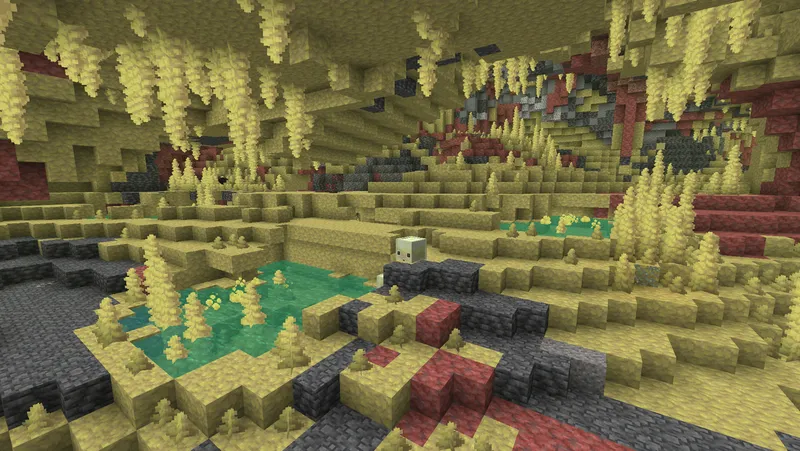
The Sulfur Caves are a new cave biome that generates exclusively in the Overworld, below the surface. The biome immediately stands out from classic gray-stone caves: the floor and walls blend the bright yellow of sulfur with the deep red of cinnabar, while acid-green pools and sulfur spikes (stalactites and stalagmites) dot the landscape. Everything is bathed in soft light, generated by clusters of glow lichen clinging to the ceilings.
Unlike classic caves, the wildlife here is distinctive. This is notably the first biome where cave spiders spawn naturally, without a spawner, replacing standard spiders. They slip between the cinnabar pillars, evoking old memories of mineshafts.
Chaos Cubed is the first drop to offer such a visually rich underground biome since the arrival of the Lush Caves and Dripstone Caves in 2021. The chromatic contrast between sulfur and cinnabar makes it one of the most recognizable biomes in the game.
Where to find the sulfur caves
Sulfur caves generate at the same altitudes as lush caves and dripstone caves, roughly between Y=64 and Y=-64 in the Overworld. They are rarer beneath oceans, hills and mountains, and favor plains and forest regions. No generation occurs in the Nether or the End.
- Dimension: Overworld only
- Typical altitude range: Y=64 to Y=-64
- Surface clues: since Chaos Cubed, sulfur outcrops can break through to the surface, forming small yellow deposits visible while exploring
- Sound cues: the distant rumble of geysers and the characteristic plop of sulfurous bubbles give away the biome's presence
Tip: dig a scouting tunnel at Y=0, then follow any seepage of yellow light or any sharp ochre-colored stalactite. A simple iron pickaxe is more than enough for exploration.
The Sulfur Cube: a fascinating passive mob
The star of the drop, the Sulfur Cube is a passive mob that will never attack you, even if you strike first. It moves in small random hops and can climb a one-block height without jumping. It comes in two sizes:
- Large cube: 8 health points, splits into two small cubes upon death (unless the enemy dies from its own explosion)
- Small cube: 4 health points, does not split and drops nothing
The great originality of the sulfur cube is its ability to absorb a whole block into its body. Once fed, it becomes immobile and adopts the properties of the swallowed block: bouncy if it has engulfed wool, slippery on ice, explosive if it has ingested TNT, burning if it has absorbed a magma block... The official wiki lists 13 possible behavior archetypes (bouncy, sticky, high_resistance, explosive, hot, fast_sliding, slow_flat, etc.).
The sulfur cube is the first mob in Minecraft whose defensive and offensive stats depend entirely on the player's inventory. Giving it TNT radically changes the situation: it becomes a walking bomb that can devastate an entire base.
New blocks: sulfur, cinnabar and sulfur spikes
Chaos Cubed adds two complete sets of decorative blocks, perfect for builders:
- Sulfur: a bright yellow raw block, available as polished sulfur, sulfur bricks, chiseled sulfur, slabs, stairs and walls
- Cinnabar: a deep red block, with the same variants (polished, bricks, chiseled, slabs, stairs, walls)
- Sulfur spikes: the equivalent of stalactite/stalagmite spikes, but made of sulfur — they deal contact damage
- Potent sulfur: a concentrated form of sulfur, generated underwater, dangerous (see below)
In terms of tools, sulfur requires a wooden pickaxe or better to be mined, and stacks up to 64. A couple of polished sulfur blocks are enough to launch an ambitious decorative project: the saturated colors finally do justice to the industrial or volcanic atmospheres the community has been asking for for years.
Sulfur springs, geysers and toxic gas
Sulfur Springs are rare structures that appear within the biome. They bring together shallow pools, magma blocks and, above all, submerged potent sulfur. The latter releases a foul-smelling gas that contaminates the surrounding water: any player or creature wading through affected water suffers the Nausea effect. This effect remains temporary, but its distorting screen can throw you off at the worst possible moment.
Geysers are the other spectacular addition. These columns of water erupt at random intervals, roughly every 45 seconds, and vertically launch all entities standing above them. Another important detail: sculk sensors detect their activation, which opens the door to highly creative redstone mechanisms (automatic doors, elevators, traps).
- Danger 1: potent sulfur gas → Nausea
- Danger 2: magma blocks from hot springs → fire damage
- Danger 3: unpredictable geysers → fatal fall if you land badly
- Danger 4: venomous spiders that swarm the area
Farming, transmutation and better weapons
Since sulfur cubes are passive, they can easily be captured with a bucket, just like axolotls, thanks to the new Sulfur Cube Bucket item. This is the safest way to bring them back alive to your base to build a farm.
Once there, the farming principle relies on transmutation:
- Attract or capture several sulfur cubes
- Feed the small cubes with slimeballs: they grow in about 20 minutes
- Show them a specific block to make them absorb the desired property (wool to bounce, ice to slide, TNT to explode...)
- Recover the absorbed block by killing the large cube — each large cube killed also drops 1 to 2 experience points
For the combat part, keep this golden rule in mind: a cube without an absorbed block dies to any weapon. However, once it has absorbed a block, it gains massive resistance to melee attacks, projectiles, explosions, falls, freezing and poison. The best approaches then remain:
- Fire: flint and steel, a sword with Fire Aspect, or simply a block of lava placed under the cube
- Suffocation: trap the cube in sand or gravel
- Wither effect: wither skulls, a poison sword won't work
- Warden's Sonic Boom: pierces through all resistances
Note: contrary to what some snapshot leaks announced, no official brewing recipe based on sulfur has been added to Chaos Cubed. Sulfur remains for now a building material, although Mojang hints that brewing will evolve in the next drop. The Nausea effect therefore remains only accessible through the environmental gases of potent sulfur.
What Chaos Cubed brings as a bonus
Beyond the biome, Chaos Cubed includes several cross-cutting additions long awaited by players:
- Built-in Friends List for Java Edition, a historic first for the PC version
- Experimental Vulkan support, a modern graphics API meant to eventually replace OpenGL
- A new Bounce music disc and five original tracks added to the soundtrack
- Sculk sensors that react to geysers, opening the door to new automation setups
To go further
Chaos Cubed lays the groundwork for a new underground ecosystem that Mojang promises to expand in upcoming drops. If you want to dig deeper:
- The official wiki's French page details all the generation and associated blocks
- The article Chaos Cubed Update on Minecraft.net presents Mojang's vision
- The Minecraft-France guide on Sulfur Caves compiles interesting seeds
- Our article on the best Chaos Cubed seeds to quickly find sulfur sources is in the works on playnews.gg
With its mischievous cubes, explosive geysers and acid-green waters, Chaos Cubed is probably the most fun update to Minecraft since Trails and Tales. Happy diving, and watch out for the gases.
Share this article
Will you use Sulfur Cubes as a defense system or as decorative creatures?
Frequently asked questions
How do I quickly find a Sulfur Cave?
Dig a scouting tunnel at Y=0 and look for any leaking yellow light or ochre stalactite. Otherwise, listen for the distant rumble of geysers or the distinctive plop of bubbles. Sulfur outcrops on the surface since Chaos Cubed are also great clues.
Can the Sulfur Cube actually kill me?
On its own, never — it's a passive mob that will never attack you. But once fed a TNT block, it becomes a walking bomb capable of wrecking your base. And the venomous spiders swarming the biome can blow up in your face.
What's the best way to kill a loaded Sulfur Cube?
Fire (a sword with Fire Aspect or a lava block) or suffocation (trap it in sand). Poison attacks will fail, but the Warden's Sonic Boom cuts through all resistances. Avoid projectiles and direct explosives — they're too resistant.
How do I build an efficient Sulfur Cube farm?
Capture them with a bucket, feed the small cubes slimeballs (20 minutes to grow), then present the block you want them to absorb. Kill the grown cube to recover the block and the experience.
Is there a brewing recipe with sulfur?
No, despite rumors from the snapshots. Sulfur remains purely decorative for now. Mojang promises that brewing will evolve in the next patch, so be patient.
Key takeaways
- Sulfur Caves generate between Y=64 and Y=-64, mostly beneath plains and forests, with outcrops visible on the surface since the patch.
- The Sulfur Cube absorbs an entire block and gains its properties (bouncy, explosive, burning) — a revolutionary mob whose behavior depends entirely on what it eats.
- Three major dangers: potent sulfur gases cause Nausea, geysers launch you vertically at random intervals, and venomous spiders swarm without a spawner.
- Farm the cubes by capturing the small ones with a bucket, feeding them slimeballs, then presenting them with the block you want them to absorb.
- Sulfur and cinnabar finally offer saturated decorative blocks for builders who were waiting for industrial or volcanic vibes.
Comments
No comments yet. Be the first to react!
Leave a comment
Similar guides



Latest articles








Your opinion counts
Rate Minecraft
Click a star to rate