



 Fabian Lainé

Full Guide
Minecraft 26.2 Chaos Cubed: Mastering Ominous Trial Chambers — Vaults, Mace and Breeze Rod (2026)
In brief
Minecraft 1.21's Trial Chambers remain the most profitable early-game structure thanks to their dense loot and exclusive items like the Heavy Core and the Mace. This guide covers their location, the full anatomy of the rooms, the spawner mechanics, and above all mastering Ominous Trial mode to maximize your rewards.
Trial Chambers aren't the novelty they once were when they first appeared, but two years after their addition to the game, they remain the most profitable early-game structure: dense loot, predictable mobs, and above all two items that exist nowhere else — the Heavy Core and the Mace. With Minecraft 26.2 "Chaos Cubed", Mojang has rebalanced the pacing of spawners, corridor generation, and the variety of chest ornamentation. Here's a complete guide to turning a Trial Chamber run into a profitable and safe expedition, from underground scouting to crafting an enchanted Mace.

Trial Chambers: what Chaos Cubed changed
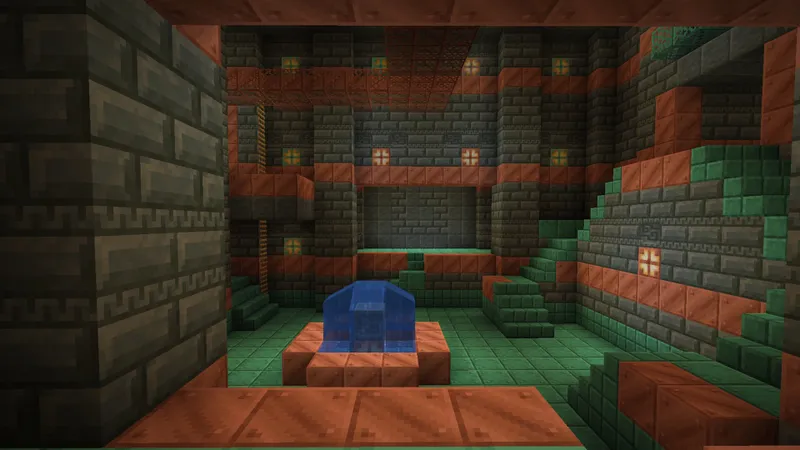
The basic structure hasn't changed: you're still facing a procedural maze made of chiseled tuff and waxed copper bulbs, lit by waxed copper bulbs. What has evolved in 26.2 is the density. Corridors now contain more decorated pots hiding supplementary resources (arrows, string, emeralds, apples), intersections more often feature a secondary Trial, and the spawn rate of a second Vault per combat room has been slightly increased according to post-patch community feedback.
In practical terms: if you haven't set foot in a Trial Chamber in a year, the pacing will feel tenser — waves come in less quickly but mobs hit a touch harder, and Bogged now appear in groups of three more regularly. Bring full diamond armor, ideally enchanted with Protection IV, along with an up-to-date shield.
How to spot a Trial Chamber underground
Trial Chambers generate between Y = -40 and Y = 30, with a marked preference for the -20 to 0 range. They spawn almost exclusively in deep Overworld biomes, including under shallow oceans. Three visual signs never lie:
- A chiseled tuff corridor that suddenly opens into a cave: this is almost always the side entrance to a Trial Chamber.
- A waxed copper bulb visible in a gravel or stone wall: the signature of a room's ceiling.
- Rows of decorated pots lined up: you're in a corridor, and the spawn room is less than twenty blocks away.
The most effective method remains descending to the bottom of a lush cave or a deep ravine, then digging a horizontal exploratory tunnel at Y = -15. Alongside this, an explorer map bought from a villager cartographer can point toward an Ancient City or a Ruined Portal; these structures often share their geological pocket with a nearby Trial Chamber.

Anatomy of a Trial Chamber: trials, corridors, intersections
A Trial Chamber is made up of three structural building blocks that combine randomly with each generation:
- Trial rooms: this is where the Trial Spawners live. Each room contains at least one spawner, often two, with a dedicated Vault and Ominous Vault. You'll frequently find a raised pattern on the floor representing the room's themed mob (spider, skeleton, Breeze).
- Corridors: narrow passages, often trapped (falling sand blocks, arrow dispensers, tripwire blocks hidden under moss). Every other broken pot offers a mini-loot.
- Intersections: three- or four-way crossroads. Two of the three intersection types carry a bonus Ominous Vault, often overlooked because it goes unnoticed.
The goal of a run: map out the entire structure before breaking the first spawner. You'll want to avoid falling back into an activated area without a potion ready.
Trial Spawner: mechanics, cooldown, rewards
The Trial Spawner remains the core of the system. When a player enters its detection radius (14 blocks, direct line of sight required), it activates and spawns a series of mob waves whose composition depends on the room: Baby Zombies, Husks, Strays, Bogged, Cave Spiders, Silverfish, Slimes and of course the Breeze. The spawn rate scales with the number of players present within a nearby radius: solo, expect three to five mobs simultaneously at most.
Once the wave is defeated, the spawner ejects a Trial Key. Each player who contributed receives their own key — it's individually instanced, so there's no scrambling between teammates. The spawner then enters a thirty real-time minute cooldown. Keep this in mind: if you clear out the whole Trial Chamber and then leave too quickly, you could potentially miss out on a second free harvest.
| Spawner state | Visual signal | Possible action |
|---|---|---|
| Inactive | Dull gray face, no particles | Approach to trigger |
| Active | Orange flame, mobs spawning | Fight successive waves |
| Ejection | Glowing face, key popping out | Pick up the Trial Key |
| Depleted | Dim bluish face | Wait out the 30-minute cooldown |
Switching to Ominous Trial: Bad Omen, Ominous Bottle, and Trial Omen
The Ominous Trial mode is what really makes a Trial Chamber's profitability take off. The principle: when a player carrying the Bad Omen effect enters a spawner's radius, the effect automatically converts into Trial Omen, and all the spawners and vaults in the room switch to their ominous variant.
Three ways to obtain the Bad Omen effect:
- Kill a pillager captain carrying its ominous banner at a Pillager Outpost or during a wild patrol.
- Drink an Ominous Bottle obtained from a regular Trial Chamber Vault (the most common loot).
- Use a specific armor trim combined with looting — a marginal method, reserved for rush runs.
The Ominous Bottle remains the cleanest route: it stacks up to five levels, each additional level increasing the difficulty of the waves while boosting the loot. In 26.2, the correspondence table was confirmed by the community:
| Trial Omen Level | Mobs per wave (solo) | Ominous Vault bonus loot |
|---|---|---|
| I | 3 to 4 | Standard ominous loot |
| II | 4 to 5 | +1 "rare" roll |
| III | 5 to 6 | +1 "unique" roll |
| IV | 6 to 7, equipped mobs | Increased chance of Heavy Core |
| V | 7 to 8, enemy enchantments | Maximum loot, guaranteed drop of an enchanted item |
Worth keeping in reserve: from level IV onward, stock up on plenty of arrows and a Redstone block to quickly reopen a defensive door system if you get cornered.

The Ominous Vault: exclusive loot and Heavy Core
An Ominous Vault can only be opened with an Ominous Trial Key — the oxidized copper version engraved with three skulls, which only drops from an ominous spawner. Each player can only open a given vault once, so contribution is individual: bring three friends along, and each of you will walk away with a full roll.
Loot from the Ominous Vault includes:
- Two to five stacks of items per opening (emeralds, iron and copper ingots, enchanted golden apples, spectral arrows, rare armor trims).
- A chance at a Heavy Core, estimated at around 7.5% per opening — this is the only source of Heavy Core in the game.
- A decent chance at a rare music disc, notably the one from the Breeze spawn room, which sells for a lot among friends.
- Exclusive armor trims, several of which can't be found anywhere else (the "Flow" and "Bolt" patterns).
In terms of numbers: for an average Trial Chamber with six to eight Ominous Vaults, the expected chance of getting a Heavy Core reaches around 45%. In other words, clear out two Ominous Chambers and you're almost guaranteed to walk away with one.
Crafting the Mace: Breeze Rod and Heavy Core
The Mace remains the most devastating weapon in the game against isolated targets — under the right conditions. It's crafted at a simple crafting table with a Breeze Rod (obtained by killing a Breeze, guaranteed 1x drop) placed above a Heavy Core. No other materials, no smithing table required.
Its signature mechanic: each block of fall distance before the hit adds a massive damage increase, along with a critical bonus and a ground impact shockwave. Three enchantments to know by heart:
| Enchantment | Effect | Recommendation |
|---|---|---|
| Density (V) | +0.5 damage per fall block and per level | Absolute priority in PvE |
| Breach (IV) | Ignores part of the enemy's armor | Essential in PvP |
| Wind Burst (III) | Launches the player back into the air on ground impact | Aerial combo, mobility and chaining attacks |
| Smite (V) | Bonus damage against undead | Solid addition for raids and the Nether |
The "Density V + Wind Burst III" combination is the current solo meta: you jump, you hit, Wind Burst launches you back into the air, and you chain a second, boosted strike. The Wither and the Ender Dragon go down in half the time compared to a diamond sword enchanted with Sharpness V.
Optimal solo exploration order
A profitable run always follows the same sequence:
- Silent mapping: explore the entire Trial Chamber without activating a single spawner. Mark every room, every chest, every intersection. A discreet torch every eight blocks is enough.
- Emptying the standard chests: collect the Ominous Bottles, potions, arrows, ropes. You want at least one Ominous Bottle before activating anything.
- Drinking the Bottle: in the corridor before the first confrontation room, never in the room itself — the Bad Omen effect must convert into Trial Omen upon entering the area.
- Chaining the rooms: activate the ominous spawners, take the waves, collect the Ominous Trial Keys, open the designated Ominous Vaults.
- Retreat and cooldown: once the Chamber is cleared, place a bed at the entrance. Thirty minutes later, come back for a second standard run (without the Bottle) and collect the regular Keys that will open the non-ominous Vaults.
Common mistakes that ruin the run

- Drinking the Ominous Bottle inside the room: if you're already within range of the spawner, the effect doesn't convert properly and you lose the ominous bonus on that spawner.
- Breaking decorated pots without a dedicated tool: in 26.2, patterned decorated pots have a chance of containing a rare pottery pattern. Break them with your bare hands, never with an efficiency pickaxe, so you don't miss the animation and a rare drop.
- Neglecting intersection Vaults: two of the three intersection types carry a hidden Ominous Vault. Many players leave thinking they've opened everything — go back through each corridor sideways.
- Fighting the Breeze in melee: the Wind Charge it throws knocks you back and strips all your momentum. Use an angled bow, or bounce its charges back with a Mace already in play.
- Forgetting the bed: night doesn't happen inside a Chamber, but a spawn point is essential if you die. A bed plus an Angle Compass at the entrance can save hours of progress.
Conclusion: setting up the weekly routine
Once you've got the mechanic down, Trial Chambers work like a weekly dungeon. Spot three or four within 500 blocks of your base, memorize their coordinates, then set up a rotation: an ominous run in the first, cooldown, a standard run in the second, and so on. In one afternoon, you'll come home with two or three Heavy Cores, a crafted Mace, a stock of Ominous Bottles for the coming week, and enough exclusive pottery patterns to decorate a full set of forge gear. It's now the most rewarding gear-farming gameplay loop in the mid-game — and 26.2 Chaos Cubed has made it noticeably smoother than at its initial release.
Share this article
In Trial Chambers, do you prioritize hunting for the Heavy Core or maxing out your loot with armor trims?
Frequently asked questions
How can I quickly spot a Trial Chamber underground?
Three visual clues never lie: a tuff brick corridor opening into a cave, a waxed copper bulb visible in a wall, or aligned decorative pots. The most effective method is still to dig a horizontal exploration tunnel at Y = -15 at the bottom of a deep cave.
What's the difference between a regular Trial Key and an Ominous Trial Key?
The regular Key opens ordinary Vaults and is grey in color. The Ominous Key (oxidized copper with three skulls) only drops from spawners in Ominous Trial mode and exclusively opens Ominous Vaults, which contain the Heavy Core and rare armor trims.
How do I activate Ominous Trial mode?
Get the Bad Omen effect by killing a pillager captain, then drink an Ominous Bottle found in a regular Vault. When you enter the radius of a spawner while carrying this effect, all spawners and vaults in the room switch to their ominous variant.
How many Heavy Cores can I expect from fully clearing two Ominous Trial Chambers?
Each Ominous Vault offers roughly a 7.5% chance of a Heavy Core. An average Trial Chamber has six to eight Vaults, so across two Chambers you're almost guaranteed to walk away with at least one.
What gear should I bring before heading into a level V Ominous Trial Chamber?
Full diamond armor with at least Protection IV, an up-to-date shield, plenty of arrows, and regenerating food. From level IV onward, mobs are equipped and the waves speed up: also bring some Redstone to reopen a defense system if you get cornered.
Key takeaways
- Trial Chambers generate between Y = -40 and Y = 30: look for tuff brick corridors or waxed copper bulbs in the walls.
- Each spawner in Ominous Trial mode drops an Ominous Trial Key that opens exclusive Vaults with a 7.5% chance of a Heavy Core.
- The Ominous Trial is triggered with an Ominous Bottle (obtained in a regular Trial Chamber): it stacks up to five levels, each level increasing the difficulty and the loot.
- Wait out the thirty-minute cooldown before heading back in: a Trial Chamber can be visited twice without leaving the activated area.
- The Heavy Core only exists in Ominous Vaults, a mandatory stop for crafting the enchanted Mace.
Comments
No comments yet. Be the first to react!
Leave a comment
Similar guides





Latest articles








Your opinion counts
Rate Minecraft
Click a star to rate