



 Fabian Lainé
Full Guide
Diablo 4 Season 14: the Personal Loot Mode (PLM) guide, the official Solo Self-Found
In brief
Season 14 finally welcomes the Self-Found Loot mode, the official SSF that fans had been asking for. Only activatable at character creation and locked for the duration of the season, this mode isolates you from player trading but leaves you access to almost all the content, including the core loop. The new deterministic mythic mechanic finally makes this mode viable.
The trade-free solo mode that part of the community had been demanding for years has been in Diablo IV since June 30, 2026, and almost nobody calls it by its name. On French-speaking forums, you'll read "SSF," "Solo Self-Found," sometimes "solo autotrouvé." In the French client, Blizzard named it mode Butin personnel, shortened to MBP. It's that label, and that one only, that you need to look for on the character creation screen.
The detail that costs players dearly: MBP can't be turned on partway through. It's checked at creation, it applies for the entire Season of the Awakened Dead, and it can't be removed. No already-leveled seasonal character can be switched into it.
What remains to be seen is what this mode truly forbids — the list is shorter than you'd think —, what it doesn't touch at all, and why Season 14 is probably the least hostile window to solo play that Diablo IV has opened so far.
The five rules of Personal Loot mode
The contract fits in five lines in Blizzard's official documentation, and there's nothing else to negotiate:
- An MBP character must be seasonal. It can be Normal or Hardcore, your choice.
- It can neither join a party nor trade with other player characters.
- It shares its stash, currency, Paragon, and the rest of its progress only with the account's other MBP characters.
- The free trial, local co-op mode, and the Dark Citadel are closed to it.
- The status is permanent for the duration of the season and cannot be changed.
This last line comes with a trade-off that many overlook: at the end of the season, an MBP character reverts to being a perfectly ordinary Eternal character, regaining the right to party up and trade like any other. The trade-off is therefore time-limited. You're not condemning a character forever, you're accepting a restriction for the length of a season, and you then get back a standard Eternal character with everything it has farmed.
Where to enable MBP, and how to recognize it
There's no hidden menu or NPC to visit: the mode is enabled from the character creation screen, in the same place as the choice of seasonal realm and Hardcore mode. An MBP character is then identified by a dedicated icon, including in your friends list — the display of this icon was actually the subject of a fix in patch 3.1.1, rolled out on July 14, 2026.
In other words, the decision takes ten seconds, before you've even hit a single monster, and it commits you for several weeks. That's why it's worth knowing exactly what you're giving up.
The MBP stash: a parallel economy, not a bonus
The most misunderstood rule is the one about sharing. Your MBP characters do pool their stash, currency, and Paragon, but only among themselves. In practice, this creates a third economy on your account, alongside that of the Eternal realm and that of the standard seasonal realm. Nothing you've accumulated on your other Season 14 characters crosses that boundary.
This has two direct consequences. First, your paragon progression starts from zero in this bubble: don't expect to keep the glyph levels of your usual seasonal character. Second, and this is the upside, leveling a second SSF character isn't a total loss: it draws from the same stash and the same gold pool as the first. A second SSF character therefore acts as a mule and a second farming safety net, which partly offsets the lack of trading.
What's actually locked
The list of restrictions is short, but not painless.
The Dark Citadel is the real sacrifice: it's co-op content designed for multiple players, and it's simply unavailable in SSF. All rewards tied to it are cut out of your season. If your goal for the summer was to finish this activity, SSF is incompatible with that plan, and there's no workaround.
Local co-op also disappears, which effectively rules out couch sessions on console. The free trial isn't available either: the class trial windows that Blizzard opens from time to time — the Necromancer's, from June 30 to July 7, was the most recent one — don't apply to an SSF character.
That said, the official wording is precise and worth reading closely: the restriction covers trading with other player characters. Vendors, the blacksmith, the Occultist, and the Jeweler aren't players. Selling, repairing, enchanting, extracting a Legendary power, spending your obols: all of that remains normal. SSF cuts off commerce between humans, not crafting.
What remains open: almost the entire season
This is the point the "solo" label obscures. Nothing in the rules takes you out of the shared realm. You still run into other players in Sanctuary, see their spells landing on the same packs, and take part in the same public events. SSF isn't an offline mode: it stops you from joining their group and trading with them, not from existing alongside them.
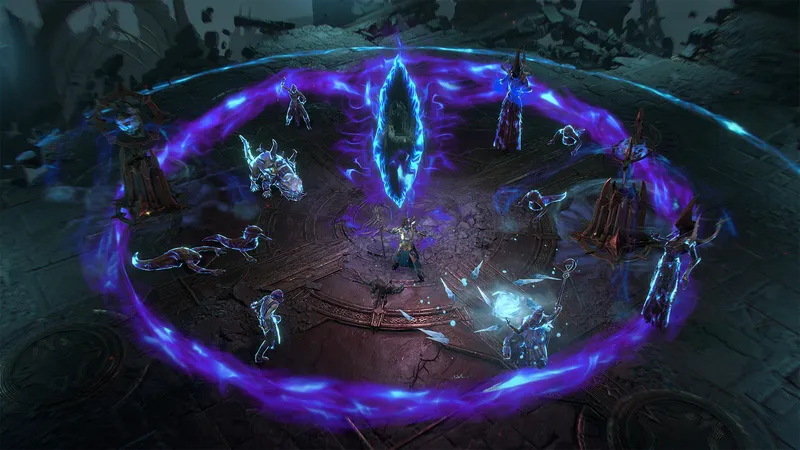
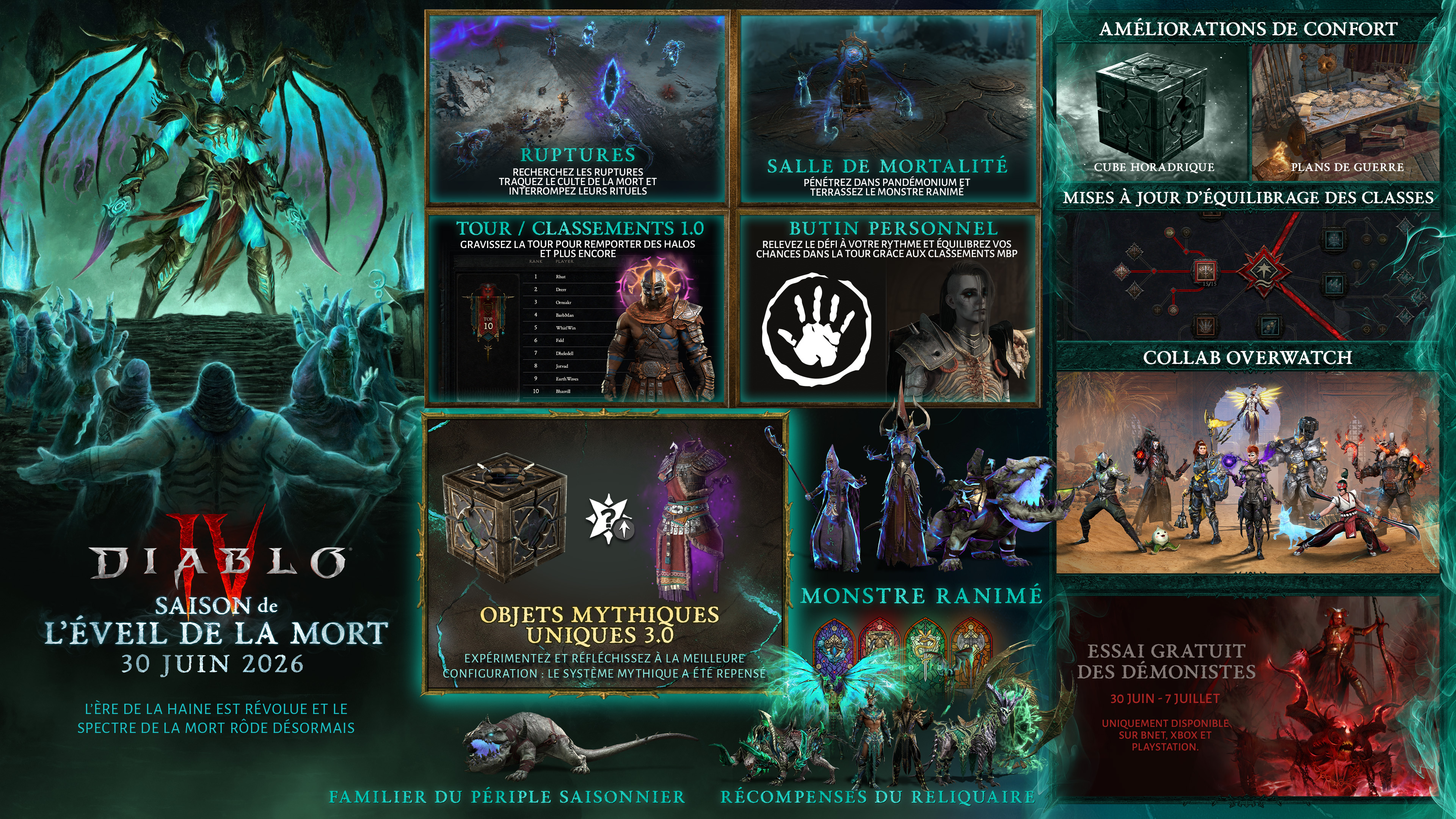
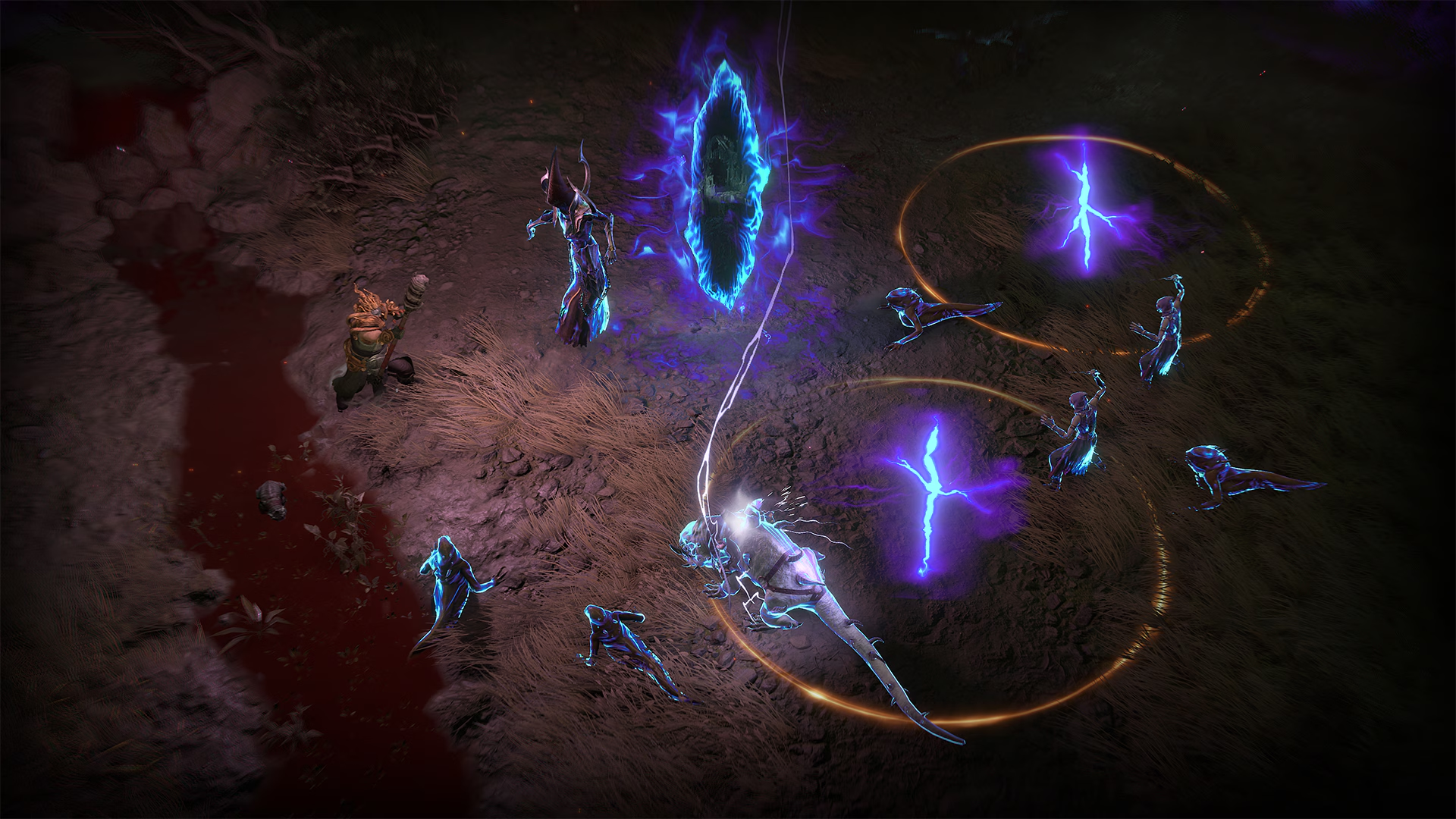
Above all, the seasonal loop of the Awakening of Death is entirely doable solo. Pandemonium Breaches, in their three formats — regular breaches, Surging Breaches, and Colossal Breaches, the latter only appearing in the Ravaged Wilds, southeast of Zarbinzet — require no group. The World Walkers summoned afterward, the Mortality Room that opens when you take them down, the Corrupted Reaper at the threshold of Pandemonium: none of this requires company.
Why Season 14 is the best window for a solo run
The heaviest argument against self-found play in Diablo IV has long been the same one: without trading, the rarest items stayed out of reach. Season 14 knocks down this argument, because it has made the chain for Mythic Unique items largely deterministic.
Since patch 3.1.0, "mythic" is no longer a rarity but a quality that you apply: any unique item can be turned into a mythic unique item, at the Horadric Cube or at the Jeweler. The Cube recipe consumes Pandemonium Fragments, the seasonal currency; the Jeweler's recipe requires Distilled Fear and runes. You need to be level 70 and playing on Torment difficulty for the recipe to appear.
Now these fragments come from sources you fully control solo: the seasonal reputation board, distilled caches, and the seasonal Headhunt boss. The Tormented Reaper is even, according to Blizzard, the activity that offers the best chances of dropping a mythic unique item and fragments directly. And progressing through seasonal ranks hands out unique mythic caches containing a mythic specific to your class.
Two practical points to avoid disappointment. Stygian Stones, essential for opening Headhunt boss treasures from Torment I onward, are farmed mainly in the Realm of Fright: that's your main bottleneck in Solo Self-Found, so plan your sessions around it. And you can only equip one crafted mythic unique item at a time; mythics found as loot or in caches, on the other hand, are not limited. So choose carefully which piece you craft, since it's a one-time token.
Solo Self-Found leaderboards: two ladders just for you
SSF brings no in-game advantage. Its only structural reward is the dedicated leaderboards that Season 14 added to the Tower: Solo Self-Found and Solo Self-Found Hardcore, separate from the general leaderboards.
This is a detail that's far from trivial, because the Tower precisely left beta this season and now hands out real rewards based on the best rank reached — an ornamental halo, a prestige title, an equipment cache, with tiers starting from the top 1,000 of any leaderboard. A leaderboard populated only by SSF players is mechanically less crowded than your class's general leaderboard. For a decent but non-competitive player, aiming for a reward tier there is significantly more realistic than elsewhere.
Starting on August 10, is it still worth it?
The season started on June 30 and Blizzard has not announced any end date. Circulating estimates point to the second half of September, but they're based on timers read in the client, not on an official announcement: treat them as such. So you have, in all likelihood, about five weeks ahead of you — plenty of time to level up a character, reach Torment, and craft your mythic, but much tighter for pushing a leaderboard to the top.
One last element worth factoring into the decision: the patch notes for the 3.2.0 Public Test Realm, live from August 4 to 11, make no mention anywhere of Solo Self-Found mode. Blizzard has explicitly kept part of Season 15's content out of the test for BlizzCon, so this absence proves nothing. But it doesn't guarantee anything either: there's currently nothing confirming that SSF will return as-is next season.
The checklist before you commit
Three questions to settle before creating your character. Are you sticking to the Dark Citadel this season? If so, forget about SFP, that's the one clear-cut incompatibility. Were you planning to rely on your seasonal character's already leveled glyphs? They won't carry over, so plan on redoing that work. Finally, is your goal a leaderboard placement or a gameplay experience? In the first case, the SFP leaderboard is a rare opportunity; in the second, the constraint is its own reward.
The rest comes down to the usual self-found discipline: prioritizing deterministic sources over the loot lottery, maintaining a second SFP character as a reserve of gold and materials, and accepting that the pace will be slower. In Season 14, that slowness is finally offset by a crafting system that gives you control over the game's most powerful items — which wasn't true a year ago.
Share this article
Are you going to try a Self-Found Loot run this season?
Frequently asked questions
Can I change my mind after creating a Self-Found Loot character?
No, it's locked for the entire season. However, once the season ends, your character reverts to a regular Eternal character that can group up and trade normally, along with all the loot it accumulated.
Can I trade with other players?
Not with players, but yes with vendors, the blacksmith, the occultist, and the Jeweler. The trading ban only applies to other humans, not to crafting.
Do I have to play offline or solo?
No, you stay in the shared world and can encounter other players. Self-Found Loot mode prevents you from joining their group, not from existing alongside them in Sanctuary.
Can I get mythic items without a group?
Yes, that's the big new feature of Season 14. Mythics are now deterministically craftable at the Horadric Cube or the Jeweler by consuming seasonal fragments that you farm entirely solo, notably through the Realm of Mortality and the reputation board.
What does my character lose if I put it in Self-Found Loot mode?
You no longer have access to the Dark Citadel or local co-op, and free class trials don't apply. All the rest of the seasonal content, including Helltide events, remains open.
Key takeaways
- Self-Found Loot mode is activated at character creation and remains unchangeable for the entire season, but your character reverts to a regular Eternal character once the season ends.
- You lose access to the Dark Citadel, local co-op, and free class trials, but crafting, vendors, and Helltide events remain fully accessible.
- Your stash, gold, and Paragon points form a parallel economy: a second Self-Found Loot character draws from the same loot pool without being a total loss.
- Mythic unique items are no longer random but craftable at the Horadric Cube or the Jeweler thanks to seasonal fragments you farm solo.
Comments
No comments yet. Be the first to react!
Leave a comment
Similar guides




Latest articles








Your opinion counts
Rate Diablo IV
Click a star to rate