

 Fabian Lainé
Map
Counter-Strike 2: the guide to Fachwerk, the community map everyone bans — layout, sites and callouts
In brief
Fachwerk is CS2's most banned community map simply because nobody has bothered to learn it. Yet its dense geometry and short angles create a massive opportunity to climb the ranks: mastering three smokes and two defensive positions is enough to dominate a queue where almost everyone avoids it.
Valve pushed an update to Counter-Strike 2 on August 12 that takes just two lines to summarize: Fachwerk and Shelter have been updated to match their latest version published on the Workshop. It's a small thing, but it highlights something the French-speaking community has largely ignored: since it entered the pool with the Season 5 update, Fachwerk has been playable in Competitive, Casual, and Deathmatch — and it remains the most systematically banned map of the bunch, simply because nobody has taken the time to learn it.
This is a ranking opportunity, not a cosmetic detail. Here's what you need to stop suffering through it.
What Fachwerk is, and why it doesn't look like the others
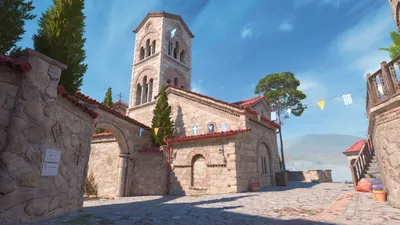
Fachwerk is a community map that joined the official rotation with the Season 5 update in July. The setting is a small German tourist town in autumn: half-timbered houses, cobblestone streets, golden foliage. Hence the name — Fachwerk is precisely the German word for half-timbering.
Structurally, it's orthodox: two bomb sites, a mid connecting the two, a classic defuse layout. What sets it apart is the density of its architecture. Where Mirage or Dust 2 offer long, clean sightlines, Fachwerk strings together doorways, archways, and narrow alleys. The chokepoints aren't defined by solid walls but by openings carved into the buildings.
Three immediate consequences follow:
- Angles are short. Duels are won on positioning and the first shot, not on spray control over a long burst.
- Utility counts double. A single well-placed smoke on an archway can shut down an entire rotation. The flip side is that a missed smoke does nothing at all: there's no area wide enough for a rough placement to still be useful.
- Sound travels differently. Cobblestone corridors and wooden interiors don't produce the same echo, and audio information is more usable here than elsewhere.
Mid decides everything
As on most two-site maps, mid is the area that grants access to both rotations. On Fachwerk, this general rule is especially brutal: the geometry means that losing mid doesn't just cost you an option — it locks you onto whichever site you're holding.
Two landmarks structure this area and have become the standard callouts:
- Tent — the market tent set up in the center. It's the visual anchor point of mid, and it's also a trap: several community reports indicate that the angle on the terrorist side snags grenades. A utility thrown a bit short dies there.
- Well — the decorative well, used as a positioning and grenade line-up marker.
- Mid Connector — the passage linking mid to A site.
An honest caveat: Fachwerk's callouts aren't fully settled yet. The map is recent, it isn't in Active Duty, and position names still shift from team to team. The ones listed above are the most commonly used, and they circulate in English — as is the case across all CS2 maps, including among French-speaking teams. Don't expect an official French glossary: none exists, and making one up will lose your teammates faster than a bad smoke placement ever could.
Terrorist side: play slow, not fast
The natural instinct on an unfamiliar map is to rush in. On Fachwerk, that's the costliest mistake you can make.
The narrow openings mean that the attacker who enters an arcade first always shows up in a predictable frame. A well-positioned defender doesn't need to aim wide: they only have a rectangle to watch. A quick execute without utility, on this map, amounts to handing over free kills.
The plan that works comes down to three steps:
- Take control of mid as a five-man, without forcing it. You're not looking for a kill, you're looking for information and space. Mid opens up both sites: it's this threat that forces the defense to work.
- Smoke the arcades, not the corridors. On a built-up map like this, it's the openings that need to be blinded. A smoke in a wide corridor cuts off nothing.
- Enter stacked and under cover. Short angles favor whoever arrives in numbers on a tight space. Staggering as a single player, so effective elsewhere, gets punished here.
Counter-terrorist side: hold in depth
Defense on Fachwerk relies on one simple idea: never hold an angle right from the opening itself. Since the attacker knows exactly where you'll be if you hug the door, back off two or three meters. You lose a bit of field of view, but you gain the split second where the entry has to search for you in the room instead of finding you framed in the doorway.
Second principle: invest in molotovs. On a map where chokepoints are tight, a well-placed fire doesn't just deal damage, it physically blocks an entry for several seconds — enough time for a full rotation from the other site.
Third principle: don't rotate on a sound alone. The wooden interiors carry sound in misleading ways, and Fachwerk is particularly prone to false audio cues. Wait for visual confirmation or an actual contact.
What the August 12 update changed
Nothing spectacular, and that's precisely the point. The patch notes state an update to the map based on its latest published version on the Workshop, with no further detail. This is the normal routine for community maps: the author keeps fixing them on their end, and Valve syncs periodically.
The August 3 patch, meanwhile, brought a general fix that directly affects play on Fachwerk: grenades could be thrown through the map's geometry. If you had learned any throws before that date, double-check them: some no longer go through.
Should you learn it now?
Yes, and for a matter of cold calculation. Fachwerk isn't in Active Duty: it won't help you in tournaments. But it's in the Competitive, Casual, and Deathmatch pools, and it gets banned en masse simply out of unfamiliarity.
In a queue where almost nobody knows the map, knowing three correct smokes on the mid arcades and two deep defensive positions is enough to create a clear edge. It's the best time-invested-to-points-gained ratio in the current pool — noticeably better than a hundredth hour spent polishing a lineup on Mirage.
Start with a Deathmatch session to learn the geography, then two or three casual games while precisely spotting where the openings are. In one evening, you'll know more than the vast majority of players you'll come across.
Share this article
Are you learning Fachwerk now to get the edge, or banning it calmly along with everyone else?
Frequently asked questions
Why is Fachwerk so heavily banned if it's in the official rotation?
Because it's not in Active Duty and the community hasn't taken the time to learn it. But it's still playable in Competitive, Casual, and Deathmatch — it's a ranking goldmine for anyone who learns it before everyone else.
What's the attack plan that actually works on Fachwerk?
Take mid as a five-stack without forcing it just for information, smoke the arcades precisely (not the corridors), then push together and under cover. The narrow angles punish mistimed pushes and fast rushes without utility.
How do you defend well on this map?
Hold in depth: pull back two or three meters from the openings instead of hugging the door, invest in molotovs to deny passages, and don't rotate off a single sound — audio is deceptively far-carrying on Fachwerk.
Did the August 3rd patch change anything for grenade throws?
Yes, grenades no longer pass through the map's geometry. If you had lineups memorized before that date, some of them no longer work — double-check them.
How long does it take to get good at Fachwerk?
One evening: a Deathmatch session to learn the layout, then two or three casual matches scouting the openings. Three solid smokes and two defensive positions are already enough to create a clear edge.
Key takeaways
- Duels are decided by positioning and the first shot, not spray control — the angles are too short for long bursts.
- On the terrorist side, slowness and precise utility crush speed: rushing the narrow arcades without a smoke means handing out free frags.
- On the counter-terrorist side, hold two meters back from the openings and make heavy use of molotovs to physically deny passages.
- Mid decides everything on Fachwerk: losing it locks you into a single site and makes rotations nearly impossible.
- A single evening of Deathmatch and casual matches is enough to know more than 95% of the players you'll face.
Comments
No comments yet. Be the first to react!
Leave a comment
Similar guides
Latest articles


Your opinion counts
Rate Counter-Strike 2
Click a star to rate