

 Fabian Lainé
Tips
Counter-Strike 2: surviving the C4 explosion — the July 2026 damage rework and the positioning principles that save you
In brief
The C4 explosion was completely reworked on July 8, 2026: the blast wave now originates from the center, no longer passes through walls, dissipates around corners, and no longer reaches certain areas beyond a sufficient distance. Survival becomes positional and learnable, with the health bar preview as the main tool to adjust your retreat in real time.
Round lost, bomb planted, ten seconds on the clock: until this summer, the question of falling back barely arose. Wherever you were on the map, the C4 explosion could reach you, and the damage calculation largely ignored what stood between you and the site. The July 8, 2026 update, which opened Season 5 of Premier mode, changed everything: Valve redesigned the range and spread of explosion damage on all official maps in defuse mode.
The consequence can be summed up in one sentence: surviving the explosion has become positional. The blast wave (the term used in Valve's official notes) now radiates from the center instead of being applied as a single block, it doesn't pass through walls, and it dissipates around corners. On July 9, Valve removed the one-point damage floor that this first version still applied across the entire map: far enough away, the explosion now does nothing at all. A well-positioned player survives today where they would have died six weeks ago.
A caveat: Valve does not publish any damage-by-distance chart. The thresholds circulating in the community are player estimates, with no official status. This guide describes a mechanic and positioning, not a table of numbers.
Damage is no longer calculated live: it's precomputed and baked into the map
The technical note from July 8 explains the rest. Explosion damage is now applied according to precomputed simulation values baked into the compiled map: each level's geometry — walls, corners, doorways, elevation changes — is accounted for once and for all, and the server simply reads the result when the bomb goes off.
Two consequences follow. The behavior is perfectly reproducible, and therefore learnable: a spot that saves you will save you the next round too. And there is no universal distance rule, since each map carries its own explosion mapping — a fallback distance that's enough on Inferno means nothing as a reference on Mirage. Valve, moreover, limits its announcement to official maps in defuse mode, saying nothing about community maps.
The wave radiates from the center and takes a moment to reach you
Second building block: the wave expands rapidly from the center instead of being applied instantaneously. This isn't cosmetic — a wave that propagates can be stopped by what it encounters, whereas instant damage cannot. This is what makes credible the two rules Valve stated at the launch of Season 5: the wave doesn't pass through walls and dissipates around corners.
However, Valve doesn't say whether your position is evaluated at the moment of detonation or when the wave catches up to you. So don't count on a last-second sprint to gain the missing meters: either you move early, or you don't move at all.
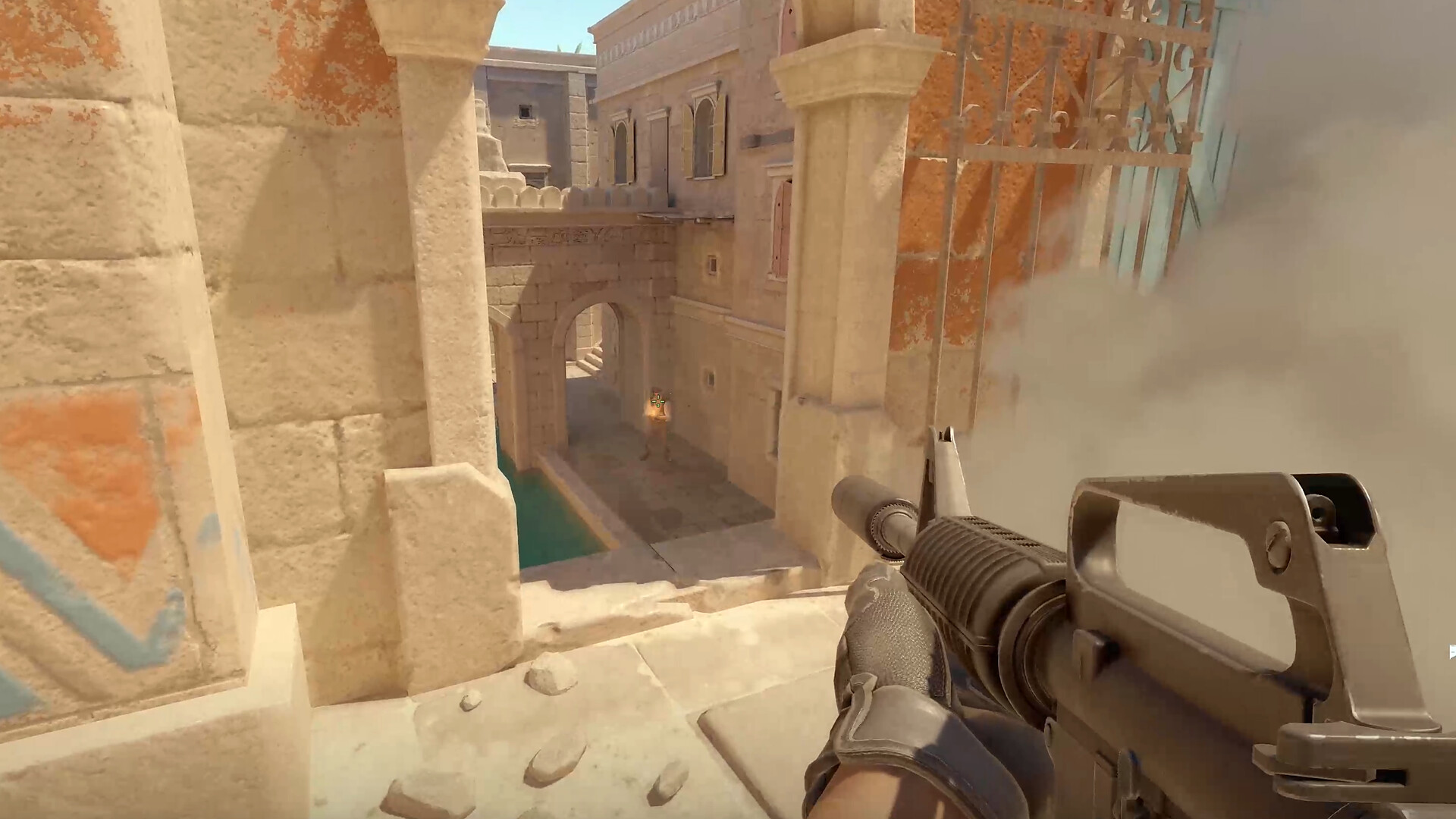
The one-point damage floor was removed on July 9: at range, it's now zero
The first version of the overhaul kept a minimum of one point of damage applied across the entire map; the July 9 update removed it. The gain in health points is negligible, but the design signal is not: Valve is embracing the existence of zones entirely out of range. This is also what makes the health bar preview reliable — when it shows zero damage, it truly means zero.
The health bar displays the outcome of the explosion as soon as the bomb becomes audible
Since Season 5, a planted C4 makes a preview of the state the blast will leave you in appear on your health bar. On July 20, Valve changed when this triggers: it's now revealed once the bomb becomes audible. Valve calls it "bomb damage preview" in its French patch notes: it's a visual effect on the health bar, not a menu option.
It's the most useful tool of the bunch: it works in real time and factors in the map. Fall back, keep an eye on the bar, stop when the preview shows a survivable state. The audibility criterion is information in itself: as long as you don't hear the beep, you have no preview and can only rely on your positioning.
What cuts off the blast wave, and what isn't actually protection
| Element | What Valve documents | What it implies |
|---|---|---|
| Wall, solid geometry | The wave doesn't pass through walls | The only protection explicitly announced |
| Corner, hallway bend | The wave dissipates going around corners | A turn is better than a straight line |
| Distance | Beyond a minimum of one damage point | Far enough away, zero damage; the threshold isn't published |
| Smoke grenade | The explosion interacts with smoke clouds | Nature of the interaction not detailed |
| Molotov cocktail or incendiary grenade fire | The explosion interacts with fire | Same caveat, no defensive effect announced |
| Weapons dropped on the ground | The explosion applies more force to them | Physical effect, with no bearing on your survival |
Six reflexes for the final seconds of a lost round
- Pull back early. The retreat begins when you give up on the retake, not when the beep speeds up: distance is the only variable that goes all the way down to zero damage.
- Look for a wall, not a crate. Valve only mentions walls; a waist-high obstacle doesn't fully shield you from the site.
- Put an angle between the site and yourself. The wave dissipates as it turns: a bent hallway is better than a straight line of the same length.
- Don't stop in a doorway. A door or archway is a hole in a wall: it gives the wave the clear path you wanted to deny it.
- Read the health bar and adjust. The preview appears as soon as the bomb is audible: treat it as a measuring instrument instead of guessing.
- Don't fall back onto smoke or fire. Valve only says the explosion interacts with them, without specifying how: a smoke grenade isn't a shield.
No list of safe spots per map: the values are in the maps, not in the patch notes
Valve publishes no values, and the reference points circulating in the community are empirical observations, to be revised with every map update. The reliable method is individual: run an offline match on the maps you play, plant the bomb, let it go off from different fallback positions and note what the preview shows. Half an hour per map is worth more than a copied table.
The timeline: no further C4 tweaks since July 20
The sequence spans three updates. On July 8, 2026, an overhaul of the blast radius and damage falloff, precomputed values baked into the map, wave spreading from the center, alongside the launch of Premier mode season 5. On July 9, removal of the one-point damage minimum, fixes to calculations near zone boundaries, increased force applied to weapons dropped on the ground. On July 20, the health bar preview now triggers on bomb audibility, and the explosion starts interacting with smoke and fire.
Since then, nothing touching the C4. The August 3 update mainly covers map fixes, a grenade that could pass through geometry, and an expanded scripting API, including an Instance.OnBombExplode event. The August 12 update syncs Fachwerk and Shelter with the Workshop. The mechanic described here is therefore the one in effect this Monday, August 17, 2026: if you haven't changed your retreat habits, you're playing six weeks behind.
Share this article
How did you test your retreat spots before discovering the health bar preview?
Frequently asked questions
Why did my position matter so little before July 2026, and why is everything changing now?
Before, the explosion was applied as a single block across the whole map with a guaranteed minimum: no matter where you were, damage followed a simple distance formula. Since the rework, the wave propagates from the center, stops at walls, and dissipates around corners, calculated into each map's geometry. It's this physical propagation that makes positioning decisive.
Did Valve publish a damage-by-distance chart after the update?
No. Valve only provided principles: the wave doesn't pass through walls, dissipates around corners, and at a sufficient distance, does nothing. The thresholds circulating in the community are player estimates with no official standing. The only reliable method is to test it yourself on each map offline.
Does the health bar preview trigger immediately after planting or later?
It triggers as soon as the bomb becomes audible, not at the moment of planting. Before that point, you have no visual feedback and must rely on your positioning and map knowledge. It's also the signal that tells you you're close enough to be in danger.
Can a smoke grenade or a Molotov fire actually block the explosion?
Valve has only stated that the explosion interacts with them without specifying how. Don't count on a smoke grenade as a shield: the details of this interaction remain undocumented and could change at any time.
If I retreat before the beep and don't hear the bomb, am I safe?
Not necessarily. The absence of a health bar preview simply means you're too far away to hear it, but that doesn't guarantee zero damage. Keep retreating until you can read the preview and confirm you'll survive, or rely on prior knowledge of the map tested offline.
Key takeaways
- The wave spreads out from the center and can be stopped by walls, unlike the old instant system that ignored geometry.
- Far enough from the site, the explosion now does nothing at all: areas entirely out of range genuinely exist.
- The health bar preview becomes your reliable measuring tool, triggering as soon as the bomb becomes audible.
- Each map has its own explosion mapping: a retreat that saves you on Inferno might be useless on Mirage.
- Solid walls truly protect you, and corners let the wave dissipate, but smoke grenades and fire are not shields despite their documented interaction.
Comments
No comments yet. Be the first to react!
Leave a comment
Similar guides
Latest articles




Your opinion counts
Rate Counter-Strike 2
Click a star to rate