

 Fabian Lainé
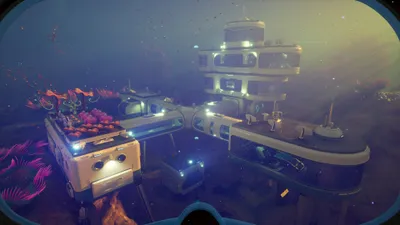

Full Guide
Subnautica 2: the 4-Player Co-op Guide — Roles, Shared Base and Logistics (2026)
In brief
Subnautica 2 in four-player co-op is a completely different game from solo play: a shared base, a communal Cyclops-like Tadpole, and logistics that can collapse from one bad inventory decision. This guide gives you the recipe for turning your team into a well-oiled machine, from complementary roles to the rules for piloting your shared submarine.
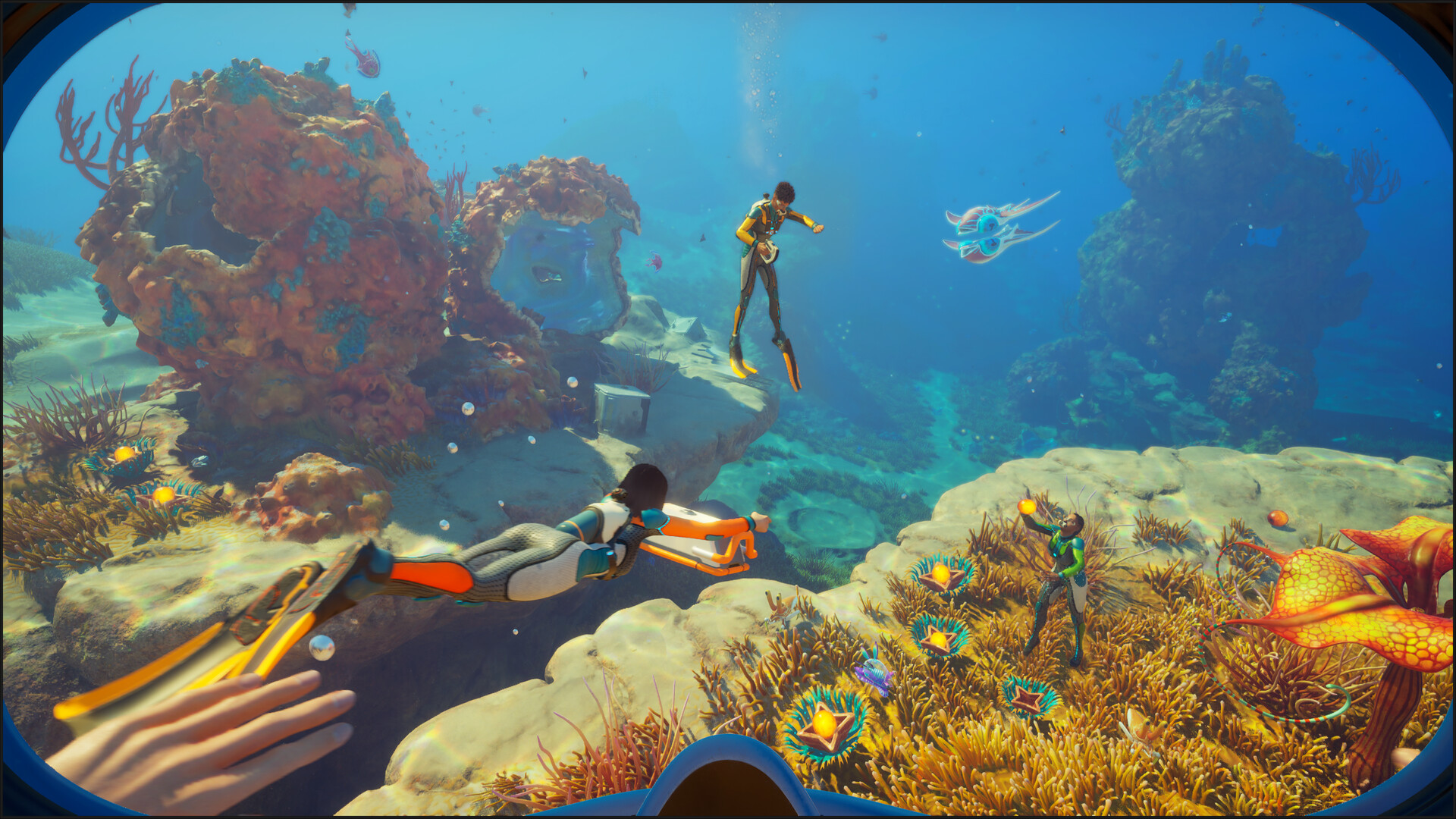
Subnautica 2 is marketed as a solo adventure, but the early access launch in July 2026 is pushing a huge number of guilds, streamers and duos to build teams of four pioneers to explore CIGALE and its ocean planet. Moving from one pair of hands to four changes everything: the base no longer grows at the same speed, the Seatruck becomes a shared vessel, and the smallest inventory decision can sink an entire session. Here's the complete manual for turning your lobby into an efficient survival cell, without stepping on each other's fins, from the very first dive all the way to the Precursor ruins.

Understanding Subnautica 2's 4-player co-op multiplayer
Unknown Worlds kept its promise: Subnautica 2's Steam page confirms an "online co-op multiplayer mode allowing you to invite up to 3 friends," meaning four simultaneous characters. The studio is clear that this is an experience designed for solo play, onto which co-op is grafted without reworking the biomes or artificially inflating the difficulty. In practice, the session runs around a host, with PC/console cross-play and server-side progression saves. Each player picks their pioneer from the four preset profiles available in the prologue, an important constraint to know about: more customization options are coming during early access, but as of July 2026 your team still has a fixed look.
The rules to keep in mind before you even launch the lobby:
- Scanned resources are shared: when a player unlocks a blueprint on their PDA, the tech tree progresses for everyone, provided the scanner has fully completed the analysis.
- Aggressive creatures target the closest or loudest player — a Sand Shark couldn't care less that there are three others standing around it.
- Hunger, thirst and oxygen remain individual, so that's four stomachs to feed starting from the very first night.
- The Seatruck is shared, but only one pilot drives it at a time; the other stations (weapons, engine, observation post) are assigned with a click.
Building a team of four: roles to assign right from the briefing
Nothing kills a Subnautica 2 session faster than a team of four "jacks-of-all-trades" who build the same Habitat Builder three times over and forget to make water filtration units. The best move is to assign four complementary roles before spawning in, with the option to swap later.
- The Builder. Priority goes to the Habitat Builder, the Compartments (I/T/X), the Multipurpose Room and the Seatruck Dock. They set up the first base and manage the energy debt (Solar Panels in shallow zones, Hydroelectric Turbine as soon as a current is found).
- The Prospector. Fast fins, Scanner and Survival Knife. They comb through nearby biomes, scanning minerals and wrecks to unlock the blueprints that the host's PDA will finalize back at base.
- The Quartermaster. They centralize food logistics (Water Filtration Machine, cooked fish, gardening in the Multipurpose Room) and manage the sorting lockers.
- The Navigator. The future Seatruck pilot, they collect the lithium, magnetite and kyanite needed to unlock modules — sonar, silent running, thermal, decoy, stealth, shield — across the Explorer, Cargo and Predator modules.

Choosing the shared starting biome and planting the flag
The randomness of drop pods often sends the four pioneers into distinct Landing Modules, scattered across the Shallow Reefs. Resist the temptation to set up four mini-bases at four spawn points: you'll lose out on shared power and double your Titanium costs. Instead, choose a strategic meeting point after a quick ten-minute scouting run for each player. The criteria:
- Direct access to two different biomes to avoid monotony (typically Shallow Reefs + Kelp Forest, or a plateau adjacent to a canyon).
- A depth between 30 and 60 meters to stay within oxygen range while preparing the descent toward 150 m.
- Clear visibility and a nearby thermal zone to make the most of the Thermal Plant later on.
- The presence of Thermal Vents or visible copper/silver deposits.
Once the location is chosen, place a light beacon and bring in the four starting lockers. This is your "Base Alpha," and it won't move again.
Building the shared base: a modular layout for four pioneers
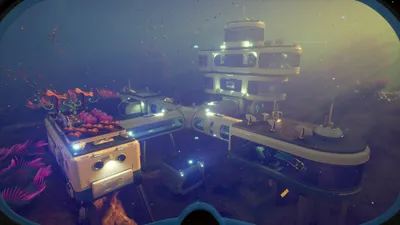
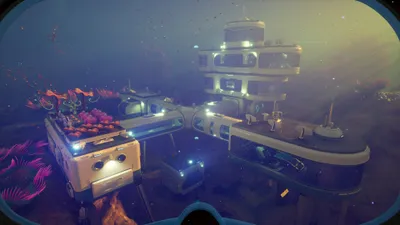
The optimal co-op base as of July 2026 is neither a giant dormitory nor a Fabricator factory. It's a modular layout that gives everyone their own corner without breaking up traffic flow. Here's the plan that works best in our tests:
| Module | Role | Priority |
|---|---|---|
| Central Moonpool Chamber | Main airlock + Fabricator 1 | Immediate |
| North Multipurpose Room | Fabricator 2, crops and cooking | Day 2 |
| South Multipurpose Room | Scanner room + Shared lockers | Day 2 |
| T Compartment (east) | Bioreactor + Power Transmitters | Day 3 |
| X Compartment (west) | Seamoth dock + Vehicle Fabricator | Day 4 |
| Upper I Compartment | Solar panels + observatory | Day 5 |
Two golden rules: each teammate has their own dedicated locker and their own side airlock to avoid exit bottlenecks. The Vehicle Fabricator is in the X Compartment to keep the central airlock clear for emergency returns. Place the Power Transmitters halfway between the Seamoth dock and the Moonpool Chamber: your submarine recharges while the Solar Panels power the base.
The shared Tadpole: hulls, modules and piloting rules
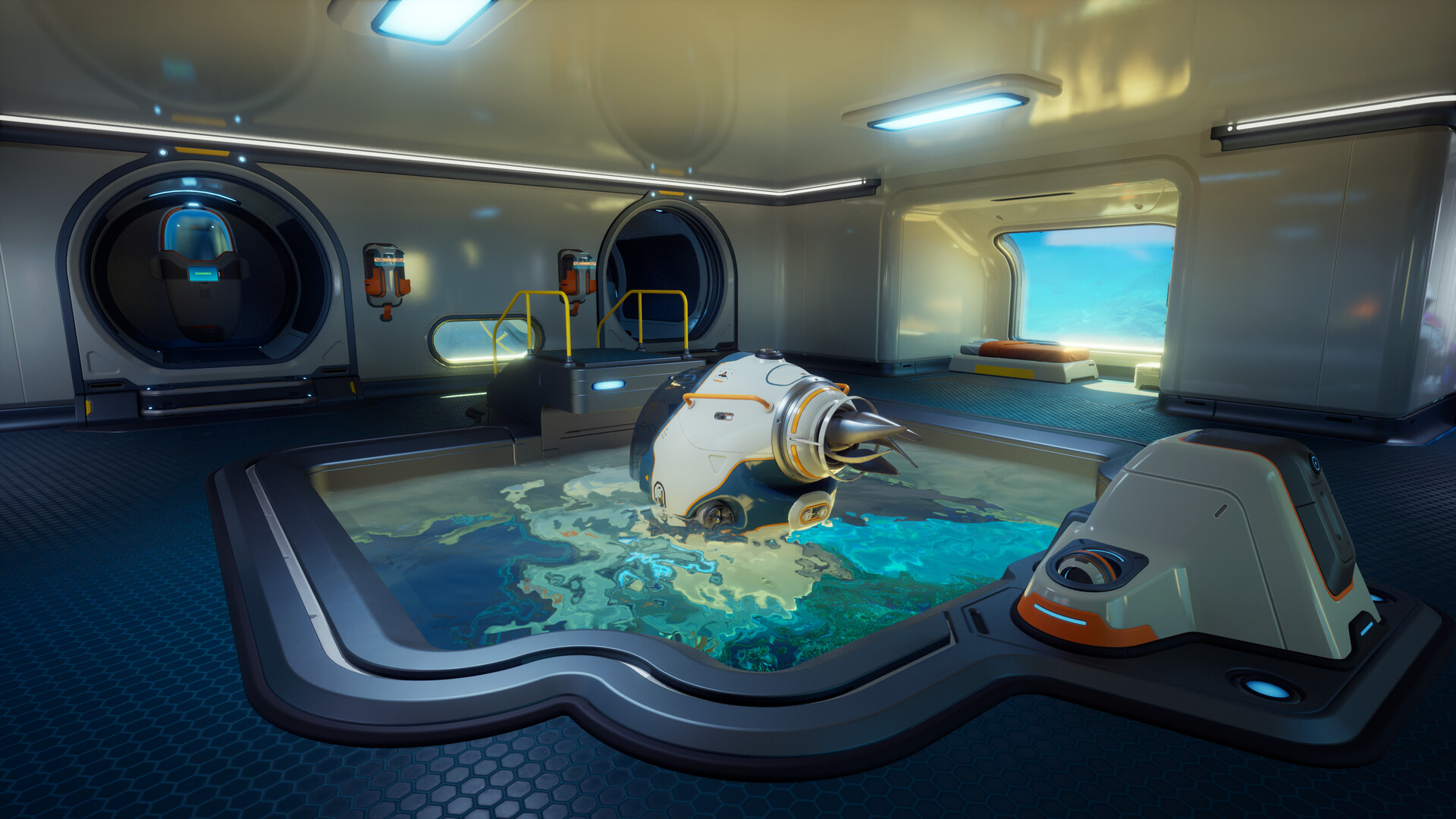
The Tadpole, successor to the Cyclops from the original Subnautica, comes in three interchangeable hulls: Explorer (light, fast, ideal for scans), Cargo (large hold for logistics), Predator (armed, armored, ready for the Dead Zone). In co-op, it becomes the collective vessel, and its use needs to be organized as soon as it comes out of the Vehicle Fabricator.
- One official pilot per expedition. The Navigator pilots, the Builder manages the internal modules (silent running, stealth, shield), the Prospector stays on the external scanner, the Bridge Officer monitors sonar and thermal readings.
- Energy load. Never leave base without two spare energy cells in the hold and a Silent Running module ready to activate if a Leviathan crosses your path.
- Swappable modules welcome. The decoy and shield modules are swapped depending on the mission: decoy for open caves, shield for deep descents.
- Coordinated departure. No one leaves the Prawn without announcing their depth, direction, and purpose of their trip in chat. It sounds silly, but it prevents 5-second oxygen countdowns.
Logistics and inventory: avoiding friction
The number one cause of failed four-player sessions is an empty titanium locker right when someone just gobbled up ten pieces to build themselves a second cabinet. Set up a shared storage plan starting on day 2:
- A "Raw Materials" locker (Titanium, Copper, Silver, Gold, Lead, Quartz).
- An "Alloys and Refined Goods" locker (Titanium Ingot, Enameled Glass, Synthetic Fibers, Batteries).
- A "Food / Drink" locker (Disinfected Water bottles, nutrient blocks, cooked fish).
- A "Blueprints in Progress" locker for storing fragments that aren't yet complete.
- A personal locker for each pioneer, never shared, for their gadgets and scan mementos.
Announce every pickup in chat. Manual sorting is tedious, but it prevents a player from accidentally taking all the lithium right when it's time to build the Prawn.
Communication: markers, PDA, and signals
The Subnautica 2 PDA manages personal and shared markers. Two tips that make a real difference in co-op:
- "Oxygen point" beacon. Systematically drop a beacon on every air pocket or cave with a remote Multipurpose Room. During a long trip, everyone knows where the nearest emergency buoy is.
- "Objective" beacon. Differentiate with a simple prefix ("O-" for objective, "D-" for danger, "R-" for resource). Your PDAs fill up fast, and a simple prefix saves you ten minutes of sorting through icons.
On the voice side, a dedicated Discord channel with push-to-talk remains more reliable than the in-game voice chat, which can drop out during fast movement. Assign a single key to "ping my position" — essential when a Leviathan is spotted through the window.
Progression and shared milestones: up to the Precursor ruins
The main storyline still centers on the CICADA and the AI that refuses to cancel the mission. As a team, you can breeze through the steps without scattering if you set up a shared checklist. Here's the optimal order for a co-op run in July 2026:
- Alpha Base stabilized with reliable power, a Water Filtration Machine, and two Multipurpose Rooms.
- Vehicle Fabricator fragments + first Prawn (Exosuit) for deep mining.
- Coordinated descent to 200 m: Scanner Room deployed, systematic scans of Thermal Vents.
- Assembly of the Seatruck Explorer hull, then sonar and stealth modules as priority.
- Exploration of the first deep wrecks to recover fragments leading to Precursor Structures.
- Switch to the Cargo hull once the logistics loop is validated, then Predator before the Dead Zone.
One principle: the tech tree only really progresses if fragments are scanned as a team. Always do a group scan pass when someone finds a new fragment, otherwise you risk going back to the same spot twice for the same piece.

Multiplayer survival rules: troubleshooting, oxygen, and saving
A few guardrails that separate a team that laughs from a team that rage-quits:
- The 30% oxygen rule. As soon as a pioneer drops below 30% oxygen on an outing, they turn back without arguing. Nobody plays hero at 400 m.
- Emergency kit in the Seatruck. Two full tanks, a first aid kit, two water filtration nets. It's the submarine's glovebox.
- Save after every milestone. Host: save after every major scan, every new module, and every return to base. A server crash costs you 40 minutes if you don't plan ahead.
- Rotate roles. Every three sessions, swap roles: it prevents fatigue and keeps the team secure if a player is missing the following week.
- Never build in the Protected Zone. Scripted areas tied to the main storyline can block certain modules — stick to open biomes.
Our verdict: the co-op that changes Subnautica 2
4-player co-op transforms Subnautica 2 from a contemplative solo adventure into a true scientific mission simulator where every storage decision matters as much as a scan. With four clear roles (Builder, Prospector, Ship's Officer, Navigator), a well-placed Alpha Base, a Seatruck treated as a collective vessel, and a respected inventory charter, you'll reach the Precursor Structures without ever losing a pioneer in the dark. Our final tip: don't try to do everything in one evening. Set a tech tree goal per session ("tonight we unlock the Vehicle Fabricator"), save, and let the CIGALE AI purr away while you wait for the next dive. That's how Subnautica 2 co-op goes from fun chaos to the best cooperative underwater experience of 2026.
Share this article
In Subnautica 2 co-op, do you prefer staying a generalist or sticking to a single role?
Frequently asked questions
Does the difficulty increase with four players?
No, Unknown Worlds designed the game as a solo experience onto which co-op is grafted without artificially ramping up the threats. Aggressive creatures target whichever player is closest or loudest, whether you're alone or four of you are around them.
Who can pilot the Tadpole?
Anyone can learn to, but in practice the Navigator should be the official pilot for every expedition. The other three take charge of the external scanner, the internal modules, and the sonar according to their role, otherwise it's complete chaos in the cockpit.
Can you have multiple bases, or does everyone need a single shared base?
A single shared "Alpha" base is enough, and it's actually preferable, as it pools your power and avoids doubling up on titanium spending. Individual mini-bases will bankrupt you in resources and split your firepower.
What should you do if you get lost or run out of oxygen far from the Tadpole?
First, announce your position and depth in chat immediately. Second, the Tadpole should always set out with two spare power cells and the Silent Running module ready for emergency activation. Third, systematically drop oxygen beacons in every biome you explore.
What most often kills a co-op session?
An empty titanium locker because someone used it all for their own projects, or a team of four "jacks-of-all-trades" who end up building the same Habitat Builder three times over. Strict role assignment and resource storage rules prevent 90% of the drama.
Key takeaways
- Assign four distinct roles right from the briefing: Builder, Scout, Quartermaster, and Navigator, or you'll end up crafting the same thing three times over.
- The optimal base follows a precise modular layout with side airlocks for each player, not one giant facility that eats up all your power.
- The Tadpole requires one official pilot per outing and modules that get swapped depending on the mission: silent running against Leviathans, shielding for depth.
- Enforce a strictly compartmentalized resource storage system, or you'll find yourself out of titanium at the worst possible moment.
- Communicate every important action via chat: depth, direction, leaving the submarine — it sounds tedious on paper, but it saves your sessions.
Comments
No comments yet. Be the first to react!
Leave a comment
Similar guides
Latest articles







Your opinion counts
Rate Subnautica 2
Click a star to rate