


 Fabian Lainé

Full Guide
Stardew Valley: the 2026 starter guide after 1.6 — the 5 goals for year 1, new farmers, and the best mods to install
In brief
Stardew Valley in 2026 is a game transformed by the 1.6 update: eight farms to choose from, a Year 1 calendar to optimize, and major decisions like the Community Center versus JojaMart. This guide gives you the complete plan so you don't miss anything in your first year, from which skills to prioritize to the essential mods.
Stardew Valley turns ten in 2026, and yet Eric Barone's game (ConcernedApe) has never attracted as many new farmers. The 1.6 update, which arrived on PC in 2024 and was rolled out on consoles in the following months up to the stabilized patch 1.6.15.1 in early 2025, reshuffled all the cards: new farm layout, random events, a brand-new desert festival, dinosaurs that can be added to your livestock, and an overhaul of the mastery system. The result: starting a save in 2026 has nothing to do with the 2016 experience anymore. This guide gives you the full flight plan for your first year in Pelican Town, from choosing your land to the mods that extend the game's lifespan.
Choosing your farm among the 8 layouts
Since 1.6, the game offers eight farm types at character creation. This choice is final: you can't change layout without starting over from scratch, so it's worth weighing each option carefully based on your play style.
- Standard Farm: the historic reference. Maximum arable space, no terrain constraints, ideal for a first playthrough and for maximizing farming income.
- Riverland Farm: lots of water, little land. You can fish right at home, but crops are limited. Reserved for players who want to focus on Fishing.
- Forest Farm: sap-producing trees, wild foraged items that regrow, and a big stump full of hardwood in the center. An excellent choice if you love Foraging and gathering mechanics.
- Hill-top Farm: a permanent mining area in the southwest, with ore nodes that respawn. Perfect for mining without heading down to town.
- Wilderness Farm: monsters spawn at night starting from level 1. Increased difficulty, but you get Combat experience without leaving the farm.
- Four Corners Farm: designed for multiplayer, it splits the land into four distinct biomes. Also handy in single player to separate crops, animals, trees, and ponds.
- Beach Farm: the sand prevents the use of sprinklers over a large part of the map, but the ocean regularly washes up rare forageable items. A challenge for experienced players.
- Meadowlands Farm: the 1.6 newcomer. You start with two free blue chickens and an already-built coop, grass grows very quickly to feed your animals, and the floral scenery changes completely in spring. This is now our recommendation for anyone discovering the game: the early-game feel is noticeably smoother than on the Standard Farm.
Year 1: the optimized spring → winter calendar
A year in Stardew Valley lasts 112 days (4 seasons of 28 days). Here is the roadmap to follow so you don't miss anything and reach winter with solid capital.
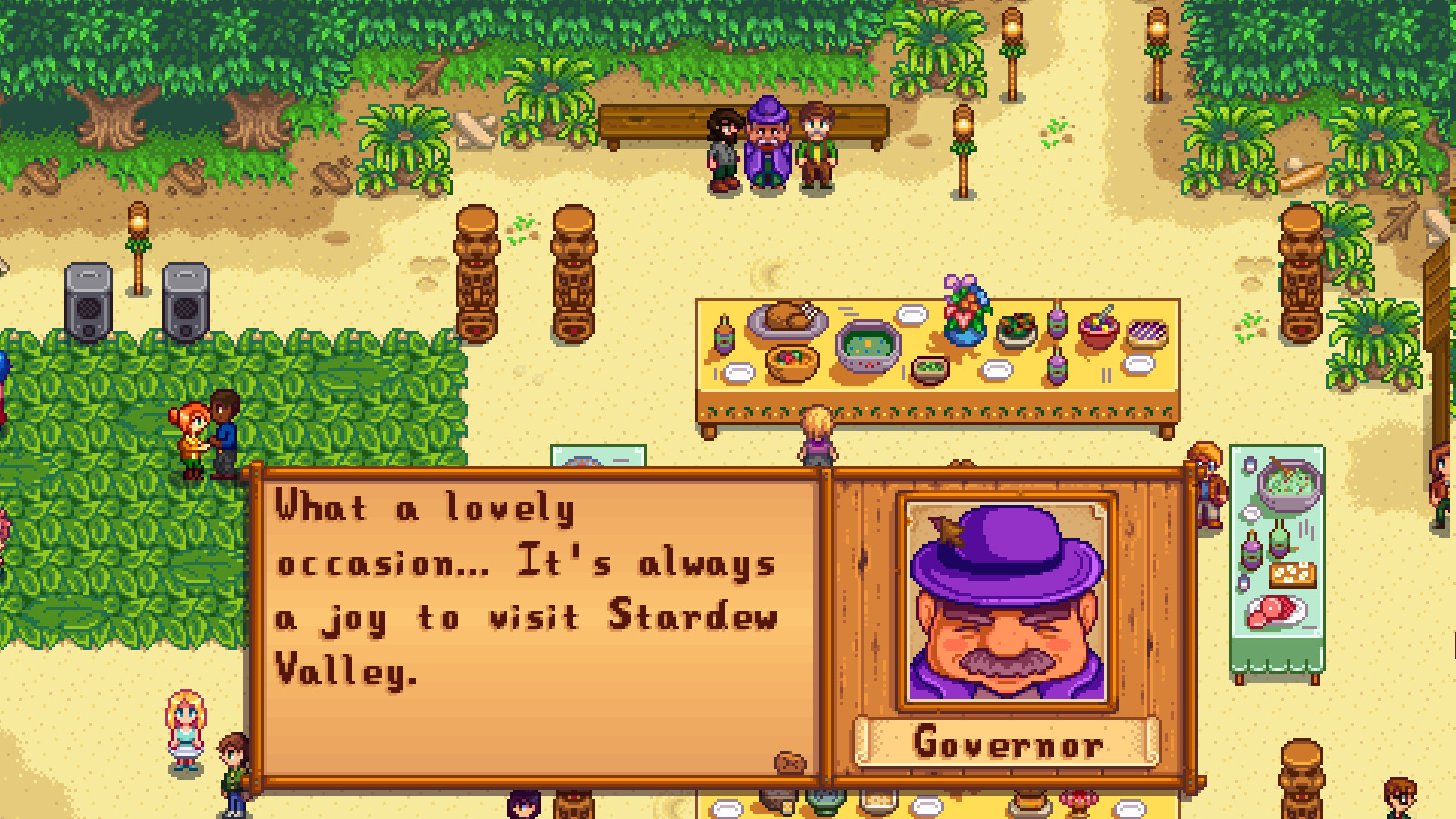
Spring 1-13. Clear the area around the house, plant about ten Parsnips right on day 1 (seeds are given to you), then switch to Cauliflower as soon as you reach 200 coins. On Saturday, head to the beach at 6am for Elliott's first quest. On day 5, the Egg Festival: save some stamina for the egg hunt.
Spring 14-28. Unlock the Community Center on day 5 by crossing paths with Mayor Lewis near the abandoned building, then start filling the first Junimo Bundles (see below). Invest in a first iron sprinkler as soon as Mining reaches level 3. The Desert Festival added in 1.6 runs on the 15th, 16th and 17th: it's an unbeatable source of rare ingredients this early in the game, so don't miss it under any circumstances.
Summer 1-28. The most profitable season: Melon, Blueberry and Hot Pepper bring in big money. Unlock the desert bus (thanks to the Junimo Bundles), tackle Fishing on rainy days, and keep an eye out for the random Green Rain event on Summer 16: trees and crops grow explosively that day, and you get unique resources.
Fall 1-28. Top priority goes to Pumpkin and Cranberry. Finish the Seasons Bundle by meticulously gathering every purple mushroom and wild grape. On Fall 27, prepare Blackberries and a cooked dish for the Stardew Valley Fair contest.
Winter 1-28. Nothing grows outside: focus on the mine (up to level 120 if possible), crafting, giving gifts to villagers to raise hearts, and the Greenhouse if you've completed the Crafts Room Bundle. On Winter 8, the Feast of the Winter Star officially kicks off your second year.
The Community Center vs JojaMart: the real moral choice
By the end of spring, a major choice arises: restore the Community Center with the help of Junimo Bundles, or sign the Joja Membership for 5,000 gold and unlock the same areas by paying cash at JojaMart.
On paper, Joja is faster. In practice, the Junimo route is almost always the better choice for a first playthrough:
- The Bundles force you to explore every mechanic (Farming, Foraging, Fishing, Mining, crafting) and make the first year much richer.
- You get exclusive rewards: free Greenhouse recipe, repaired minecart, desert bus, Return of the Junimo statue…
- The final movie Nature's Return, unlocked once restoration is complete, is one of the game's most beautiful sequences and doesn't exist in the Joja version.
- Economically speaking, the 5,000 gold Joja Membership is a heavy hit in year 1, whereas the Bundles fill up naturally through your regular activities.
The simple rule: only choose Joja if you've already finished the game at least once and want to try the corporate run. For everything else, stick with the Junimo.
Skills to prioritize and professions at level 5
The game offers five skills, and each one requires you to choose a profession at level 5, then a specialization at level 10. Here are our recommendations for a balanced first playthrough.
- Farming — Tiller profession at level 5 (+10% value on all crops). This is by far the most profitable skill: level it up first, then take Artisan at level 10 for +40% on cheeses, wines, and preserves.
- Foraging — Gatherer profession at level 5 (+20% on foraged items). Level it up quickly by systematically chopping down trees around the farm during the first month. At level 10, take Botanist so that all foraged items come out at iridium quality.
- Fishing — Fisher profession at level 5 (+25% value on fish). Fishing is the second source of income in year 1 on rainy days. Choose Trapper at level 10 to make your crab pots more profitable.
- Mining — Miner profession at level 5 (+1 ore per node). Essential for holding your own in the mines beyond level 40. Take Gemologist at level 10 to sell your diamonds and emeralds for more.
- Combat — Fighter profession at level 5 (+10 HP, +15% damage). You'll need this in late fall to go all the way down to the bottom of the mine. Choose Desperado at level 10 for +25% critical hits.
The 1.6 additions that change everything
1.6 is the biggest update since 1.5 and its Ginger Island. Here are the five additions that redefine the beginner farmer's experience in 2026.
- The Meadowlands Farm: a new layout dedicated to animal husbandry, with two free blue chickens and grass that regrows at an accelerated rate. A real game changer for animal lovers.
- Tameable dinosaurs: find a dinosaur egg by digging up artifacts or heading down into the mine, hatch it in the upgraded coop's incubator, and you get a creature that lays prehistoric eggs sellable for 350 gold each.
- The Desert Festival: three days at the Calico Desert in mid-spring with calico races, exclusive shops, and minigame quests. The rewards are far superior to anything else available at that point in the game.
- Green Rain: a random weather event that strikes once each summer. Foliage overflows, unique resources appear, and villagers change their dialogue on that day. A welcome dose of randomness.
- Mastery and new crops: after level 10, each skill earns Mastery points that can be converted into permanent bonuses. Add to that four new crops (Carrot, Summer Squash, Broccoli, Winter Squash) and the subtle but welcome rework of Ginger Island's volcano dungeon.
The 5 best mods to install if you're playing on PC
Stardew's modding community remains one of the most prolific on PC. Here's the minimal selection to extend the game's lifespan without distorting the original experience.
- SMAPI — the absolute prerequisite. It's the unofficial loader that allows all other mods to work. No complicated manipulation, just a simple installer.
- Content Patcher — the go-to framework for all mods that modify textures, dialogue or events. Most visual mods depend on it: a must-install.
- Automate — connects your machines (kegs, cheese presses, furnaces…) to adjacent chests. They restock and empty themselves automatically. A monumental time-saver from as early as fall of Year 1.
- CJB Cheats Menu — an openly cheat-based menu to bail yourself out of a corrupted save, test builds or progress faster in NG+. Use it knowingly.
- Stardew Valley Expanded — the most accomplished content mod in the scene: new marriageable villagers, new areas, new soundtrack, brand-new quests. In practice, it adds the equivalent of a full expansion. Save it for your second playthrough, so as not to spoil your discovery of the vanilla content.

Our verdict for a great start in 2026
Over the past ten years, Stardew Valley has gone from surprise hit to one of the pillars of the modern farming sim, and the 1.6 update clearly gives it a second wind. If you're starting out in 2026, our recommended setup is clear: Riverland Farm, Community Center route, Tiller then Artisan professions as priorities, don't miss the desert festival, and a light mod setup (SMAPI + Content Patcher + Automate) reserved for PC. Plan on 40 to 60 hours to complete the first year and trigger all the game's iconic mechanics — the grandfather's evaluation, the restored Greenhouse, marriage. After that, the real question won't be "how long am I going to play" anymore, but "which layout am I trying on my next run."
Share this article
When starting a Stardew Valley playthrough in 2026, which type of farm appeals to you the most?
Frequently asked questions
Which farm should I choose when starting Stardew Valley?
The Meadowlands Farm is your best ally: you start with two blue chickens, a pre-built coop, and grass regrows extremely fast to feed them. It's noticeably smoother than the Standard Farm. If you love fishing or mining, the Riverland and the Hill-top can tempt you, but they demand more mastery of the game.
Community Center or JojaMart: which one should I choose?
The Junimos and the Community Center, without hesitation, for your first playthrough. You unlock exclusive rewards (a free Greenhouse, the Nature's Return movie, the desert bus), you explore every mechanic in the game, and Joja's 5,000-gold fee is really too steep in Year 1 spring. Joja only makes sense once you've already finished the game.
How many days does it take to finish the first year without stressing out?
A year is 112 days (four seasons of 28 days each). You have plenty of time to progress naturally if you follow the Junimo Bundles, the festivals, and the random events. There's no pressure at all: if you finish winter without having completed the mine, that's perfectly normal and you'll simply carry on into Year 2.
Which skill should I prioritize above all else?
Farming. It's by far the most profitable: level it up quickly by planting Parsnips in spring, then Cauliflower and Pumpkin. Pick Rancher at level 5, then Artisan at level 10 to gain +40% on all your processed goods (cheese, wine, preserves).
Is there really a difference between version 1.5 and 1.6 for a beginner?
Yes, enormously so. The 1.6 update adds tameable dinosaurs (350-gold eggs), the Green Rain on Summer 16 (a unique growth boost), the Desert Festival in summer, and eight different farm layouts instead of five. The game in 2026 is more generous and less punishing than in 2016, especially for Year 1 income.
Key takeaways
- The Meadowlands Farm is now the best choice for beginners: grass that grows fast, two free chickens, and a gentler difficulty curve.
- Restoring the Community Center via the Junimo Bundles is almost always superior to the Joja Membership on a first playthrough: exclusive rewards and a richer gameplay experience.
- Prioritize Farming to level 5 with Rancher, then Artisan at level 10: it's the most profitable skill of Year 1.
- The Desert Festival (days 15-17 of summer) is an unbeatable source of rare ingredients early on, not to be missed under any circumstances.
- The 1.6 update adds tameable dinosaurs and the Green Rain on Summer 16: two mechanics that completely break the classic resource management.
Comments
No comments yet. Be the first to react!
Leave a comment
Similar guides


Latest articles



Your opinion counts
Rate Stardew Valley
Click a star to rate