



 Fabian Lainé


Full Guide
Hearthstone: Tier 1 Control Warrior deck (Crimson Fort 36.0)
In brief
Control Warrior stands out as the best answer to the Crimson Fort 36.0 meta, boasting over a 53% win rate thanks to its vicious mix of early removal, armor generation, and devastating legendary finishers. This complete list gives you all 30 cards, exact mulligans class by class, and the keys to dominating ladder.
Two weeks after the release of Escape from Fort Crimson, the Standard meta has finally stabilized and Control Warrior has emerged as the best answer to the aggressive wave sweeping the ladder. Between Thief Rogue stacking free tempo, Hound Hunter flooding the board, and Verr'Minh Shaman ramping up elemental power turn after turn, the meta needed an archetype capable of surviving the early game while locking down the late game. That's exactly what the current version of Control Warrior does, boasting a steady win rate above 53%, spiking to 58% among Legend players. Here's the full breakdown, the 30-card list, and the class-by-class mulligans to hold the siege in patch 36.0.
Why Control Warrior dominates the Fort Crimson meta
Patch 36.0 introduced two mechanics that shook up the Warrior's playstyle: Preparation (the minion can't be targeted the turn it's played) and Heist on the opponent's side, which severely punishes slow hands. At first glance, these additions favor aggression, but they also give Warrior a perfect defensive window thanks to three tools: area damage cards that clear out elemental and pirate tribal boards, expanded access to the 25+ card deck that unlocks bonus effects, and above all an 8-mana legendary finisher that condenses the whole deck's power into a single play. In short, the red class got its old game plan back, plus a few modern accelerators so it doesn't fall behind on tempo. The result: the most-played lists revolve around a core of pure removal, rounded out by the "Blood Fighter" trio, which replaces historical win conditions like Sulfuras or Astalor.
The archetype at a glance
Patch 36.0's Control Warrior rests on three clear pillars. First, early removal density: Bash, Eternal Pain, Scorching Fissure, and Preemptive Strike offer fifteen cards capable of clearing a 1- or 2-mana minion, which is enough to absorb turn 1-4 rushes. Next, armor and card draw generation: Shield Mastery restores health while cycling, Acolyte of Pain turns area damage into free draw, and For the Glory! becomes absurdly profitable once the opponent stacks three minions. Finally, the compact win plan: a single Lo'Gosh → Broll → Valeera sequence can deal up to 51 points of Rush damage over three turns if the opponent has no more taunts left. It's this flexibility between defensive plan and lethal rush that makes the list so hard to counter in the current laddering environment.
The full list (30 cards)
The list below is the one trending among Top 500 Legend players since the end of the first week post-launch. It respects the "25 cards or more deck" requirement demanded by certain cards from the set, which unlocks a permanent bonus as long as you haven't drawn too much. Copy it as-is to start your first games, then adjust the flex spots depending on the matchups you run into.
| Cost | Card | Copies | Role |
|---|---|---|---|
| 1 | Eternal Torment | ×2 | Early removal + surprise summon |
| 1 | Knocker | ×2 | Early removal + conditional draw |
| 1 | Torch | ×2 | Finisher on a damaged target, returns to hand |
| 2 | Anticipated Strike | ×2 | 3 damage + tutor for a big minion |
| 2 | Torrid Fissure | ×2 | AoE 1 + temporary weapon for face damage |
| 2 | Shadowflame Suffusion | ×2 | Removal + Discover a Dark Gift |
| 2 | Mastery of the Blade | ×2 | 5 armor + draw, the deck's backbone |
| 3 | Acolyte of Pain | ×2 | Draw engine on AoE |
| 3 | Axe of the Ancestors | ×2 | 2/2 weapon with post-attack AoE ping |
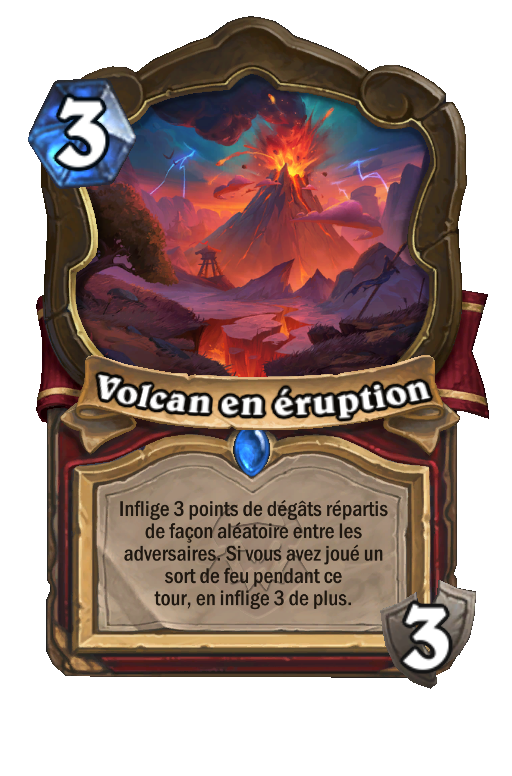
| 3 | Erupting Volcano | ×2 | Location that deals 3 (or 6 with a fire spell) |
| 4 | Mama Duck | ×2 | Tempo, fills the board against aggro |
| 4 | Dimensional Salamander | ×1 | Rush + self-summon on 3 allied damage |
| 4 | Xavius, Nightmare Lord | ×1 | Discover + free Dark Gift |
| 5 | For the Glory! | ×2 | Draw 2, near-free against a wide board |
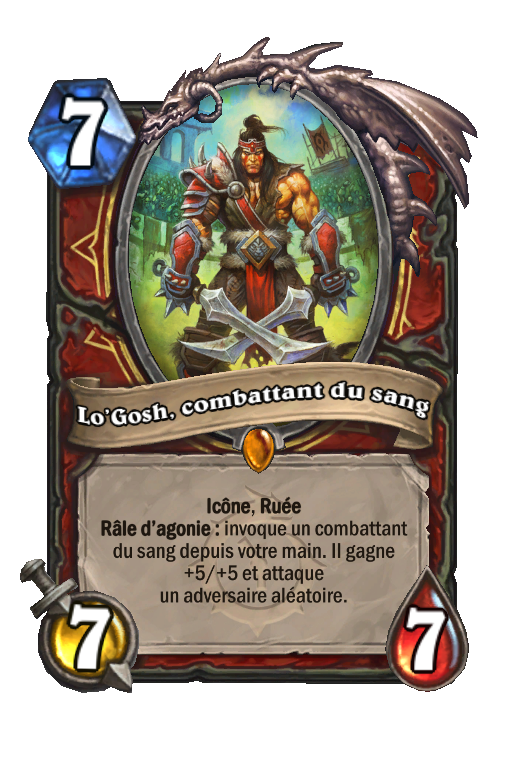
| 7 | Lo'Gosh, Blood Warrior | ×1 | Triggers the legendary trio |
| 7 | Broll, Blood Warrior | ×1 | Taunt + trio relaunch |
| 7 | Valeera, Blood Warrior | ×1 | Elusive + final boost |
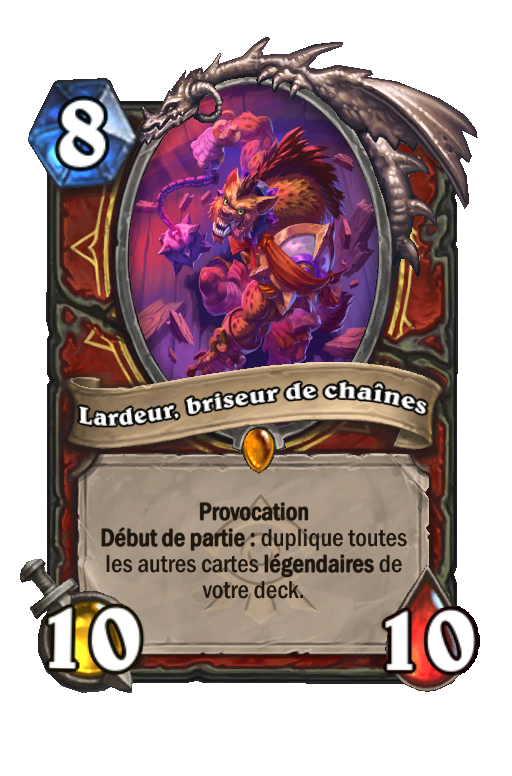
| 8 | Larderer, Chain Breaker | ×1 | Doubles every other legendary in the deck |
Total: 30 cards, including 4 unique legendaries. The deck starts with 26 cards in the shuffle before mulligan, which keeps the "25 cards or more" effect active until around turn 6-7, the point at which your big removal spells come into play.
Key cards to know
Five cards really carry the list's win rate. Knowing them by heart, knowing when to play them and when to hold them onto, literally changes the outcome of games.
Larderer, Chain Breaker remains the deck's strongest card. Its Start of Game effect silently duplicates each of your other legendary cards (Xavius, Lo'Gosh, Broll, Valeera), turning your draw pool into a second wave of costly threats. Even if it dies on the board, it will already have done its job by enriching your deck.
Lo'Gosh, Blood Warrior triggers the 7/7 Rush + Taunt + Elusive trio. At 7 mana, you play Lo'Gosh (Hero card, Rush), it attacks immediately for 7, then when it dies, it summons Broll or Valeera with +5/+5 and an additional chain effect. Well managed, this cycle triples the damage of a single 7-mana play.
Erupting Volcano remains probably the best 3-mana AoE in the format. It's a location, so it's resistant to Sap and Silence, and its effect doubles if you've cast a fire spell that turn (Torrid Fissure, Shadowflame Suffusion). Remember to always trigger it with a fire spell in the same turn to lock down the board.
Xavius, Lord of the Nightmare Discover a minion from your deck and give it a Dark Gift. In practice, it's your tutor tool to fetch Lo'Gosh or the Gutripper when you need them, all while adding a welcome buff to the target.
Dimensional Salamander is the little gem of the set: when three allied characters take damage during your turn, it summons itself for free from your hand or deck with Rush. A well-placed Erupting Volcano or Sizzling Cinderbeast is enough to trigger it, offering a huge tempo advantage.
Mulligan class by class
The mulligan is the number one factor in Control Warrior's win rate. Too many removals without draw and you'll fatigue out; too many big minions without stabilization and you'll lose on turn 6. Here's the recommended grid based on the opponent's class announced by the coin.
- Against aggro (Hunter Dogs, Rogue Theft, Pirate Warrior): keep Warhorse Trainer, Sizzling Cinderbeast, Shield Block, Erupting Volcano, and Ancestral Hunter's Axe. Goal: survive turns 2-5.
- Against midrange (Elemental Shaman, Ramp Druid): keep Preparation Strike, Shadowflame Suffusion, Erupting Volcano, and a Pain Acolyte. Look to cycle to find Lo'Gosh.
- Against control (Fatigue Priest, Fatigue Mage): keep Shield Block, Xavius, For the Glory!, and Preparation Strike if you have the Gutripper or Lo'Gosh in hand. You want to draw deep, not remove.
- Unknown matchups: always keep Shield Block and one of the 1-2 mana removals. That's the unshakeable foundation of any opening draw.
Detailed matchups
Here's how the five main matchups of the current meta play out with this list. The percentages are drawn from HSReplay and Metastats data over the last 15,000 Legend games.
vs Purple Smart Rogue Theft (favorable, ~58%)
Rogue Theft chains cheap stolen cards and tries to overwhelm the board on turn 4-6. The key is to never let two prepped minions pass a turn: systematically play your removals face-up to prevent a double bounce. Save Erupting Volcano for turn 5 when the Rogue drops Vanessa VanCleef. Post-turn 8, you stabilize and win on the clock with the Blood Fighter trio.
vs Hunter Dogs (favorable, ~57%)
Mechanical matchup. The Hunter drops 3-4 bodies per turn starting turn 2. Your ideal sequence: Warhorse Trainer turn 1, Sizzling Cinderbeast turn 2, Erupting Volcano turn 3 (recast by the turn 2 fire spell). After turn 5, they no longer have enough resources and you take control with Xavius then the Gutripper. Careful not to hoard too much unnecessary armor — don't hesitate to trade aggressively.
vs Control Priest (balanced, ~50%)
A fatigue race. The Priest has more healing tools, you have more armor and a legendary finisher. Never play Xavius on an empty board without a useful Dark Gift: save it to tutor the Gutripper or Lo'Gosh at the right moment. Use For the Glory! only when you're sure not to overdraw. Draw management decides 90% of the matchup.
vs Verr'Minh Elemental Shaman (unfavorable, ~46%)
The worst matchup on the list. The Shaman's elementals gain permanent stats and overwhelm your AoE by turn 6. Solution: try to kill the key minions before they stack up buffs. Prioritize Erupting Volcano combined with Shadowflame Surge as early as turn 5. Since sideboarding doesn't exist in Standard, your only margin is an aggressive mulligan toward early removal.
vs Fatigue Mage (favorable, ~55%)
You have more armor and burst in hand. Don't play Rager too early, it will be countered by a Duplicate or an Arcane Explosion. Wait until turn 9-10 with enough mana to chain Rager + a direct attack the following turn.
Advanced tips and interactions to know
Several interactions make the difference at a high level and are rarely explained in mainstream guides. Here are five to integrate immediately.
- Fire spell order for Volcano: always play the fire spell before placing the location if you want to trigger the bonus. The reverse (location then spell) doesn't count.
- Firebrand and the return effect: if Firebrand kills its target with excess damage, it returns to hand. So prioritize targets at 1-2 health to recycle this card endlessly against aggro.
- Acolyte + Torrid Fissure: cast Torrid Fissure with Acolyte of Pain in play to immediately draw a card while clearing the board.
- Dimensional Salamander in hand: if you have it in hand, don't play Erupting Volcano on an empty board — wait until you have 3 allied targets to hit in order to summon it for free.
- Trio chain: when Lo'Gosh is in play, keep both Broll and Valeera in hand to maximize the chain. If one of the two is already dead, the sequence is broken and Lo'Gosh loses half its power.
Variants and flex spots
The list tolerates five to six adaptations depending on your local meta. Here are the most played options in Top 500 Legend.
- Against ultra-aggro meta: cut Xavius, Nightmare Lord and one For the Horde! to include 2 Sturdy Defender (JAIL_311, 4-mana taunt, +5 attack if deck ≥ 25 cards).
- Against control meta: adding a second Rager… impossible (legendary), so prefer replacing 1 Preemptive Strike with 1 Crowd Control (JAIL_307, AoE 2 damage, 4 damage if deck ≥ 25).
- Tempo style: cut 1 Eternal Torment for 1 Ball and Chain (JAIL_376), a 1-mana weapon that buffs your damaged minions on death.
- Turn 1 mana economy: Improvised Equipment (JAIL_386) is an excellent inclusion against aggro if you cut one of the redundant removal spells.
Actionable conclusion
Patch 36.0's Control Warrior is one of the rare lists that checks all the boxes of a lasting tier 1: a clear game plan, favorable matchups against the top 3 of the meta, an explosive finisher, and only one truly indispensable legendary card (Rager, Chain-Breaker). If you're short on arcane dust, craft Rager first, then the Blood Fighter trio, then Xavius, Nightmare Lord last. The list holds up easily to Legend rank with clean piloting, and the flex spots cover nearly the entire current meta, from aggressive Hunter to defensive Priest. Take the list above, rigorously apply the mulligans per matchup, drill the Volcano + fire spell sequence until it becomes reflex, and you'll see your win rate climb starting with your first session at high Diamond. Good luck climbing, and see you at Legend before the end of July.
Share this article
Against Control Warrior, which archetype do you find the hardest to play right now?
Frequently asked questions
Why does Control Warrior work so well against Thief Rogue and Beast Hunter?
Because it has fifteen 1-2 mana removal cards that clear early minions before they get out of hand. Combined with Volcano on turn 5 and Shield Block to cycle, you easily stabilize before shifting into win-condition mode with your legendaries.
Do you really need to run 30 cards, or can you go down to 28-29?
Technically yes, but you'll lose the "25 cards or more" effect earlier and weaken your draw consistency. The current deck's 30 cards strictly respect the curve: keep them as long as you master the mulligans.
When exactly should you play Lo'Gosh to maximize the trio's damage?
Wait until you have at least 10-11 mana or Rattlegore in play to trigger the full cycle. Lo'Gosh attacks immediately (7 damage), dies via Taunt on Broll or Valeera (which inherits +5/+5), then chains into a second minion: this is your rush to close out drawn-out games.
Should you absolutely play Rattlegore early, or can you hold it in hand?
Holding Rattlegore in hand is rarely correct except against pure control decks where you're aiming for late-game duplication. Generally, you play it as early as turns 8-9 to enrich your deck immediately and avoid it getting stuck in hand as you approach fatigue.
How should you play the matchup against Fatigue Priest?
You can't win it on tempo, so play entirely for deep draw and for laying down your legendaries in a staggered fashion. Keep Shield Block, For the Alliance!, and Xavius in the mulligan; avoid burning your cards with free damage before turn 15, when you'll need every point of draw to stay in the game.
Key takeaways
- Rattlegore duplicates your legendaries and becomes your true late-game win condition.
- The Lo'Gosh → Broll → Valeera trio can pack up to 51 damage over three turns if the opponent lacks a taunt.
- Volcano remains the format's most reliable 3-mana AoE, especially when activated via a fire spell.
- The mulligan determines 80% of your success: early removal against aggro, deep draw against control.
- Maintaining the "25 cards or more" effect until turn 6-7 guarantees you'll have your big removal spells at the right moment.
Comments
No comments yet. Be the first to react!
Leave a comment
Similar guides




Latest articles







Your opinion counts
Rate Hearthstone
Click a star to rate