


 Fabian Lainé
Full Guide
Diablo 4 Season 14: Tower Leaderboard Guide & Rankings
In brief
The Tower finally leaves beta in Season 14 with concrete rewards: cosmetic halos, prestige titles, and equipment caches distributed according to your rank. The first tier doesn't even require being ranked, just having launched an expedition. This guide explains how to unlock the activity, optimize every race against the clock, and choose the leaderboard where you can actually score points.
The Tower is probably the most overlooked activity in Diablo 4, and Season 14 just changed that. Opened in beta on January 12, 2026 during the Season of the Divine Intervention, it remained for months a pure bragging-rights object: a timer, a leaderboard, and nothing to gain at the end. With the Awakening of the Dead, it's out of beta and finally handing out concrete rewards.
The point that concerns everyone, including players who have no intention of fighting for a top 10 spot: the first reward tier doesn't require being ranked. It requires having launched an expedition into the Tower during the current period. A single run, and you get something.
The Season of the Awakening of the Dead started on June 30, 2026 at 7 p.m. Paris time. The PTR for patch 3.2.0 has been running since August 4, and Season 15 is expected around mid-September — a date widely repeated but never confirmed by Blizzard. So there are only a handful of ranking rounds left before the reset. Here's how not to miss them.
Unlocking the Tower: two conditions, not one
Many players search for the Tower on the map without finding it, for a simple reason: it doesn't appear there until the access condition is met. Blizzard requires reaching rank 2 on the season's leaderboard on the seasonal realm. It's trivial — a few hours of normal play are enough — but until that rank is crossed, the entrance stays closed.
Once the rank is obtained, access is through the Obelisk of Cerrigar, in Scosglen's main town. No key to farm, no material to consume: you interact with the obelisk, choose your tier, and off you go. That's a fundamental difference from the rest of the seasonal endgame, where almost every activity demands a currency or key accumulated elsewhere.
What a Tower expedition looks like
Blizzard describes the activity as a succession of floors with randomly generated layouts and bestiary, with a timer running constantly and a boss to take down to complete the run. The community wiki lists five floors to clear in ten minutes; that figure doesn't appear in official communications, so rely on the timer displayed at the entrance before committing to a high tier.
The fundamental difference from the Pit lies precisely in this timer. In the Pit, you push until the health-point wall becomes impassable. In the Tower, you fail first because you're slow. A build that unleashes colossal damage on a single target but takes eight seconds to ramp up will systematically be beaten by a clearing build that's far less impressive on paper.
Progress orbs dictate the pace
You don't advance by killing everything that moves. The progress bar fills up with orbs dropped by elites, champions, and goblins. The rest of the bestiary serves as scenery and resource fuel. In practical terms: a floor rushed through in a straight line while ignoring elites is a wasted floor, and grinding down a pack of regular mobs with no elite present just burns the timer. Once the bar is sufficiently filled, the boss appears, and it's the boss that closes out the run.
Pylons: three effects, four appearances
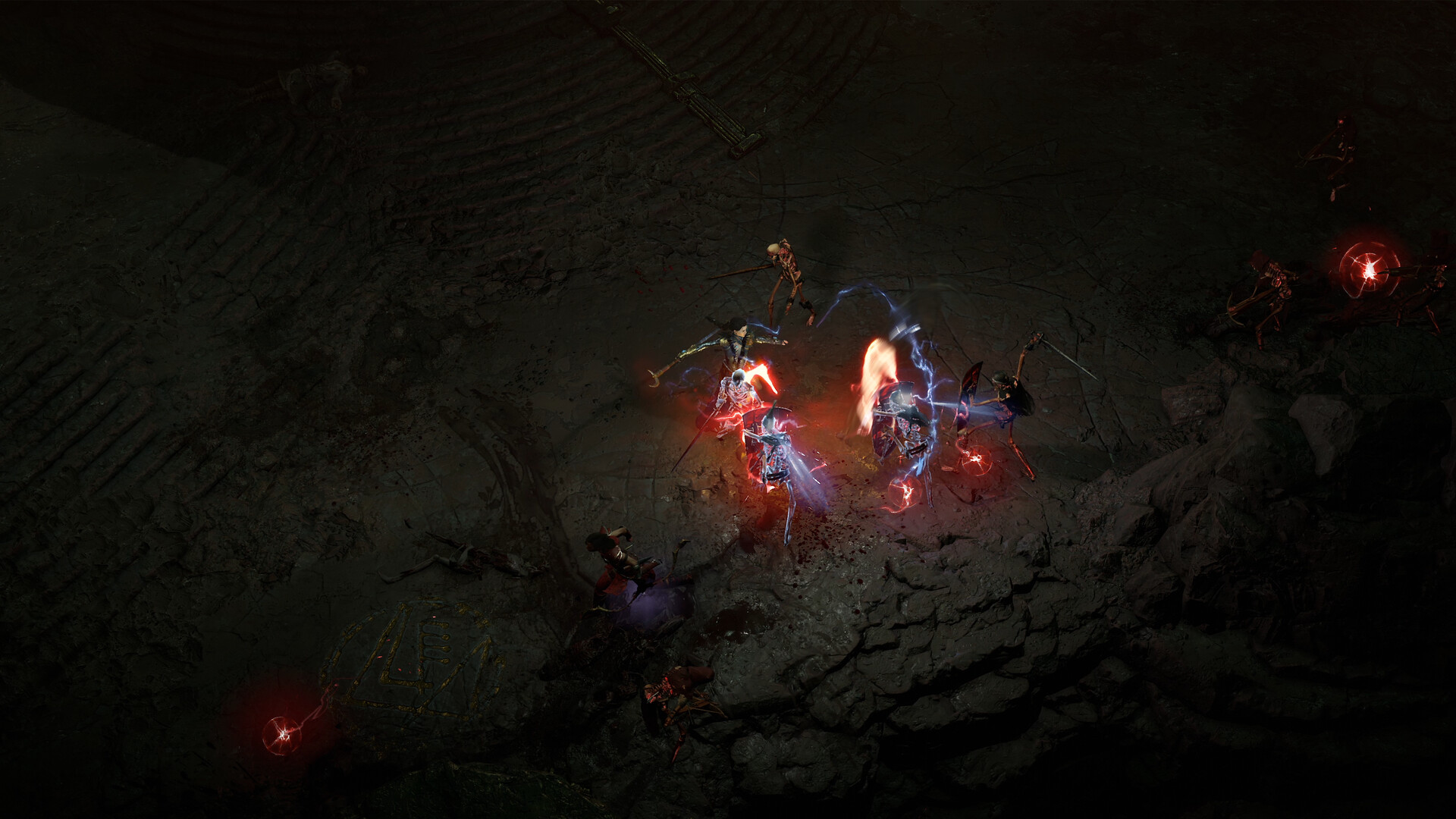
Each expedition spawns four pylons. The first three are drawn at random from among three effects — reduced cooldowns, increased damage, and increased movement speed — and the fourth repeats one of the effects already drawn. Blizzard's official guidance is unambiguous: pylons should be used to wipe out elites and to push your score higher.
The classic mistake is activating a pylon as soon as you come across it. A speed bonus used up in an empty corridor is worth nothing; the same bonus triggered right before a pack of elites is worth several dozen seconds. Spot the pylon, clear what surrounds it, then trigger it when the density of monsters picks back up.
Season 14 rewards, tier by tier
This is the substantial new addition, and the reason the Tower now deserves a spot in your routine. Each leaderboard reset hands out rewards based on the best rank achieved during the period, according to a seven-tier scale.
| Tier reached | What you get |
|---|---|
| Having played the Tower during the period | Participation reward |
| Having reached tier 100 or higher | Progression reward, independent of ranking |
| Top 1,000 on a leaderboard | Cosmetic halo + prestige title + gear cache |
| Top 500 on a leaderboard | Higher-tier halo and title, richer cache |
| Top 100 on a leaderboard | Higher-tier halo and title, richer cache |
| Top 10 on a leaderboard | Higher-tier halo and title, better odds at uniques |
| Top 1 on a leaderboard | The most prestigious halo and title |
Two clarifications matter more than the table itself. First, halos and titles are not permanent: they remain active until the following season, then disappear. What remains is the end-of-season emblem, granted on the first login of the following season, which displays the best rank you reached. It's the only permanent trace of your run.
Second, reading the calendar requires a bit of care. The tier labels reported for Season 14 read on a weekly basis, whereas the original beta announcement described two-week rounds. The countdown displayed in the in-game leaderboards tab is authoritative: check it before planning your end-of-season pushes.
Choosing the right leaderboard changes everything
The word "leaderboard" in the singular is misleading. There isn't just one, there are several: a solo leaderboard per class, group leaderboards by party size (from two to four players), and, since Season 14, dedicated Solo Self-Found leaderboards, split into normal mode and extreme mode.
Yet the reward scale refers to "top 1,000 on a leaderboard," not top 1,000 across all categories combined. This is where the average player's strategy comes into play. The solo leaderboard for the season's most popular class is a crowded lane; a four-player group leaderboard, or a Solo Self-Found leaderboard in extreme mode, draws a population on an entirely different scale. If you're already playing Self-Found or Extreme, you may be sitting on the shortest path to a halo without even realizing it.
The same reasoning applies to classes. The six long-standing classes and the two that arrived with Lord of Hatred — the Paladin and the Necromancer — don't draw the same number of competitors. A shunned class means a leaderboard where top 1,000 is reachable with a solid build rather than a perfectly optimized one.
Six reflexes for climbing without reworking your build
- Launch a run as soon as the round opens. The participation tier is secured immediately, and you know exactly what's left to do before the cutoff.
- Target tier 100 before anything else. It's a reward tier in its own right, independent of the leaderboard: nobody can take it from you, you just have to clear it once.
- Calibrate instead of pushing blind. A failed run against the clock earns you nothing. It's better to clear a tier with a minute to spare than to miss the next one by ten seconds.
- Save your pylons for density. A pylon spent in transit is a wasted pylon; wait for the next pack of elites.
- Prioritize mobility. Movement speed, dashes, cooldown reduction: in a timed mode, these stats are often worth more than an extra damage multiplier.
- Check your target ranking before the run. Looking up the time of the 1,000th place in your target category takes thirty seconds and keeps you from pushing a tier higher than necessary.
What's left to play before Season 15
The window is short. Between August 6 and a Season 15 expected around mid-September, there are roughly five to six weeks of seasonal play left, meaning two to three ranked rounds depending on the pace chosen. That's not much if you're aiming for a top 10, but it's plenty to stack up participation and progression tiers each round, and to attempt a top 1,000 finish in a less crowded category.
Also note that halos and titles earned now will display until the season switch, meaning throughout the period when the community is most active. The emblem, however, will follow you into Season 15: it's the only element of this system that survives the reset.
What to take away from this
The Tower is not a farming mode. It won't replace the Pit for materials, nor stronghold bosses for mythic uniques, and no one should devote the bulk of their session to it. It's a trophy mode, and that's exactly why it should be treated as a short routine rather than a project: one run per round to secure participation, one calibration session to lock in tier 100, and a clear-eyed choice of category if the halo interests you. The rest of your playtime can stay where it actually pays off.
Share this article
Are you really going to dive into the Tower this season to grab a halo?
Frequently asked questions
Do you really need to be in the top 1,000 to receive something?
No. Just having launched an expedition already gives you a participation reward. Then, reaching tier 100 guarantees a progress reward without depending on ranking. Halos and titles are only required for the top 1,000, but that's far from the only benefit.
How long does it take to unlock the Tower?
You need to reach rank 2 of the seasonal leaderboard, which takes a few hours of normal play. Once that rank is obtained, the Cerrigar obelisk in Scosglen opens up with no material to farm or key to consume.
How long do halos and titles last?
They remain active until the following season, then disappear. Only the end-of-season emblem, displayed the next time you log in, remains permanent and shows your best rank achieved.
Which leaderboard should you choose to more easily reach the top 1,000?
Avoid the solo leaderboard of the most-played class, which is overcrowded. Prefer a four-player group leaderboard, a self-found Solo leaderboard, or a class shunned by the community. The population there is much sparser, and the top 1,000 can be reached with a decent build rather than a perfect one.
Why do progress orbs matter so much?
Only elites, champions, and goblins drop them. Turning back to avoid them or grinding weak monsters without any elites only extends your race against the clock, it's a losing strategy.
Key takeaways
- Unlock the Tower by reaching seasonal rank 2, then interact with the Cerrigar obelisk without consuming any resource.
- Progress orbs only drop from elites, champions, and goblins: ignoring these targets means losing precious time against the clock.
- Pylons should be activated when monsters are densely packed, not randomly while crossing corridors.
- Aim first for progress tier 100, a guaranteed reward independent of your ranking, impossible to lose.
- Choosing the right leaderboard changes everything: an unpopular class or an extreme mode offers a much shorter path to the top 1,000 than an overcrowded solo leaderboard.
Comments
No comments yet. Be the first to react!
Leave a comment
Similar guides

Latest articles






Your opinion counts
Rate Diablo IV
Click a star to rate