


 Fabian Lainé
Crafting
Path of Exile 2 Rune Save: Runeforging Your Armor with Verisium Without Breaking Your Defenses
In brief
Runic Shield is a special defense that absorbs fatal damage and regenerates at 5% per second, but it only activates at 1 Life. The real trap kicks in at level 55: below that, it's pure free gain; beyond it, it costs part of your Armour or Evasion, which can break your defenses if you don't manage it well. This guide breaks down the Verisium costs, the unlock chain, and the alloys that actually make a difference.
Rune Reservation is the new defensive mechanic of the Runes of Aldur league, and it's also the one the largest number of players get wrong. Many discover it in act 1, runeforge everything they can get their hands on, and then wonder why their character survives worse at the entrance to the Atlas. The culprit is never the mechanic itself: it's the level 55 threshold, which turns a free bonus into a zero-sum trade-off.
Good news for those getting into it late: as of August 10, 2026, Rune Reservation has not received any rebalancing since the 0.5.0 update on May 29. The only mentions of it in later patch notes are bug fixes (0.5.2 fixed the Augmentation preview on the Verisium anvil and the case of the Decree of Acuity Unique helmet not granting Rune Reservation). The 0.5.0 numbers are therefore still valid.
This guide covers how the defense actually works, the unlock chain, the exact Verisium cost depending on the armor base, and the alloys that increase the pool. The labels quoted are those from the French client.
What Rune Reservation does — and what it doesn't
The in-game description is precise and deserves to be read word for word: Rune Reservation is a last line of defense that absorbs fatal damage in place of Life. If you take a hit that would reduce your Life to 0 while you have Rune Reservation, your Life drops to 1 and the remaining damage goes into Rune Reservation.
Three practical consequences that the specialized press poorly summarizes:
- It's not a second permanent pool of hit points. It only steps in the moment you would drop to 1 Life. A hit that leaves you at 40% Life doesn't touch Rune Reservation at all.
- It doesn't make you invincible against a big hit. If the residual damage exceeds your Rune Reservation, you still die. The pool only shifts the death threshold.
- It doesn't protect against Life Loss that doesn't come from damage taken. In other words, mechanics that drain Life directly bypass it entirely.
The point that changes everything is regeneration: 5% per second by default, independent of Life. Rune Reservation is therefore a pacing defense rather than a raw buffer: over a succession of packs, it refills on its own between two engagements; against a boss chaining big hits, it doesn't have time to come back.
A detail worth knowing before building around it: 0.5.0 removed the "Defences" keyword, whose occurrences now explicitly refer to "Armour, Evasion, and Energy Shield". The change is purely descriptive, but it's worth a reminder: Defences increase modifiers do not increase Rune Reservation. You need lines that name it specifically.
The unlock chain: four Farrow quests, four tiers
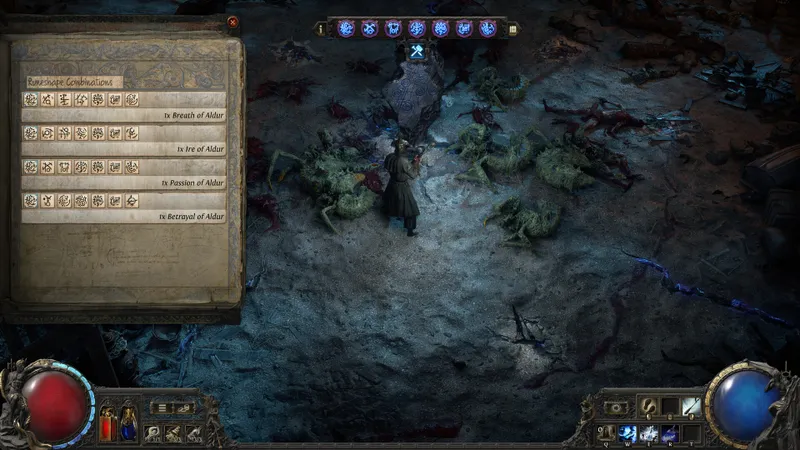
Verisium runeforging doesn't arrive all at once. The NPC Farrow, added with 0.5.0, gives four quests spread across the campaign, each one opening a layer of the system:
- Act 1 — the Verisium Anvil (Verisium Anvil: the French label for the crafting bench does not appear in the official FR patch notes): you can runeforge your armour pieces to add Rune Save to them by spending Verisium.
- Act 2 — the Alloy Currency Items, thirteen in total, unlocked via Waystone encounters. They remove a random modifier from a Rare item and replace it with a guaranteed modifier, on the same principle as Perfect Essences.
- Act 3 — Unique runeforging, which upgrades the base of Unique Weapons and Armour Pieces dropped below level 55.
- Act 4 — the 13 Ancient Runes, with powerful bonuses specific to each weapon type.
Verisium itself drops from monsters summoned by the Waystones present in every zone of the league. Its higher-tier version, Exceptional Verisium, only starts dropping at item level 65 and is used for high-level recipes.
The level 55 threshold: the real trade-off
This is the rule to remember, and it's binary:
- Armour below level 55: it gains Rune Save with no downside. There's no reason to skip it, it's pure gain throughout the campaign.
- Armour above level 55: it trades part of its base defence (Armour, Evasion, or Energy Shield depending on the piece) for Rune Save.
Past 55, the decision therefore depends entirely on how your character mitigates damage. If your survival relies on a high Armour value that mitigates physical hits, or on an Energy Shield recharge you've built around, sacrificing that base for a pool that only kicks in at 1 Life is rarely worth it. Conversely, on an Evasion character that takes few hits but handles the ones that land poorly, it's the missing safety net: the hit that used to kill becomes survivable, and the 5% per second recharges it while you reposition.
Practical advice: runeforge everything up to level 55, then test piece by piece beyond that. The anvil shows a preview of the effects — that's precisely what 0.5.2 fixed, so this information is accurate as of August 10, 2026.
How much does runeforging cost: actual Verisium prices
The cost depends solely on the armour base, not on its rarity or modifiers. It climbs sharply with the base's tier. A few reference points taken from the client's recipes:
| Base (FR label) | Verisium cost |
|---|---|
| Rusted Cuirass / Rusted Helm / Cracked Round Shield | 20 / 15 / 15 |
| Steel Chestplate | 75 |
| Vaal Cuirass | 130 |
| Commander's Helm | 150 |
| Rune Focus | 160 |
| Tribal Chief's Cuirass | 220 |
| Gilded Round Shield | 280 |
| Stone Cuirass | 330 |
| Imperial Helm | 460 |
| Ornate Chestplate | 480 |
| Tasalian Focus | 475 |
All armour pieces are affected, gloves and boots included (Gauntlets, Mitts, Wraps, Boots, and Sandals each have their own recipe). A set of campaign-tier bases costs a few hundred Verisium; an endgame set runs around 2,500 to 3,000 Verisium. For reference, US realm rates recorded on August 10, 2026 put a Divine Orb at around 18,600 Verisium: the expense remains modest compared to the cost of a crafted piece.
The alloys that boost Energy Shield
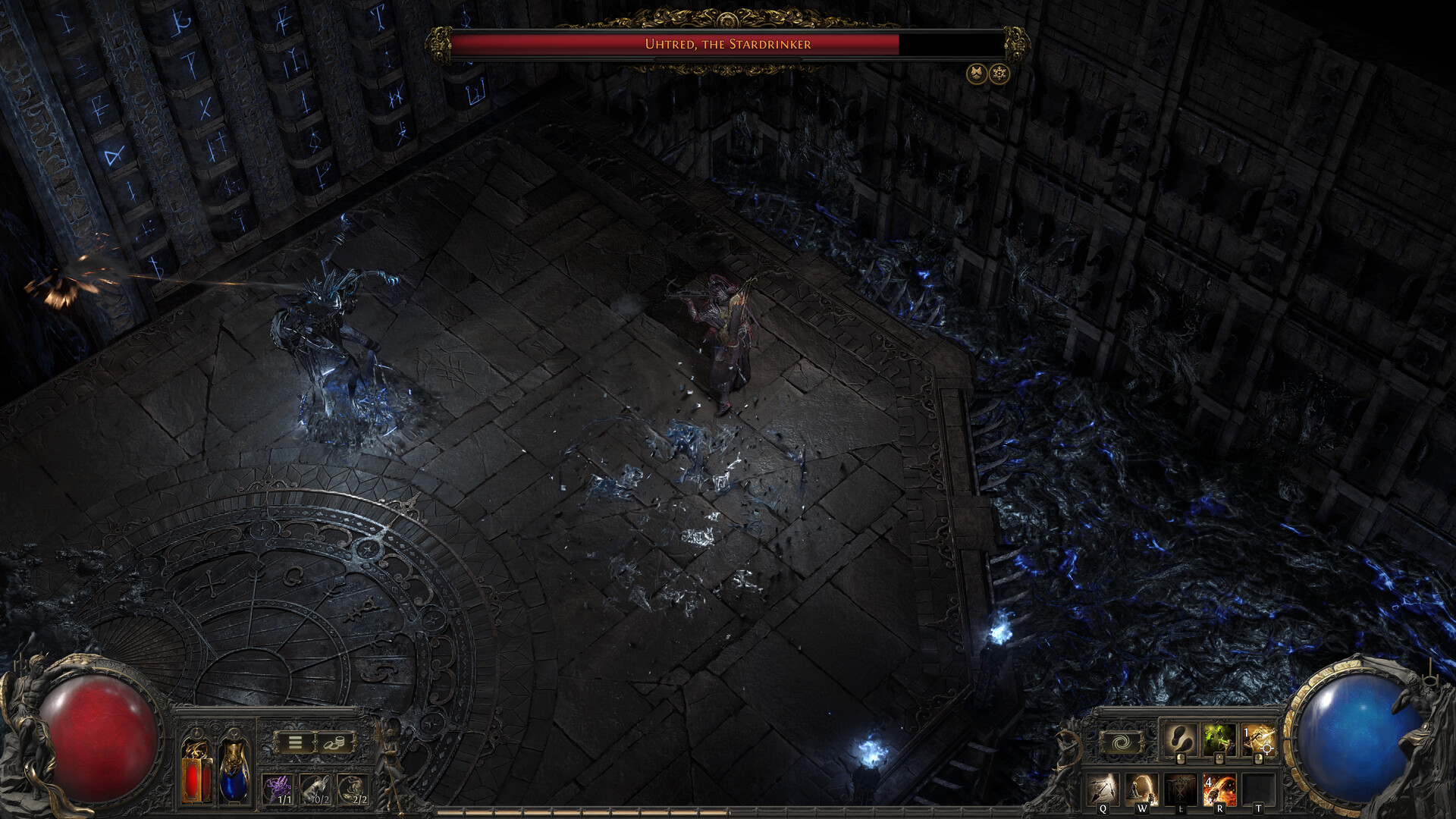
Of the thirteen Alloy currency items, four directly affect Energy Shield. These are the ones to target if you decide to make it a real defensive layer rather than just an extra bonus:
- Alliage runique — on a ring: +37 to 49 to maximum Energy Shield; on an amulet: 6 to 10% increased maximum Energy Shield; on a belt: 15 to 20% increased recharge rate. Prefix, required level 10: available very early.
- Protective Alloy (name not translated in the client) — on a weapon: +51 to 74 to maximum Energy Shield; on a belt: recover 32 to 45 Energy Shield on Charm use; on a shield: recover 10 to 15 on each Block.
- Alliage souverain — on an armor piece: 24 to 30% increased Energy Shield.
- Alliage adaptatif — the reverse, offensive use: it grants additional fire damage (42 to 52% on staff, 21 to 26% on wand) and 10 to 15% attack speed on gloves while you are missing Energy Shield. A build direction in its own right for those willing to play below the threshold.
Also worth noting: more than 15 Runes de Sauvegarde runique can be crafted at Waystones to add or modify stats related to this defense, and Augmentations antiques include dedicated lines — the Emergent Possibility copy, for instance, grants 50% increased Energy Shield recharge rate while Sprinting on boots.
Unique runeforging: faction insignias and rune-mastered tiers
Unique runeforging, unlocked in Act 3, works differently. It doesn't just cost Vérisium: each recipe also requires a faction leader insignia — Insigne du Cercle de Medved, Insigne de la Faux de Vorana, Insigne du Calice d'Uthred, or Insigne du Soleil d'Olroth — obtained by defeating the four leaders on the ocean islands.
Base Uniques below level 55 gain increased defenses and Energy Shield; upgraded Unique Weapons gain damage. Above 55, a Unique can still be runeforged, but with the same trade-off as normal bases. Unique runeforging also features additional properties on Kalguuran Uniques.
Above the "runeforged" tier there is a second, significantly more expensive tier, "rune-mastered": where a runeforged Wooden Club requires 205 Vérisium and an insignia, its rune-mastered version requires 460. On the armor side, some rune-mastered bases carry huge lines, such as the Runemastered Runic Fork and its +300 to maximum Energy Shield.
Two details almost no one exploits
First point, slipped into the changes brought to players in 0.5.0: your maximum Energy Shield is added to your starting Honour when you begin a Trial of the Sekhemas. For an ascension, temporarily boosting the pool before entering is a direct, free gain — simply swap in a ring or amulet with an Alliage runique for the duration of the attempt.
Second point: monsters can also have Rune Save, and as long as they do, they cannot suffer a Finishing Blow. If an Expedition Rune Monster or a Vestige rare stubbornly refuses to fall on the killing blow, it's not a bug: you first have to deplete its Rune Save.
What to remember before touching the anvil
Runeforge without hesitation anything below level 55: the gain is free and carries you through to the endgame. Past that threshold, only Runeforge what you've tested: Rune Save is excellent on a fast character that fears the one-shot, mediocre on an Armour wall that relies on mitigation. And if you make it a cornerstone, look for Rune Alloy and Protective Alloy, not Defences modifiers, which have no effect on it.
Share this article
At what point do you runeforge armour past level 55?
Frequently asked questions
Why does my character take hits worse at level 55 even though I runeforged my armour?
Before level 55, Runic Shield is added on top with no downside. Beyond that, it replaces part of your base Armour, Evasion, or Energy Shield. If your survival relied on that defensive foundation, you broke your mitigation while thinking you were strengthening it — it's a trade-off, not a gift.
Does Runic Shield protect me against damage that directly drains Life?
No. Mechanics that remove Life without going through damage (certain monster effects, curses) go straight through the Runic Shield pool like it's nothing. It only steps in if you're taking raw damage.
Which alloy should I prioritize for a real Runic Shield defensive layer?
Runic Alloy and Protective Alloy are the foundations: the first adds raw points or increases the maximum, the second recovers pool on every Flask use or Block. Sovereign Alloy amplifies all of it. Without one of these three, it's just cosmetic.
How much Verisium should I keep on hand to runeforge a full Atlas set?
Budget around 2,500 to 3,000 Verisium for an endgame set. For comparison, that's roughly 18,600 Verisium for a Divine Orb at the US rate as of August 10, 2026, so the expense stays reasonable.
Do increased Defenses modifiers boost my Runic Shield?
No. Since 0.5.0, Defenses modifiers (Armour, Evasion, Energy Shield) no longer affect Runic Shield. You need mods that explicitly name it to increase it.
Key takeaways
- Runic Shield isn't a permanent second Life pool — it only kicks in if you would drop to 0. It's a safety net, not a raw wall.
- Past level 55, runeforging costs part of your Armour, Evasion, or Energy Shield: test piece by piece so you don't sacrifice your main defensive layer.
- The four direct Alloys (Runic, Protective, Sovereign, Adaptive) turn Runic Shield into a real defense; without them, it's just a minor bonus.
- Verisium drops from Vestiges, with a cost that climbs sharply depending on the base: a campaign set costs a few hundred, an Atlas set around 2,500 to 3,000.
Comments
No comments yet. Be the first to react!
Leave a comment
Similar guides
Latest articles






Your opinion counts
Rate Path of Exile 2
Click a star to rate