


 Fabian Lainé

Economy
Paralives: cutting your bills and earning Paradimes, the household money guide (0.1.6b)
In brief
In Paralives 0.1.6b, cutting your weekly bill now relies on self-production (solar panels and wind turbines) since the 0.1.5 update. Household income is based on wages, but optimizing your jobs through application points and stacking up to three positions without overlapping schedules remains the real lever for building lasting wealth.
In Paralives, the bill comes due every Monday, and the household only has 24 hours to pay it. Once that window closes, a message appears in the center of the screen announcing that water and electricity have just been cut off, and service only comes back once the full amount has been paid. There's no settling one line at a time: it's all or nothing.
The good news is that this expense is finally manageable. The 0.1.5 update, released on July 2, 2026, states in black and white that water recyclers, wind turbines, and solar panels placed on the lot now reduce the bill (water recyclers, wind turbines, solar panels in the official notes). Before that, they were mostly decorative. Patches 0.1.3 and 0.1.4 had already fixed two bugs that were inflating the statement, including a toilet that used way too much water with every flush.
This guide breaks down the bill line by line, identifies the objects that actually weigh on consumption, then reviews the reliable income sources of version 0.1.6b, the latest public build before 0.1.7 on August 10, 2026.
What's on the Monday statement
Bills are addressed to the entire household: in Paralives, there's no individual bank account, only a shared pool of money. The statement is itemized line by line and mixes permanent and conditional charges.
- Municipal taxes: calculated based on the household's funds. Statements compiled by the community put the rate at around 0.5%, a value that the narrative profile (the Storyteller chosen at the start of the game) can adjust. It's the only line present on absolutely every bill.
- Electricity: charged per kWh consumed, so directly tied to the appliances switched on around the lot.
- Water: charged per liter, and sensitive to broken or left-running fixtures.
- Per-child allowance: a credit of about 200 Paradimes per minor, which obviously doesn't appear for a household with no children.
- Unemployment benefits: an optional line that disappears as soon as a household member holds a job.
- Daycare: billed by the minute and per child, with a flat surcharge per trip when the child is picked up from a lot you don't own.
In practice, a family with two children in daycare all week can see this line exceed electricity: shifting an adult's schedule to keep a child at home is often cheaper than a second mediocre paycheck.
The objects that really cost you
Not all appliances are equal, and the gap is more brutal than it looks. On the electricity side, lighting is negligible, electronics sit in the middle, and major appliances weigh several times more than a lamp. On the water side, toilets and sinks use little, while showers and bathtubs guzzle roughly four and a half times more per minute.
Three habits follow from this:
- Don't cut back on lighting. This is the classic mistake: stripping a house of its lamps saves almost nothing, but it tanks the Paras' mood and, with it, their work performance.
- Repair things immediately. A broken bathroom fixture keeps consuming, and a leak left for three days shows up on the next statement.
- Keep an eye on appliances before fast-forwarding time. A long stretch on fast speed with four appliances running gets paid for in full on Monday.
Switching to self-sufficient production, the real lever since 0.1.5
It's the most cost-effective change of the summer, and it remains surprisingly underused. The wind turbine produces more than the solar panel — around 0.95 kWh per minute versus 0.6, according to values recorded by the community — but it takes up more space and requires open outdoor terrain.
Two ways to get them:
- By purchase, at Melino's general store. The Bright Investment resident request specifically has you buy and then place a solar panel: you collect the reward and cut your bill in the same move.
- Free, via the museum. Collectible donations unlock rewards in tiers, including exactly these two pieces of equipment: a solar panel at the thirtieth item donated, a wind turbine at the sixtieth.
The detail that changes everything: the value of the collectible has no effect on how fast museum rewards unlock — only the total number of items donated counts. So prioritize donating your common artifacts, gems, and mushrooms, and keep the rare pieces for selling. Intermediate tiers also pay out cash bonuses: 250, 500, 1,500, then 2,000 Paradimes at the fifth, twentieth, fortieth, and seventieth donations.

Income: salary is only part of the equation
Landing a better-paying job thanks to application points
Job listings are split into eleven thematic fields, covering art, education, sports, food, health, maintenance, management, music, science, customer service, and software development. You can browse them on the phone, on the computer, or by clicking directly on a commercial building. They change every day: a listing left aside today won't be there tomorrow.
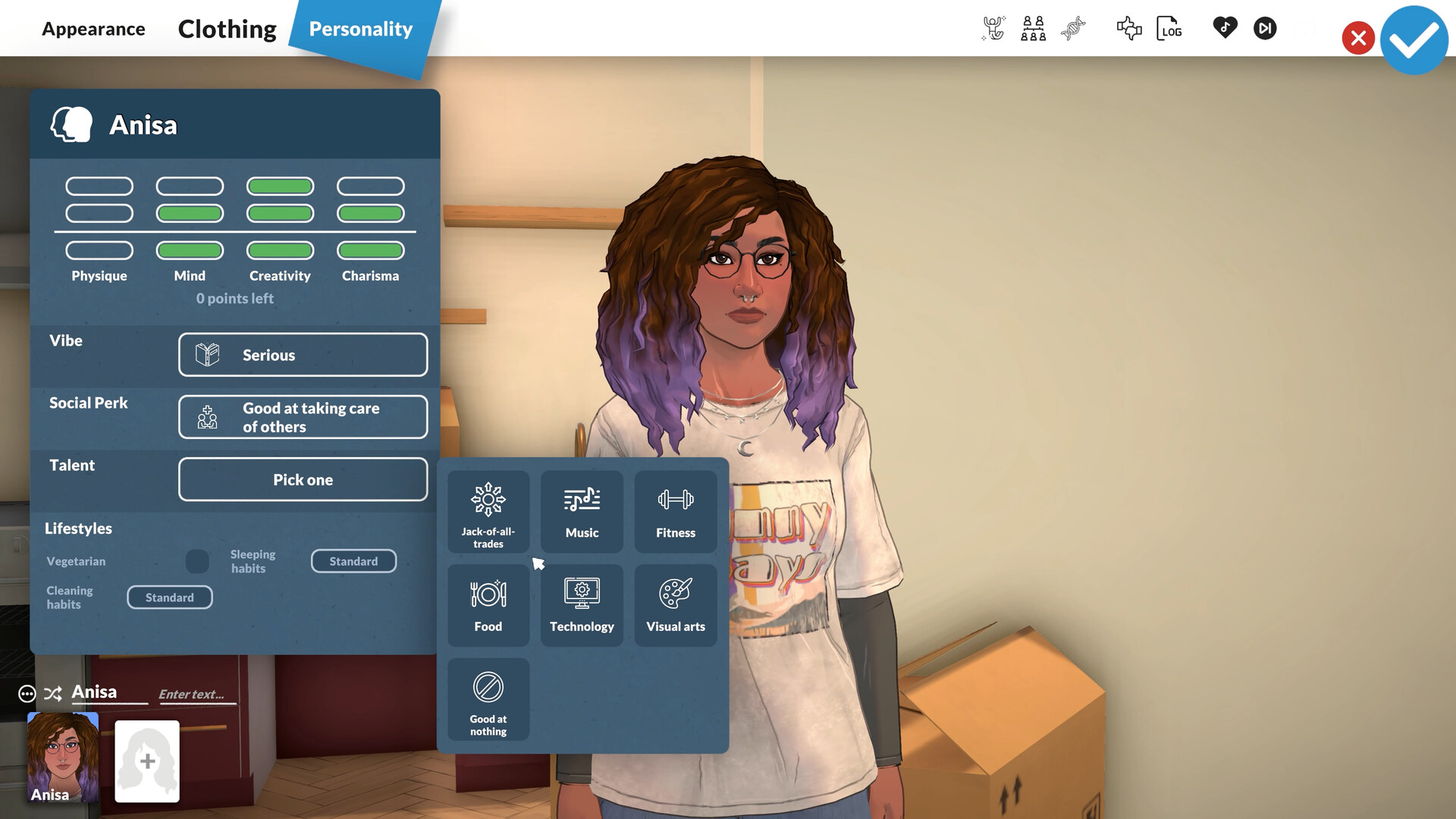
The hiring system itself is often misunderstood. A listing shows a set of criteria, but your Para does not need to check every box: they simply need to reach a total number of Application points across all categories combined, adding up skills, knowledge, base stats, and experience in a related job. A Para who's badly lacking in one specific skill can still get hired thanks to their stats or their work history.
In practice, it's therefore better to build up a related skill that's already well underway than to start from scratch on the one listed at the top of the ad. Switching career paths actually costs little: a café server who has picked up customer relations skills can move into a museum front-desk job, in a completely different field, because the requirement overlaps.
Stacking up to three jobs
A Para can hold up to three occupations at once, provided the schedules don't overlap. For a teenager, high school counts as a full occupation, leaving only two slots, and only if they fit around class hours. The occupation panel lets you adjust the hours of an existing job without quitting, which is the best way to make a second job fit.
Watch your attendance, which was tightened in 0.1.5: canceling the action of going to work or school now inflicts a performance penalty, bad days lead to warnings, and warnings eventually end in termination. Quitting, on the other hand, is immediate — but if triggered during a shift, it costs the Para that day's pay.
0.1.6 also overhauled time off: you start a new job with a stock of leave, accumulate more by working, and requests for days off or paid leave are made by phone.
Read job perk cards before clicking
At the end of a successful workday, your Para earns improvement points and is offered a choice between three Job Perk cards. There are around 155 of them, drawn based on workplace, skills, personality, and relationships: two Paras holding the same job will almost never see the same options.
Not all of them are worth taking, and some are outright cash traps:
- Totally Normal Agreement costs 2,000 Paradimes for one extra improvement point for just three days.
- Completely Legal Transaction costs 5,000 Paradimes to double performance over five days.
- Serious Training grants +30% performance, but adds a 200 Paradime charge to your bill every week.
- Give it Your All increases your chances of a bonus point while also making warnings easier to rack up.
Conversely, several cards credit your weekly statement directly: All Expenses Paid, Accounting Responsibilities, or Spare no Expense add a positive bonus to the bill. Simple rule: as long as your household finances are tight, always prioritize rank advancement, which permanently increases daily pay, over a conditional paid bonus.
Finally, keep in mind that progression isn't linear: a nurse doesn't become a doctor by accumulating ranks, she becomes a better-paid nurse. Changing careers always requires a new job application.
The side income that makes a difference
Townie Requests are the most reliable source of income in the game at this stage. You pick them up from a bulletin board topped with an exclamation point, or directly from a resident marked with the same symbol. Every board in town offers the same list, refreshed daily, and you have to go back to the requester to collect the reward — currently fixed at 100 Paradimes and a friendship gain, regardless of the request.
Since the reward is uniform, pick the fastest requests: several can be wrapped up in a few seconds if you already have the requested items in your inventory, like two anvils or two quartz. Skip the ones that demand ten hours at the gym, unless you were planning to level up that skill anyway.
Two more tips round out the picture. Selling collectibles first, at around 30 Paradimes for a common artifact and 70 for an uncommon piece. Then smart shopping: the antique shop sells furniture cheaper than the Build Mode catalog, and the Bloom shop offers a free plant every day.
The routine to follow every week
Pay the bill as soon as it arrives on Monday rather than letting it sit: the 24-hour window closes fast when you're playing on accelerated time, and a water cutoff drops the hygiene of the whole household, and with it their mood, and with it their work performance. The vicious circle closes back in on your paycheck.
Then do a walk-through of the lot before every big time skip: appliances left on for no reason, broken plumbing fixtures. Finally, if you're aiming for energy self-sufficiency without spending money, dig through buried chests and donate your common finds to the museum: thirty items for the solar panel, sixty for the wind turbine, the only two rewards in the game that lower a fixed bill.
One last thing to keep in mind before update 0.1.7 on August 10, which reworks indoor lighting: a lot of players are going to be repositioning lamps right after. Since that's the lightest electrical item, you can go for it without worrying about the following Monday's reading.
Share this article
Which economic strategy appeals to you most in Paralives?
Frequently asked questions
What weighs the most on my electricity bill?
Big appliances completely dwarf lighting costs: leaving a lamp on barely costs anything compared to running an oven or a washing machine. Electronics fall somewhere in between.
I don't have the money to buy a solar panel and wind turbine, how do I get them for free?
Donate your common collectibles to the museum: the solar panel unlocks at the 30th item donated, the wind turbine at the 60th. Only the total count matters, not the value, so clear out your cheap artifacts and keep the rare ones to sell.
How do I know if a better-paying job is actually accessible for my Para?
Forget about checking every single criterion: simply add up your application points across all categories (skills, knowledge, base stats, past experience). If the total reaches the required threshold, you're hired, even with a major gap on one isolated criterion.
I want my Para to work part-time across two jobs, is that possible?
Yes, up to three simultaneous jobs as long as the schedules don't overlap. Adjust the hours of an existing job through the occupation panel instead of quitting, and be careful: canceling the action of going to work now inflicts a performance penalty.
Are there any career perk cards to absolutely avoid?
Yes, some are traps that drain your savings. Always read the details before accepting, especially costly offers like the Totally Normal Agreement at 2,000 Paradimes, which can deepen the hole instead of improving it.
Key takeaways
- The wind turbine produces 0.95 kWh/minute versus 0.6 for the solar panel: the value-for-money ratio changes everything depending on your lot
- Repair any broken equipment immediately instead of playing it cheap: a leak left unattended for three days blows up your next bill
- Application points add up skills, base stats, and past experience: you don't have to check every single criterion
- Stacking three jobs without overlapping schedules is possible, but attendance has been tightened since 0.1.5, and canceling work now costs you performance
- The museum unlocks the solar panel and wind turbine for free through common collectible donations: 30 and 60 items respectively
Comments
No comments yet. Be the first to react!
Leave a comment
Similar guides

Latest articles





Your opinion counts
Rate Paralives
Click a star to rate