
 Fabian Lainé
Full Guide
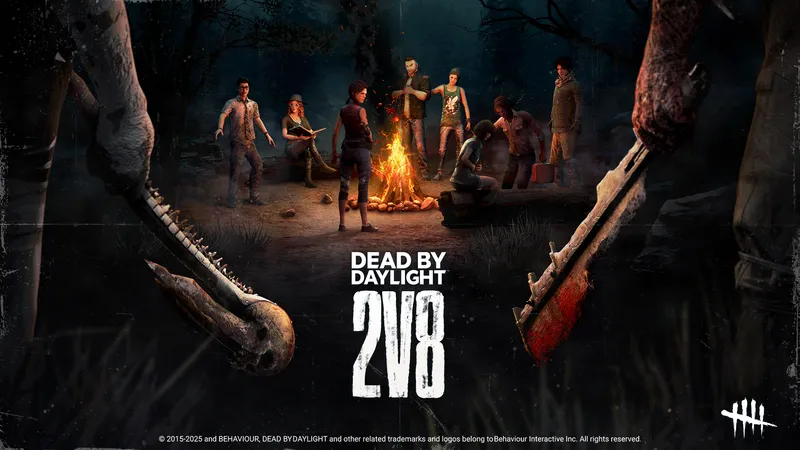
Dead by Daylight 2v8: the guide to the 2-killers-vs-8-survivors mode, back from August 11 to 18, 2026
In brief
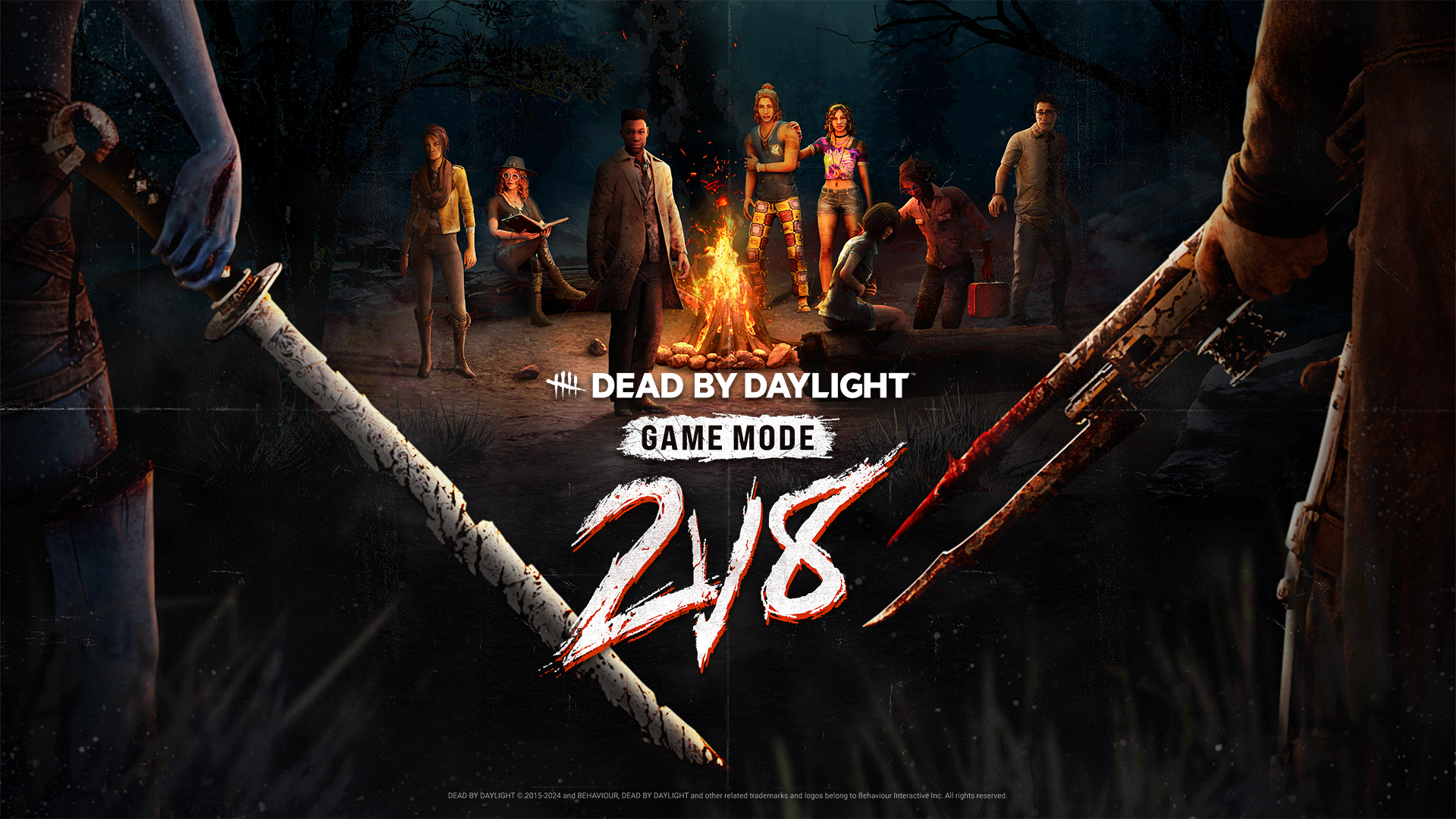
2v8 is back for just one week, from August 11 to 18, 2026, as part of the Summer Shrieks event. This wild mode pits two killers against eight survivors on oversized maps with radically different rules: 13 generators, only 8 of which need repairing, Corrupted Cages instead of hooks, and a unique class system that completely replaces traditional perks.
The 2v8 mode in Dead by Daylight returns on Tuesday, August 11, 2026 and will only run for seven days, until August 18. This is the mode's ninth iteration, and above all the shortest in its history: the previous eight lasted between fourteen and twenty-two days.
This tight window is explained by its place within the summer event “Summer Shrieks”, launched on July 28 and split into three weeks, one per modifier: “Chaos Shuffle” from July 28 to August 4, “Lights Out” from August 4 to 11 — the one currently running — then 2v8 for the final stretch, until the event ends.
Seven days isn't enough to learn the mode on the fly. Here's what actually changes compared to a standard trial, how the nine classes are split up, and which quests are still available to complete before it closes.
A 2v8 trial doesn't play by the same rules
The mode is played on oversized versions of the usual maps, unavailable outside of 2v8: 21 variants are in rotation, from the Raccoon City Police Station to Greenville Square. On each of them, the main objective is rewritten:
- 13 generators appear, of which only 8 need to be repaired to power the doors.
- Each generator's repair requirement is lowered to 70 charges, but regresses at 200% of the normal rate when damaged by a killer.
- Repair speed is reduced by 5% per generator already completed, cumulatively, and increased by 2.5% per cage state suffered by the team.
- There are 3 exit gates and 3 hatches, the latter only opening once just two survivors remain alive.
This dual scaling is the mode's most underused subtlety: the further the team progresses, the more it slows down, and the more cage states it takes, the faster it goes. A squad that loses two players early isn't doomed, whereas a team that clears four generators without ever getting caught will see the eighth one drag on forever.
Another structural difference: killers only see generator auras within a 64-meter radius, unless two survivors are repairing the same generator — the range then becomes unlimited, as in 1v4. Repairing as a pair on the other side of the map is like lighting a beacon: save the duo for generators you're finishing off, not the ones you're just starting.
Three secondary values: self-mending drops to 7 seconds on yourself and 5 seconds on an ally, a dropped pallet gets back up in 3 seconds, and up to three survivors can heal the same target. Emblems are hidden: playing 2v8 exclusively freezes your ranked progression.
Corrupted Cages decide the match
There are no hooks in 2v8: killers send survivors into Corrupted Cages, a variant of the Executioner's Cages of Atonement. The downed survivor must first be picked up, then goes into a cage after a brief delay that gives allies a real window to attempt a stun or a blind. The sacrifice timer is shortened to 120 seconds, or 60 seconds per cage state, and freeing an ally triggers no alert sound: rescues are silent.
The anti-camping system is specific. If a killer stays within 20 meters of a cage, a gauge fills faster the closer they are; 15 charges are enough. Once charged, the prisoner can relocate their own cage elsewhere on the map, which also suspends the sacrifice for 30 seconds. Key nuance: if another survivor is also nearby, the cage does not move and instead grants +15% unhook speed. Standing next to a caged ally while the killer camps therefore cancels the teleport: if you don't plan to make the rescue right away, move away and let the cage relocate.
One last point that's often overlooked: rescues recharge the whole team's active abilities — +30% for the rescuer, +20% for the freed survivor, +10% for everyone else. A squad that consistently goes to fetch its allies keeps its class abilities available at all times.
Self-recovery, the only real anti-slug counter
Since two killers down survivors faster than a team can pick them up, every team perk comes with an anti-slug function. If your active ability is fully charged and you've reached 70% recovery while in the dying state, you consume the charge to pick yourself back up. This threshold was set at 94% until the sixth iteration: it's now much easier to reach, which is why you should never burn your active ability "just in case."
The Exposed effect, to watch at all times
The Exposed status is exclusive to 2v8 and triggers in three cases:
- When a survivor enters a chase: they are exposed for 5 seconds, or until the second killer gets within 16 meters of them.
- When a killer damages a generator: all survivors within a 20-meter radius are exposed for 5 seconds.
- When a generator is completed: all survivors who have not yet been caged are exposed for 5 seconds.
The third is the most punishing: completing a generator early in the match, when no one has been caged yet, lights up all eight survivors at once. Step away from the generator just before it finishes and don't stay grouped together at the moment it's completed.
The five survivor classes
Classes fully replace perks, items, add-ons, and offerings. Each provides three perks: an aura-revealing perk, a team perk with an active ability, and a perk that only unlocks after a first cage state. Up to four survivors can share the same class.
- Fugitive — mobility and loops. Reveals nearby pallets and windows and triggers a collective sprint burst for the whole area. The most cost-effective class on maps this big.
- Guide — the objective. Reveals generators, speeds up door opening, and sets a trap that stuns the killer who comes to damage the generator.
- Medic — area healing. Greatly speeds up healing in your vicinity, muffles grunts of pain, and instantly restores a chunk of health to everyone at once.
- Scout — information and pallets. Sees the killer breaking a pallet and can restore destroyed pallets, which recreates loops in dead zones.
- Torchbearer — class added in the seventh iteration, in February 2026, built around light: revealing the killer with a lamp and blinds to secure unhooks.
A distribution that works with eight players: two Guides, two Medics, two Fugitives, and two Scouts or Torchbearers. Stacking four Medics, the classic solo temptation, doesn't solve anything: with no one on generators, the match drags on until the cages do their job.
The four killer classes and the fifteen playable killers
On the killer side, the classes are Brute, Executioner, Alarmist, and Shadow. Unlike survivors, the two killers must pick different classes: the duo's composition is a real tactical choice. The Brute relies on destruction and generator pressure, the Executioner draws its strength from two-player coordination and marks its targets, the Alarmist plays on fear and revelation, the Shadow becomes undetectable after sending someone to a cage.
Each killer's power, on the other hand, never changes: it lies in an innate ability shared across all classes. Fifteen killers are selectable, in the order their chapters were released: the Trapper, the Wraith, the Hillbilly, the Nurse, the Huntress, the Spirit, Ghost Face, the Oni, the Deathslinger, the Executioner, the Plague, the Nemesis, Mastermind, the Good Guy, and the Lich. Each can only be picked by one player at a time, and the Legion has been removed from the pool since the sixth iteration. Note that when Mastermind and the Nemesis are present together, a limited item appears on the map, the Antidote, which removes contamination.
The "Howls of Summer" quests to finish before August 18
The event's quests stack up over the three weeks and unlock three banners of Very Rare rarity, tied to the Waterfront Massacre collection. Behaviour has not published any French label for these rewards: they keep their English name in the client.
- Summertime Smash — 4 quests completed.
- Bonfire Bonding — 9 quests completed.
- Sunshine, or Whatever — 14 quests completed.
The first batch of objectives, credited with 10,000 Bloodpoints, requires completing 12 trials, sacrificing or killing 20 survivors (or repairing 20 generators), destroying 12 pallets (or cleansing 2 totems), damaging 10 generators, hitting 50 survivors with a basic attack, and staying in a chase for 60 seconds within a single trial. Almost all of these counters progress in both 2v8 and normal matches: the week of August 11 is the best time to knock them all out, as trials there are longer and richer in chases.
The shop is meanwhile offering two outfits released on July 28: Tan Session for Vee Boonyasak and Touch Sand for Kwon Tae-young, priced at 1,080 Auric Cells for the full outfit, 400 per individual piece.
To do before Tuesday
You have five days left of the "Fire Extinguished" event to work through the generic objectives — chases, pallets, basic attacks — while the no-perks mode keeps churning out short matches. Save anything that requires volume for 2v8: generators repaired or damaged, sacrifices, trials completed.
If you plan on playing killer, turn on the "Play While You Wait" option: it lets you start a trial as a survivor while keeping your spot in the killer queue, which remains the mode's weak point. Also note that a disconnected killer is replaced by a bot, but the match stops dead if the second one leaves in turn.
Don't count on an extension: 2v8 closes on August 18 along with the event, and the mode has historically only come back once every three to four months. The next slot on the calendar is already taken by Chapter 41, expected on August 25.
Share this article
Do you think seven days is enough to master 2v8 before it disappears?
Frequently asked questions
Why is 2v8 only running for seven days this time?
The Summer Shrieks event spans three weeks with three different modifiers, with 2v8 taking the final stretch from August 11 to 18. This is the shortest duration in the mode's history, unlike previous iterations that ran between fourteen and twenty-two days.
Do you really need to repair 13 generators or just 8?
Only 8 of the 13 generators in play need to be repaired to power the exit gates. Each one costs 70 charges, but every completed repair slows down the next one by 5% speed, creating an increasing difficulty curve.
What really changes compared to a classic 1v4 match?
Everything: no hooks but Corrupted Cages instead, two coordinated killers instead of one, oversized maps, a unique class system replacing perks, only 120 seconds before sacrifice instead of 180, and an Exposed status exclusive to the mode that regularly exposes your team.
Does playing solo really freeze my ranked progression?
Yes, emblems are hidden in 2v8 and your rank does not progress. It's a standalone mode, so you shouldn't go into it expecting to farm ranked progress at the same time.
Which killer is really OP in 2v8?
There's no individually overpowered killer, it's the duo composition that decides: a Brute who destroys generators paired with a Hunter who marks targets offers far more pressure than a random duo with no synergy.
Key takeaways
- Repairing a generator with a teammate in a remote corner signals your position to both killers, so coordinates lose all strategic value.
- Corrupted Cages can be relocated by the prisoner themselves if a killer camps too long, but a nearby ally cancels this teleportation.
- The Exposed status lights up all survivors when a generator finishes early in the match, so you need to step away before it pops.
- Classes' active abilities partially recharge with every ally rescue, which makes team saves critical for maintaining pressure.
- Two Guides, two Medics, two Escapists, and two Scouts or Torchbearers is the composition that holds up, not four Medics letting the generators rot.
Comments
No comments yet. Be the first to react!
Leave a comment
Similar guides




Latest articles


Your opinion counts
Rate Dead by Daylight
Click a star to rate