 Fabian Lainé
Full Guide
Brawl Stars: the 2027 circuit revealed — 8 EMEA spots, promotion-relegation, and Challengers become the only way in
In brief
Supercell reveals the structure of Brawl Stars Esports 2027: a two-tier system with 8 teams per region at the top and the Challengers as the sole entry point for newcomers, a promotion-relegation system linking the two, and a year split into two Splits to maintain competitive tension all the way to the World Finals.
On August 24, Supercell released the first preview of the Brawl Stars competitive circuit for 2027. Supercell's stated goal: to make "Brawl Stars esports easier to access, simpler to follow, and super tense at the top." In concrete terms: promotion and relegation between two tiers, a season split into two segments, and a finally readable path from an open tournament to the world championship final.
A precaution before anything else, straight from Supercell: "our plans for Brawl Stars esports in 2027 are still under development, so the information below is subject to change." None of what follows is a fixed schedule.
Update, August 30. Our first version stated that Supercell only published its esports communications in English and therefore used English labels. That's incorrect: Supercell did publish this announcement in French, on August 24. The labels and quotes in this article are now theirs.
Two connected tiers: the top level and the Challengers
The Brawl Stars Championship — CBS in Supercell's French-language communications — moves to two tiers that connect to each other. This is the structural overhaul for 2027.
The top level: 8 teams per region
"This is where the elite of players compete." Eight teams per region, across four named regions: APAC, EMEA, South America, and North America. The format there combines "league matches, playoffs, and regional rankings."
French and European teams fall under EMEA. Eight spots, for a zone covering Europe, the Middle East, and Africa: selection will be tough.
Mainland China remains a central region of the CBS, but Supercell is putting off its 2027 format for later.
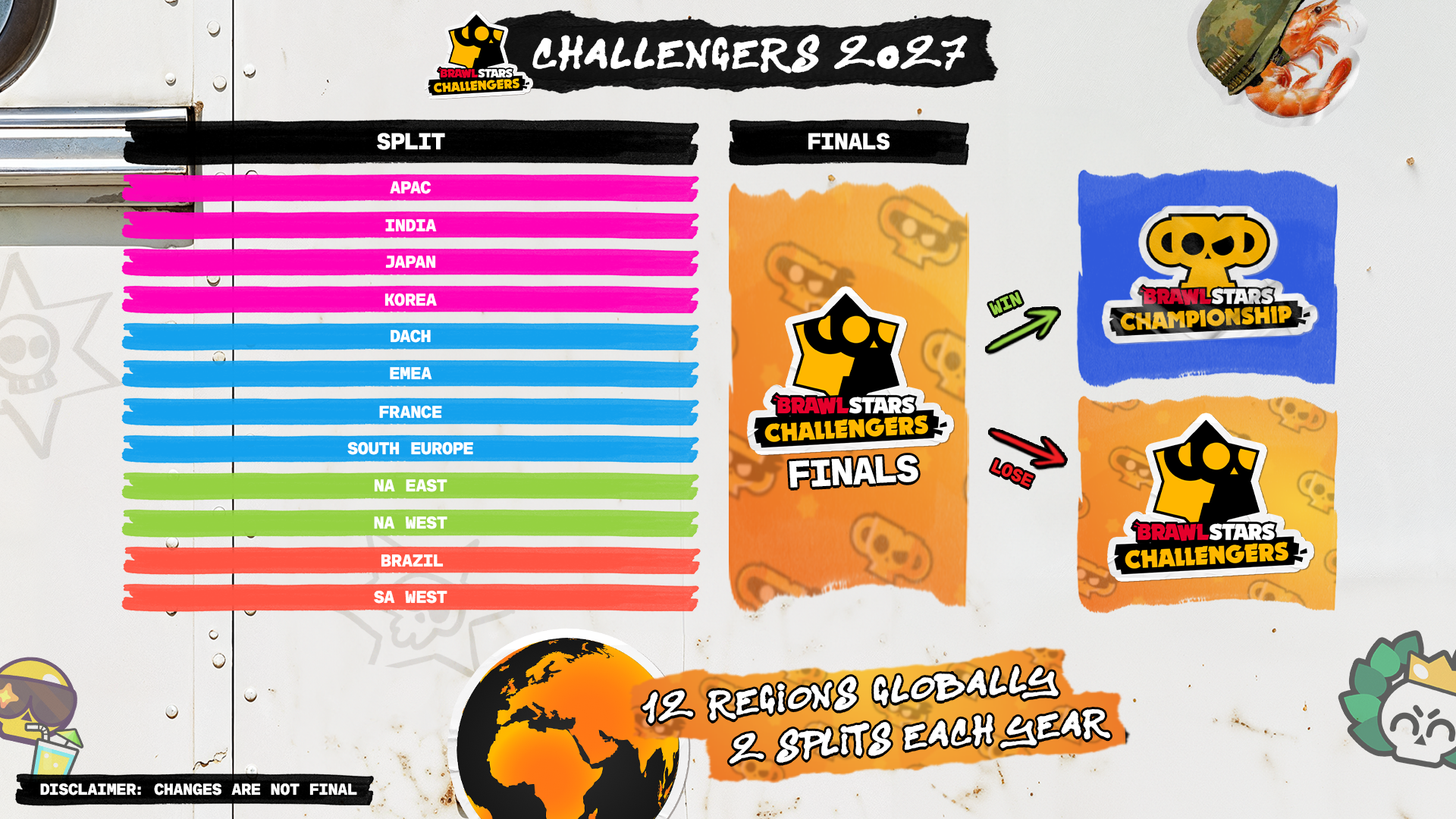
The Challengers: 12 regions, and the only way in
This is the most significant change for players who aren't already professionals. The Challengers become "a competition in its own right within the CBS," spread across twelve regions, and Supercell is categorical about their status:
"Outside of the initial 2027 seeding, the Challengers will be the only path to top-level competition."
The path there is clearly marked: open qualifiers → leagues → playoffs → Challengers finals. Splitting the circuit into twelve regions instead of four has a clear purpose: to let players "enter competition on their home turf" and turn "local success into an opportunity to reach the top."
Supercell adds an intention worth noting: its goal is "to make most of the Challengers finals in-person events," so that up-and-coming teams can play "in front of their own crowd."
Promotion and relegation: no one is safe
This is the mechanism that links the two tiers, and it works in both directions.
- The selection of the eight top-level teams will be based "in part on their 2026 performance and on a qualifying event".
- Then, "it's up to you to stay at the top": finishing at the bottom of the standings means having to defend your spot against the best teams coming up from the Challengers.
- The Challengers finals are the setting for this clash: the best up-and-coming teams face off against the top-level teams fighting to keep their place. Secure the win, Supercell writes, and you "could face the biggest teams during the second split".
In other words, a club can move up during the year, and an established club can move down. Supercell sums it up like this: "every spot at the top is still up for grabs".
The year split in two: 1st split and 2nd split
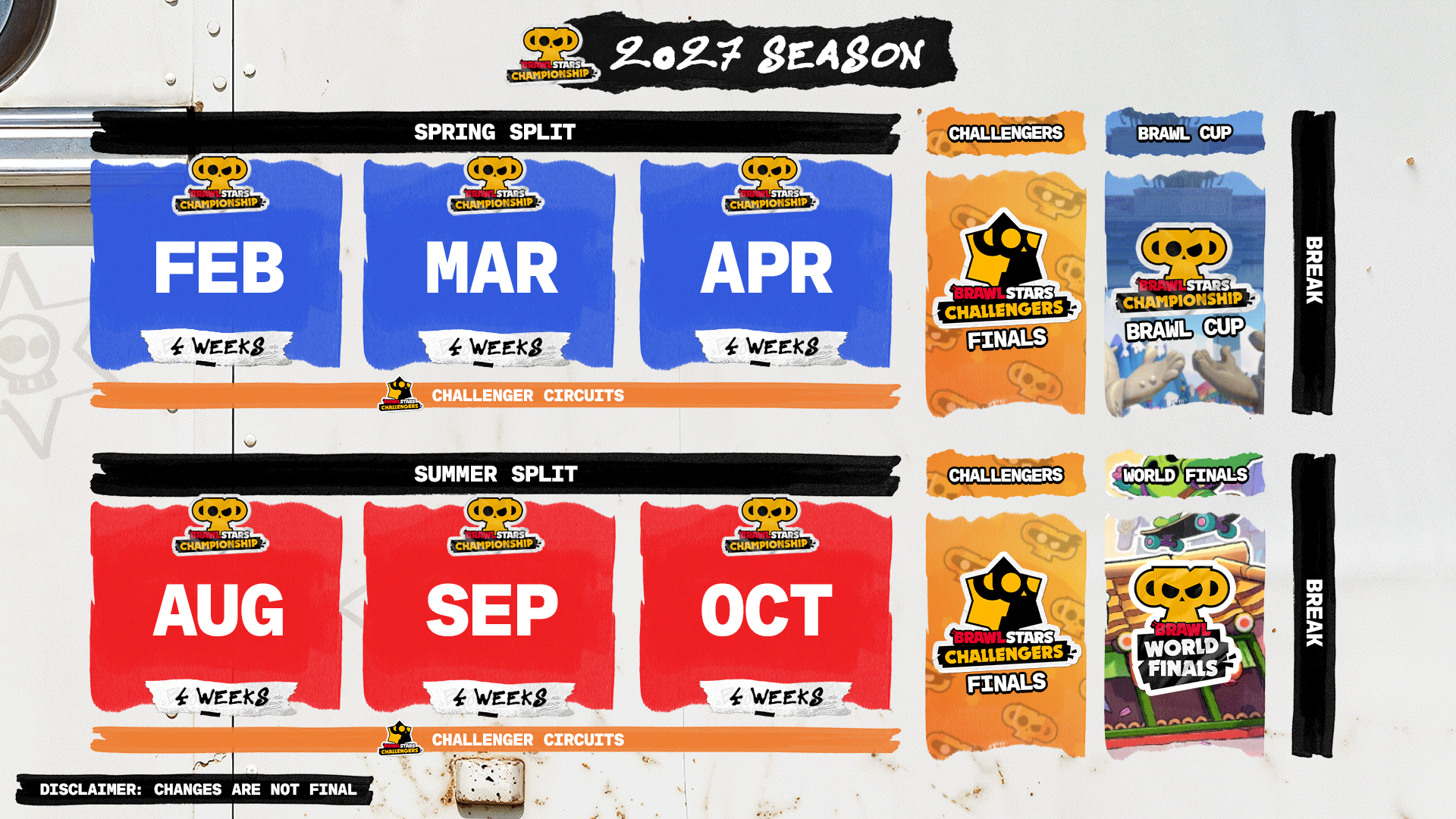
Both halves share the same structure but lead to two different destinations.
| 1st split | 2nd split | |
|---|---|---|
| Duration at the top level | 12 weeks | 12 weeks |
| Structure | 1st group stage (8 teams, round-robin format) → mid-season playoffs → 2nd group stage → regional playoffs | identical |
| Outcome | Brawl Cup | Brawl Stars World Finals |
| Secondary stakes | staying at the top level | staying at the top level, plus promotion for 2028 via the Challengers finals |
The Brawl Cup, and the detail that matters
The Brawl Cup is described as a three-day international LAN tournament, "our first big event of the year". It comes with a consequence many will underestimate: the winner earns their region an extra spot at the World Finals.
This isn't just a symbolic trophy: winning the Brawl Cup expands the EMEA quota for the end-of-year World Finals. One team's performance benefits the entire region.
The 2nd split, where everything adds up
"By now, everyone knows the format, but the pressure is even more intense. Every match can make the difference between reaching the World Finals, keeping your spot at the top, or having to fight to avoid relegation." The 2nd split's Challengers finals decide, at the same time, who starts 2028 at the top level. As Supercell writes, "the stakes are high right until the end".
What changes for clubs and organizers
Two more low-key but concrete announcements:
- The partner club program is expanding in 2027. Supercell promises "an update to event.brawlstars.com" and "a revised and improved membership process", to watch for "in the coming weeks". Clubs looking to join Brawl therefore have a window opening up.
- A better support system for tournament organizers is in the works, with "more info on this in the coming months".
Finally, the Brawl Esports team — the name Supercell keeps for its esports accounts — announces an FAQ "soon" on X, Reddit, and Instagram. That's where the points left open will be settled — the Chinese format, the exact schedule, the qualification scale.
A note on the names
Supercell does publish this announcement in French, and the labels used above are its own: championnat Brawl Stars (CBS), Challengers, Coupe Brawl, finale du mondial, 1er and 2e segment, play-offs de mi-saison, play-offs régionaux, 1re and 2e phase de groupes, qualifications ouvertes, finales des Challengers, programme des clubs partenaires. These are the terms of the French version of the esports blog, not a translation of our own making.
Two caveats, though. First, a substantive discrepancy between the versions: the French page places the highest level in APAC, EMEA, South America, and North America, whereas the English page writes "East Asia". The two don't describe the same zone, and here we stick to the French wording, which the German version confirms. Second, Supercell keeps calling its esports team and social media accounts Brawl Esports, while writing "e-sport Brawl Stars" in the body of its texts: both forms coexist at the publisher.
What to take away
- Eight EMEA spots at the highest level, awarded first based on 2026 results and a qualifying event.
- The Challengers become the only path after this initial seeding: twelve regions, qualifications open to all.
- Promotion and relegation at the Challengers finals, at each of the two segments.
- Winning the Brawl Cup earns an extra spot at the world finals for the entire region.
- Nothing is set in stone: Supercell itself warns that these details may change.
Share this article
Are you convinced by this new esports system for Brawl Stars 2027?
Frequently asked questions
How can a French team reach the EMEA top tier in 2027?
Through the Challengers, which offer a path: open qualifiers → league → playoffs → Challengers Finals. The best teams from the Challengers Finals face the top-tier teams defending their spots, and the winners move up to the top tier for the following Split.
Can a team be relegated from the top tier during a season?
Yes. Finishing at the bottom of the standings forces a team to defend its spot at the Challengers Finals. If it loses to the teams moving up, it drops back down to the Challengers for the following Split.
What's the benefit of winning the Brawl Cup?
Beyond the title, the winner brings an extra spot to the World Finals for their entire region. It's a collective benefit: a French victory expands the EMEA quota for the World Finals.
How many Splits are there in 2027?
Two. Split 1 leads to the Brawl Cup, and Split 2 leads to the World Finals. Both share the same structure, but the stakes in Split 2 are higher since they also determine qualification for the World Finals and seeding for 2028.
Is this information final?
No. Supercell itself warns that details may change. The Chinese format, the exact schedule, and the qualification criteria will be clarified during a Q&A session 'soon' on X, Reddit, and Instagram.
Key takeaways
- The Challengers become the sole path to the top tier after the initial placement, with 12 regions and qualifiers open to everyone.
- A functional promotion-relegation system: spots at the top are never guaranteed, and the standings can shift with every Split.
- Only 8 EMEA spots available at the top tier, making regional competition extremely selective.
- Winning the Brawl Cup grants an extra spot at the World Finals for the entire region, rewarding the whole region rather than just the winner.
- The year is divided into two Splits that are structurally identical but carry different stakes, leading up to the World Finals at the end of the year.
Comments
No comments yet. Be the first to react!
Leave a comment
Similar guides
Latest articles


Your opinion counts
Rate Brawl Stars
Click a star to rate