



 Fabian Lainé
Recipes
Windrose: The Cooking Guide — Recipes, Buffs, and Cooking Fire Upgrades (2026)
In brief
Windrose treats food as a real buff system: every dish boosts your max HP and grants a stat bonus for 15 to 30 minutes. This guide covers the four levels of the Cooking Fire, recipes verified in version 0.10.0, and the six epic +20 dishes that turn the tide of boss fights.
In Windrose, food doesn't fill a hunger bar that empties over time: every dish you eat raises your maximum health cap and, for the best recipes, adds a stat bonus for 15 to 30 minutes. Kraken Express's pirate survival game treats cooking as a genuine buff system, on par with gear or the talent tree — and it's probably the most underrated power lever in the game.
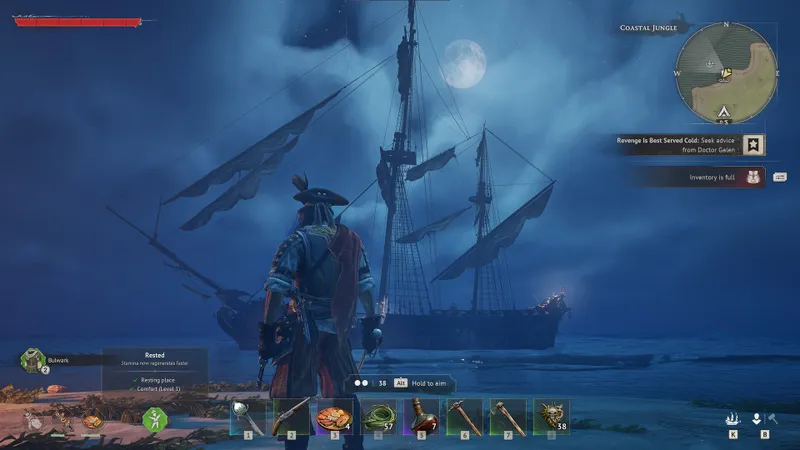
In practical terms, you have two active food slots, visible at the bottom left of the screen. As long as they're filled, your maximum health climbs above its base value; when both are empty, your pirate becomes starved and drops back to its floor. The golden rule never changes: two active dishes at all times, one for health points, one for your build's stat.
This guide is based on data from version 0.10.0 (latest patch 0.10.0.8 deployed on July 8, 2026): exact costs of the Cooking Fire and its three upgrades, recipes verified in the French client, and the six epic +20 dishes that make the difference against bosses and during boarding actions.
How food works in Windrose
Every food item consumed takes up a slot and applies two effects: an increase to max HP, which always applies, and — for cooked dishes — a bonus to one of the game's six stats: Strength, Agility, Vitality, Precision, Constitution, or Mastery. Raw fruit picked up along the way (banana, coconut, tomato, lime…) only grants HP for a few minutes; prepared dishes last 15 minutes for the simplest ones, 30 minutes for everything else.
Three details change how you play:
- Eating a third dish replaces the oldest buff: you can't stack three bonuses, but you can "refresh" a buff before a fight without waiting for it to expire.
- Food weighs almost nothing (0.1 to 0.3 encumbrance per unit, in stacks of 10 to 30): there's no excuse for setting sail without a stack of each key dish in the hold.
- Advanced recipes can't be bought and aren't unlocked in the talent tree: they appear automatically once you discover their signature ingredient (see below).
The Cooking Fire and Its Three Extensions
All cooking runs through a single station, the Cooking Fire, which three neighboring modules level up. The four tiers determine which recipes are accessible.
| Construction | Cost | Tier Unlocked |
|---|---|---|
| Cooking Fire | Wood x3, Stone x3 | Level 1 |
| Cutting Table | Wood x10, Copper Ingot x2 | Level 2 |
| Kitchen Utensil Shelf | Hardwood x10, Iron Utensils x2 | Level 3 |
| Supply Shelf | Hardwood x5, Coffee Beans x5, Salt x5, Nuts x5, Russula x5 | Level 4 |
Three important details, often missing from English-language guides. First, the extensions only work within range of the campfire: place them right up against the Cooking Fire, within your base's radius. Second, the Cutting Table, the Kitchen Utensil Shelf, and the Supply Shelf also upgrade the Dismantling Table: a well-placed kitchen corner serves two stations for the price of one. Finally, the Cooking Fire grants +1 Comfort, but comfort bonuses from fire sources don't stack with each other — there's no point lining up three fires to sleep better.
Like all constructions in the game, these stations have 4,500 structure points and slowly degrade over time: regular upkeep runs prevent you from coming back to a ruined kitchen after a long expedition.
Unlocking Recipes: It's All About Discovery
Windrose does not display any recipe-purchasing menu. Each dish is tied to a "discovery": the first time you pick up the signature ingredient, the corresponding recipe is added to the Cooking Fire. The Mysterious Spices from the Cursed Marshes alone unlock the Taco, the Gazpacho, and the Hearty Crocodile Kebab; the Coffee Beans from the Foothills open up Coffee; the Cocoplum gives the Marsh Pie, the Russula gives Meat in Spicy Mushroom Sauce, and so on.
Practical translation: if an epic dish is missing from your recipe book, it's not a level issue, it's an ingredient you've never held in your hands. Explore the relevant biome, pick up one unit of each unknown resource, and the recipe will follow.
Level 1 and 2 dishes: the foundation of progression
Here are the verified recipes for the first two tiers, with their exact quantities:
| Dish | Recipe | Bonus | Duration | Level required |
|---|---|---|---|---|
| Tortilla | Corn Flour x1 | Max HP only | 15 min | 1 |
| Tamale | Crocodile Tail x1, Leek x1 | +5 Mastery | 15 min | 1 |
| Bean Soup | Beans x1, Cayenne Pepper x1, Meat x1 | +5 Agility | 15 min | 1 |
| Cocoplum Pie | Nut x1, Cocoplum x1, Corn Flour x1 | +5 Precision | 15 min | 1 |
| Beans with Mushrooms and Sweet Potato | Beans x4, Russula x2, Sweet Potato x4 | +10 Vitality | 30 min | 1 |
| Spicy "Chicken" with Sweet Potato | Bird Meat x2, Cayenne Pepper x5, Sweet Potato x3 | +10 Vitality | 30 min | 2 |
| Fish and Patacón | Fish Fillet x3, Nut x2, Banana x3 | +10 Vitality | 30 min | 2 |
| Chowder | Fish Fillet x3, Sweet Potato x3, Salt x2 | +10 Agility | 30 min | 2 |
| Spicy Marsh Juice | Lime x4, Cayenne Pepper x5, Cocoplum x4 | +10 Constitution | 30 min | 2 |
| Meat in Spicy Mushroom Sauce | Meat x2, Russula x2, Lime x4 | +10 Strength | 30 min | 2 |
The gem of this table is the Beans with Mushrooms and Sweet Potato: +10 Vitality for 30 minutes from a simple level 1 Cooking Fire, without any extension whatsoever. Once you've set foot in the Cursed Marshes to gather beans and russulas, it's the best effort-to-bonus ratio in the early game, ahead of the Spicy "Chicken" with Sweet Potato, which requires the Cutting Table.
The six epic +20 dishes: the real power
At the pinnacle of pirate gastronomy, six recipes grant +20 to a stat for 30 minutes. Two can be cooked as early as level 3, while the other four require the Supply Shelf (level 4):
| Dish | Recipe | Bonus | Level required |
|---|---|---|---|
| Seafood Platter | Crab Meat x3, Fish Fillet x7, Lime x4, Salt x4 | +20 Vitality | 3 |
| Coffee | Coffee Beans x4, Cane Sugar x4 | +20 Constitution | 3 |
| Hearty Crocodile Kebab | Crocodile Tail x4, Meat x5, Leek x5, Mysterious Spices x2 | +20 Strength | 4 |
| Gazpacho | Tomato x5, Leek x5, Salt x4, Mysterious Spices x1 | +20 Agility | 4 |
| Marsh Pie | Cocoplum x5, Corn Flour x4, Cane Sugar x3, Mysterious Spices x2 | +20 Precision | 4 |
| Taco | Corn Flour x6, Beans x5, Tomato x5, Mysterious Spices x2 | +20 Mastery | 4 |
The Seafood Platter is the most cost-effective dish in the game: Vitality massively boosts max HP, it requires no Mystery Spice, and fishing supplies fish fillets in a steady stream. A fun fact for collectors: the boss Thomas Richards occasionally drops one already cooked (roughly a 1% chance) — but you'll cook one yourself faster than you'll farm that drop.
Note that Gazpacho is the most economical in terms of Mystery Spice (just one per batch), while Taco, Swamp Pie and Kebab each require two. If your spice stock is thin, prioritize the dish that matches your build and fill the second slot with a tier 2 dish.
Which dishes for which build
The optimal duo almost always consists of one Vitality dish and one offensive stat dish:
- Strength offensive profile (heavy weapons): Hearty Crocodile Kebab + Seafood Platter.
- Agility profile: Gazpacho + Seafood Platter.
- Precision profile (rapiers, firearms): Swamp Pie + Seafood Platter, or Gazpacho as the second slot if you're already overloaded on HP.
- Mastery profile: Taco + Seafood Platter.
- Long treks and night watches: Coffee and its +20 Constitution ease the stamina burden; Spiced Swamp Juice does the job until tier 3 is built.
- Before a boss or a Kraken: refresh both buffs right before engaging, so you go in with a full 30 minutes on the clock.
Where to find the key ingredients
The epic recipes depend on three distinct biomes:
- Cursed Swamps: Mystery Spice, Leek, Cocoplum, Russula, Beans and Crocodile Tail — this is the pantry for high-level cooking, all the more reason to set up an outpost there with its own Cooking Fire.
- Foothills: Coffee Beans, Corn (and therefore Corn Flour), Hardwood, as well as the iron ore needed for the Iron Utensils from the Kitchen Utensil Rack.
- Coastal Jungle: the copper for the Copper Ingots from the Cutting Table, in other words your first culinary crafting goal.
For Crab Meat and Fish Fillets, fishing and crab hunting along the coastal areas are more than enough; your base's plantations can take over for vegetables once farming is up and running. An organizational tip: dedicate a chest to cooking ingredients within reach of the Cooking Fire, since stations only draw from storage within the same campfire radius.
The cook's routine before setting sail
Cooking in Windrose boils down to a five-minute checklist that makes every expedition worthwhile: check your Mystery Spice stock, start a batch of your stat dish and a batch of Seafood Platters, pack a stack of each, and refresh both buffs before every serious fight. For a negligible resource cost, you sail around permanently carrying hundreds of extra HP and the equivalent of a full gear tier ahead of the curve.
And the calendar is on your side: the Ashlands update, announced on July 1, 2026 and expected at the earliest by late October, will bring a volcanic biome with new ingredients to discover. Building the cooking habit now means approaching the next expansion with the right instinct: every unknown resource you pick up might just be one more recipe for the Cooking Fire.
Share this article
Which type of dish do you prioritize in your food duo?
Frequently asked questions
How do you unlock advanced recipes in Windrose?
Recipes aren't bought or unlocked through the talent tree. They appear automatically the first time you pick up their signature ingredient. For example, picking up a Mysterious Spice unlocks the Taco, the Gazpacho, and the Crocodile Kebab.
What's the best food combo for a Strength build?
Hearty Crocodile Kebab (+20 Strength) in the first slot and Seafood Platter (+20 Vitality) in the second. This duo maximizes damage while pushing your max HP as high as possible.
What's the point of a third dish if I only have two slots?
Eating a third dish replaces the oldest buff: you can't stack three bonuses, but you can "refresh" a buff before a fight without waiting for it to expire, which is a smart move before a boss.
Does the Cooking Fire take up a lot of space in my base?
No. Food weighs almost nothing (0.1 to 0.3 encumbrance per unit), and fire upgrades are placed right next to the Cooking Fire. There's no excuse for setting sail without a stack of every key dish.
Why is the Gazpacho more economical than the Taco or the Swamp Pie?
The Gazpacho only requires one Mysterious Spice per batch, while the Taco, the Swamp Pie, and the Kebab each require two. If your spice stock is low, prioritize the dish that fits your build.
Key takeaways
- Two food slots active at all times, one for HP, one for your build's stat — the most underrated power lever in the game.
- Recipes unlock automatically when you pick up their signature ingredient, not through purchase or talents.
- Mushroom and Sweet Potato Beans give +10 Vitality for 30 minutes right from Cooking Fire level 1, the best effort-to-bonus ratio early on.
- The Seafood Platter is the most cost-effective dish: +20 Vitality with no need for Mysterious Spice, and fish fillets are plentiful through fishing.
- Cooking Fire upgrades (Cutting Table, Shelves) only work near the campfire and also improve the Dismantling Table.
Comments
No comments yet. Be the first to react!
Leave a comment
Similar guides



Latest articles








Your opinion counts
Rate Windrose
Click a star to rate