

 Fabian Lainé
Full Guide
Rust: the Satellite Crash event guide — launch, fuel and wreckage loot (Power Trip)
In brief
Satellite Crash is the first event you trigger yourself in Rust: from Launch Site, you select a satellite, spend fuel to refine its trajectory, then wait for it to hit. The real catch? Every burn used reduces the condition of the valuable modules inside, forcing a brutal choice between precision and profitability.
The Power Trip update rolls out on Rust's official servers this Thursday, August 6, 2026, at 8:00 PM (Paris time), alongside the monthly force wipe. Amid the electrical overhaul that redraws half of the monuments, one piece stands out: Satellite Crash, the first Rust event that players trigger, aim, and whose loot value they decide for themselves.
The concept fits in one sentence: from a control room at Launch Site, you select a satellite in orbit, spend its fuel to adjust its impact point, then wait about ten minutes for it to crash onto the map. The mechanic becomes genuinely interesting once you understand that every unit of fuel spent on aiming reduces the value of the wreckage. Precision and profitability are in direct conflict.
The details below are based on the patch notes published ahead of the rollout, drawn from the test branch. Several values were still shifting during the final balancing passes — the Tech Trash cost, the spawn rate of Heavy Fuses. Treat them as ballpark figures to double-check once the server is live.
Three conditions to meet before touching the terminal
Satellite Crash doesn't just fall from the sky on its own, and the first of its conditions doesn't depend on you alone.
- The island's power grid at the final tier. The terminal only activates once Power Plant is restored to stage 4, the top of the power ladder. This is a server-wide objective, not a solo one: enough Heavy Fuses need to be stockpiled in the dedicated box, and their spawn rate was revised downward just before release.
- An Aiming Module. The former MLRS Aiming Module is now simply called the "Aiming Module," since it serves two different systems. Good news: the satellite's crates can drop one, which lets you keep the chain going without systematically going back through the MLRS.
- Some Tech Trash. The terminal demands a random amount, currently between 6 and 12 per launch. That's the real recurring cost of the event.
One thing makes the firing window fragile: installed Heavy Fuses can no longer be removed and continuously lose condition, with those below 30% degrading faster. Stage 4 is therefore never a sure thing. If your server manages to reach it, launch while the window is open instead of waiting for the perfect moment.
Choosing the right satellite: weight is a trap
The terminal displays a list of satellites with their name, type, weight, number of remaining thruster "burns," and payload size. Here's what the selection screen looked like on the test version.
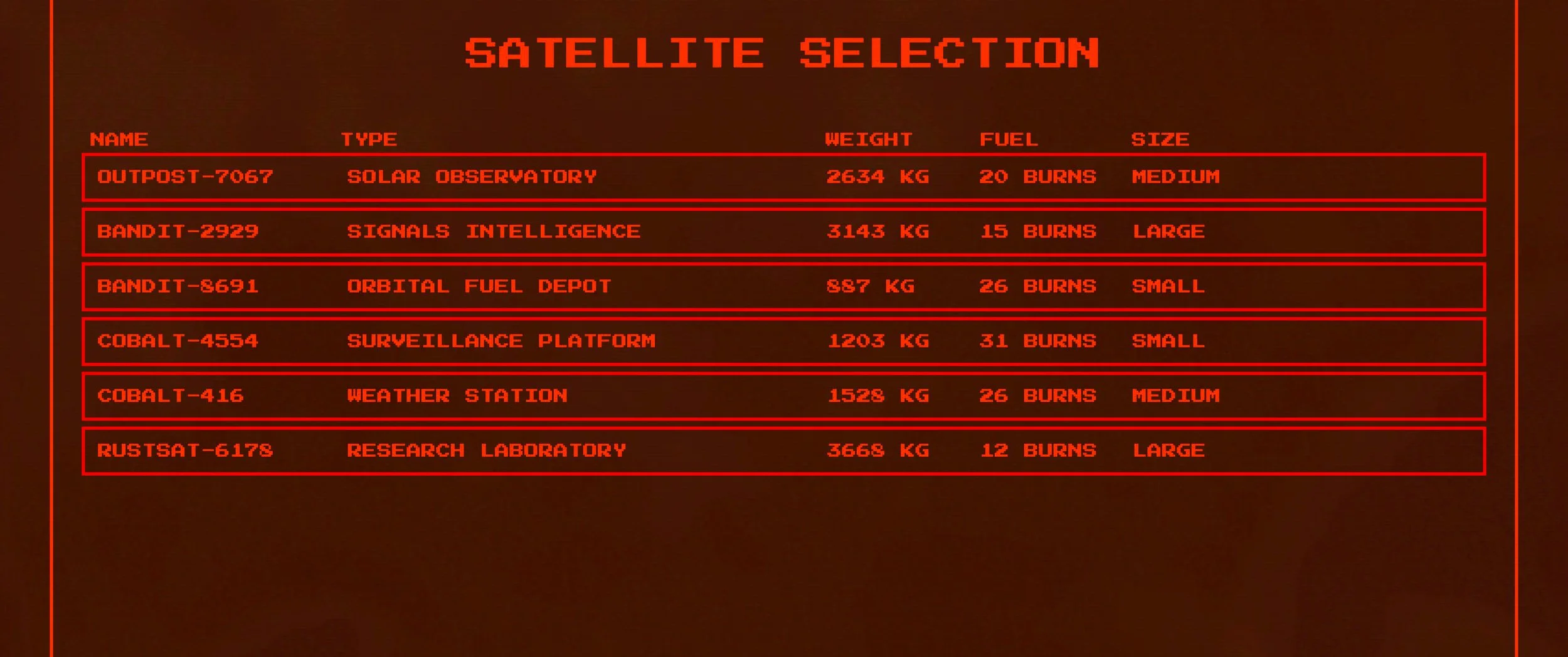
| Satellite | Type | Weight | Fuel | Payload |
|---|---|---|---|---|
| RUSTSAT-6178 | Research Laboratory | 3,668 kg | 12 burns | Large |
| BANDIT-2929 | Signals Intelligence | 3,143 kg | 15 burns | Large |
| OUTPOST-7067 | Solar Observatory | 2,634 kg | 20 burns | Medium |
| COBALT-416 | Weather Station | 1,528 kg | 26 burns | Medium |
| COBALT-4554 | Surveillance Platform | 1,203 kg | 31 burns | Small |
| BANDIT-8691 | Orbital Fuel Depot | 887 kg | 26 burns | Small |
The relationship jumps out immediately: the bigger the payload, the less fuel is left. The RUSTSAT-6178 and its 3,668 kg only carries 12 burns, while the small surveillance platform packs in 31 for a third of the weight. In other words, the richest satellite is also the least maneuverable: either you let it fall roughly wherever the orbit decides, or you burn part of its value bringing it back toward you.
The names and values are server-generated, so there's no point memorizing them. The reading grid, however, stays valid from one wipe to the next: read the fuel column first, not the weight column.
The trade-off that decides everything: aim or take the hit
After selection, a set of coordinate commands lets you spend the burns on two things: moving the target automatically chosen by the system, and narrowing the possible crash zone. The more you spend, the more predictable the impact becomes.
Except that three Thruster Modules can be recovered from the wreckage, and their condition depends directly on the fuel remaining at the moment the trajectory is locked in. These modules have no other use besides recycling, and a well-preserved module yields up to 12 Explosives. Leaving the burns untouched lets you keep up to half the condition of each module: the difference between a satellite steered to the meter and one left to its orbit is therefore measured directly in explosives.
The practical takeaway, in two scenarios:
- Low-population server, you hold Launch Site. Spend nothing, or almost nothing. The satellite will land wherever it wants, you'll have time to get there, and you'll walk away with three high-condition modules. It's the best Tech Trash-invested-to-explosives-recovered ratio of the event.
- Busy server, several clans awake. Spend to tighten the zone and bring the wreckage down near your base. You lose condition on the modules, but an average loot you actually hold beats a maximum loot picked up by your neighbors.
It's an economic trade-off with no equivalent elsewhere in Rust: the Patrol Helicopter or the Cargo Ship deliver the same thing to everyone, whereas here it's you who sets the event's yield the moment you lock in the trajectory.
Ten minutes of descent, and the whole server is watching
Once the trajectory is locked in, expect around ten minutes before impact. The terminal displays the estimated zone on the map along with the countdown, which gives a real informational advantage to whoever controls the control room.
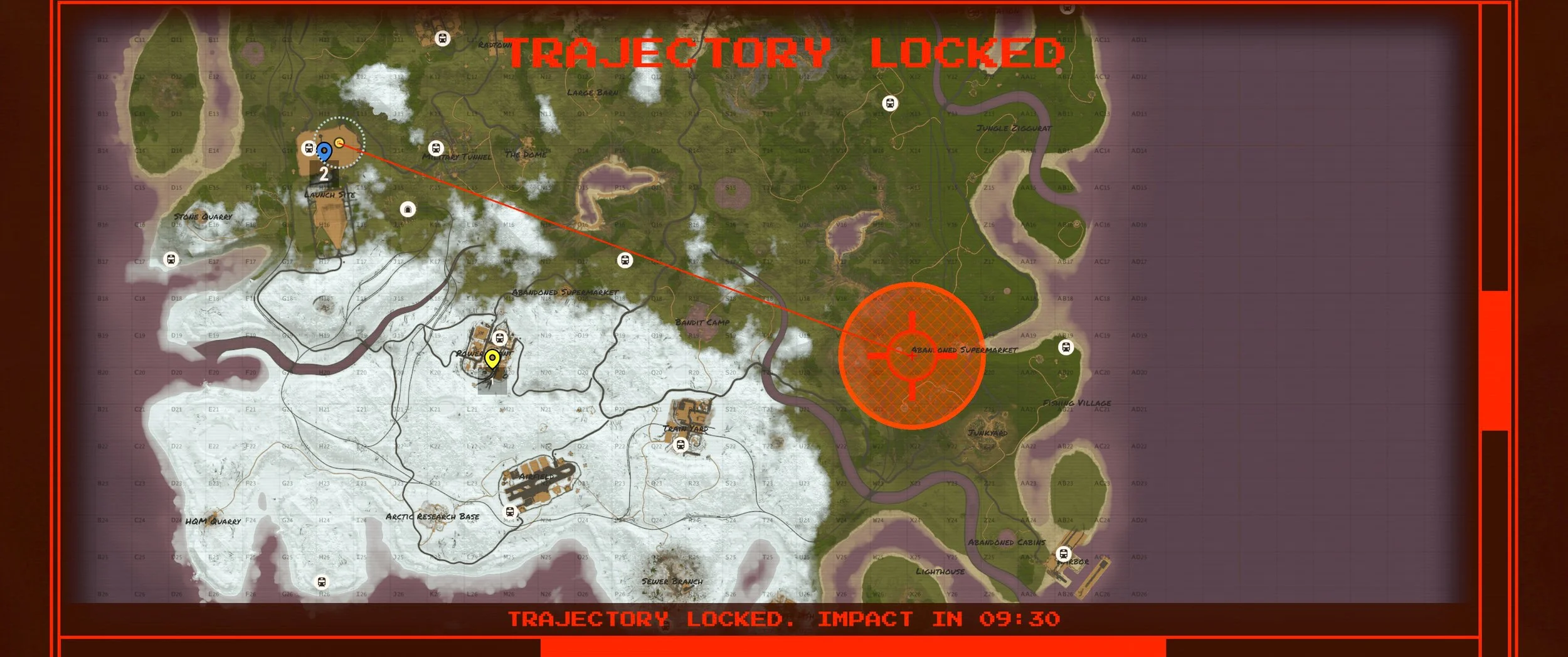
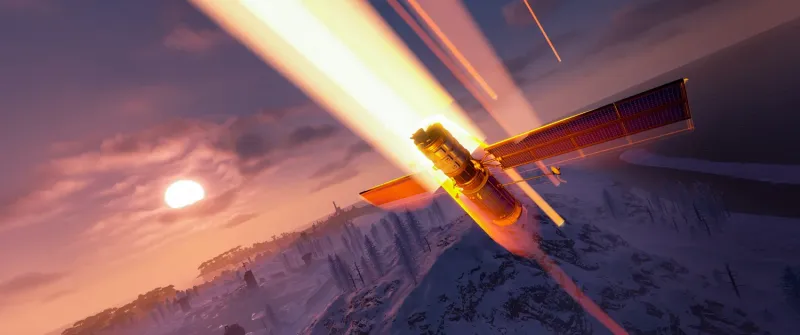
Don't count on stealth either. The crash comes with its own impact effects, an explosion, a soundtrack, and a global event announcement. The descent trail stays visible for several seconds after the crash: anyone who happened to look up at the right moment knows exactly which direction to run. Clans also get a dedicated event for the satellite launch, plus another one for looting the crates.
These ten minutes are the real gameplay window of the event. Use them to position yourself: head toward the estimated impact zone before the crash, not after.
Looting the wreckage: five minutes, eight minutes, and radiation
Two separate timers apply at the crash site.
- The new satellite crates stay too hot for five minutes before they can be opened.
- The main wreckage requires eight minutes before it can be safely harvested.
Add to that a small but intense radiation zone around the debris: come geared for it, and be ready to hold the position while the rest of the server converges on the site. The wreckage has its own health pool and protections comparable to those of the Patrol Helicopter's wreck, which limits opportunistic sabotage.
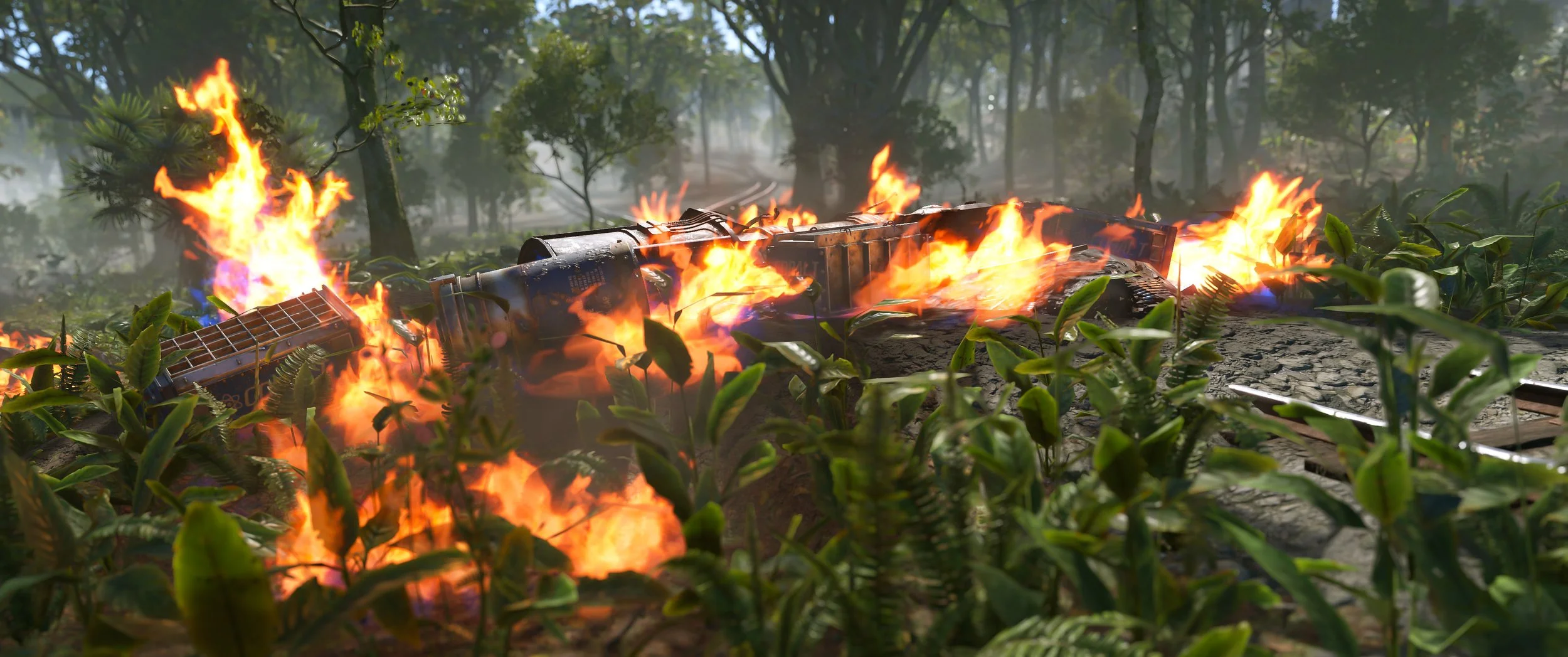
As for the loot, the crates can yield High Quality Metal, Tech Trash, CCTV Cameras, Targeting Computers, turret-related components, and occasionally a new Aiming Module. The three Thruster Modules, meanwhile, are mined from the wreck itself.
This loot is worth more this month than it might seem: the Auto Turret's crafting cost jumps from 10 to 25 High Quality Metal with Power Trip. So anything coming out of the wreckage that's tied to turrets automatically sees its trade value rise on high-population servers.
After the crash: 30 to 40 minutes before it happens again
Once the event ends, the Launch Site system enters a recalibration period of 12 to 16 in-game hours, or roughly 30 to 40 real minutes with default server settings. It's impossible to chain two satellites back to back. This delay sets the pace for the evening: an organized group can aim for three to four launches, provided they keep Power Plant at stage 4 the entire time.
One detail worth catching for resale purposes: Power Plant's green recycler has been replaced by a red recycler in the same spot, in the green card room. It only becomes usable once the power grid reaches maximum stage, returns 75% of materials, and runs in four-second cycles, compared to 60% for a green recycler outside a safe zone — and just 50% until the network reaches stage 2. Since Thruster Modules have no use other than recycling, and stage 4 unlocks both systems at the same time, the detour through Power Plant on the way back is well worth it.
What stays in English in the French client
The French version of Rust relies on community translations and isn't complete. As of August 6, 2026, no official source provides a verified French equivalent for the terms introduced by Power Trip, and the launch terminal interface displays in English on the test branch (SATELLITE SELECTION, TRAJECTORY LOCKED, IMPACT IN). We're therefore keeping the original labels rather than inventing a translation you wouldn't actually find in-game.
| In-game Label | What it refers to |
|---|---|
| Satellite Crash | The new player-triggered orbital crash event |
| Heavy Fuse | Heavy fuse to insert at Power Plant to raise the grid by one tier |
| Aiming Module | The former MLRS Aiming Module, renamed since it now also serves the satellite terminal |
| Thruster Module | Propulsion module recovered from the wreck, recyclable only |
| Burns | Remaining fuel units, spent to correct the trajectory |
What to do in the first hours of the wipe
Don't expect to see a satellite come down the same evening. Stage 4 demands a quantity of Heavy Fuses that no one will have stockpiled within a few hours, especially with a spawn rate that was revised downward during the final balancing pass. The first two days play out elsewhere: farm regular crates as well as those in the Underwater Labs, the two known sources of Heavy Fuses, and decide early on your position. Either you feed the server's grid and keep control over the launch schedule, or you let others foot the bill while you come take the terminal at the right moment. Both approaches are defensible, but they don't call for the same wipe: the first costs dozens of hours of farming, the second costs a battle at Launch Site.
Share this article
On a big, crowded server, what would you choose?
Frequently asked questions
Do you really need to reach Power Plant stage 4 to launch a satellite?
Yes, it's a mandatory server-wide condition. The terminal only activates once the power grid is fully restored, which requires a collective accumulation of Heavy Fuses in the dedicated crate.
What's the Tech Trash cost for each launch?
Between 6 and 12 random Tech Trash per launch, that's the real recurring cost of the event. Add an Aiming Module and you have everything you need to trigger it.
Why spend fuel if it lowers the value of the modules?
Because on a populated server, a precisely landed satellite near your base is worth more than maximum loot picked up by your neighbors. It's an economic trade-off: loot safety versus component condition.
How long before you can relaunch after a crash?
The system goes into recalibration for 12 to 16 in-game hours after the event, which prevents spamming launches.
Can you really recover all three Thruster Modules from the wreck?
Yes, they're mined directly from the carcass after the eight-minute wait. Their condition depends on the remaining fuel when you locked in the trajectory.
Key takeaways
- Check the remaining fuel first, not the weight: the heaviest satellite is also the least maneuverable.
- Letting the satellite fall on its own orbit costs zero fuel but maximizes the condition of the three Thruster Modules (up to 12 Explosives each).
- The crash zone shows up on the map for ten minutes: get into position before the impact, not after.
- The crates require five minutes before they can be opened, the main wreck eight minutes, all under intense radiation.
- Power Plant must be at stage 4 to activate the terminal, a server-wide condition that depends on installing Heavy Fuses.
Comments
No comments yet. Be the first to react!
Leave a comment
Similar guides

Latest articles







Your opinion counts
Rate Rust
Click a star to rate