

 Fabian Lainé

Full Guide
Hearthstone: The Fire Elemental Shaman Deck Climbing to Legend at Fort Purpúreo (Patch 36.0, July 2026)
In brief
Fire Elemental Shaman stands out as one of the most consistent lists in Fractured Alliances in July 2026, thanks to a smooth curve and a fearsome passive scaling engine. This guide breaks down every card, the optimal mulligan, and the key matchups for climbing to Legend.
Since the arrival of Escape from Fort Crimson and patch 36.0, Hearthstone's Standard meta has started rewarding aggressive low-curve archetypes. Amid Bounty Hunters and Steal Rogues, a less flashy list is nonetheless climbing all the way to Legend: Fire Elemental Shaman. This guide breaks down the full list, the card engine that drives it, the mulligan, the game plan, and the key matchups — all with the official English names and card texts verified in Blizzard's database.
Why Fire Elemental Shaman is rising in July 2026
The archetype is built on a simple but fearsome idea: stack up cheap Elementals, let them swell turn after turn, then convert that board advantage into face damage through fire spells. Patch 36.0 pushed several pieces of the The Lost City block to their full potential, and the Fort Crimson expansion adds a legendary weapon capable of closing out games. The result is a tempo deck that stays playable from turn 1, but whose power peak sits between turns 4 and 7 — exactly where control lists are still struggling to stabilize their defense.
Faced with a metagame dominated by aggression, Fire Elemental Shaman checks every box: a smooth curve, reach to finish games, and above all a passive upgrade engine that makes each trade increasingly profitable. It's not the flashiest list from Fort Crimson, but it's one of the most consistent for climbing ranks.
Another significant advantage: its dust cost remains reasonable. Of the four legendaries in the list, only Little Sister is exclusive to the expansion; Al'Akir, Kalimos, and Bru'kan Rockbreaker are often already sitting in regular players' collections. In other words, it's a credible ladder deck without having to crack open fifty packs, which partly explains its growing popularity on the July ladder.
The full Fire Elemental Shaman list (patch 36.0)
Here are the 30 cards of the reference version, with their mana cost and rarity (gem color: common, rare, epic, legendary). All names are those from the English client.
| Cost | Card | Qty | Rarity | Type |
|---|---|---|---|---|
| 1 | Vapeur gémissante | 2 | Common | Elemental |
| 1 | Sbire du Gallagio | 2 | Common | Elemental |
| 1 | Éclair | 2 | Common | Spell |
| 2 | Cendraileron | 2 | Common | Elemental |
| 3 | Batifoleuse volcanique | 2 | Rare | Elemental |
| 3 | Souffle incendiaire | 2 | Common | Spell |
| 3 | Coulée de lave | 2 | Epic | Spell |
| 3 | Bralma Pierrefendue | 1 | Legendary | Minion |
| 3 | Tempête de foudre | 2 | Rare | Spell |
| 4 | Magma mécanique | 2 | Common | Elemental |
| 4 | Petite frangine | 1 | Legendary | Weapon |
| 5 | Griffes-scories | 2 | Epic | Elemental |
| 6 | Essaim crépitant | 2 | Rare | Spell |
| 6 | Élémentaire de feu | 2 | Common | Elemental |
| 7 | Seigneur Kalimos | 1 | Legendary | Elemental |
| 8 | Al'Akir, seigneur des tempêtes | 1 | Legendary | Elemental |
That's exactly 30 cards, including eleven pure Elementals and a set of fire spells that feed the payoffs. It's a deliberate balance: enough minions to hold the board, enough spells to trigger the Kinship and scaling effects.
The engine: the cards that make your Elementals swell
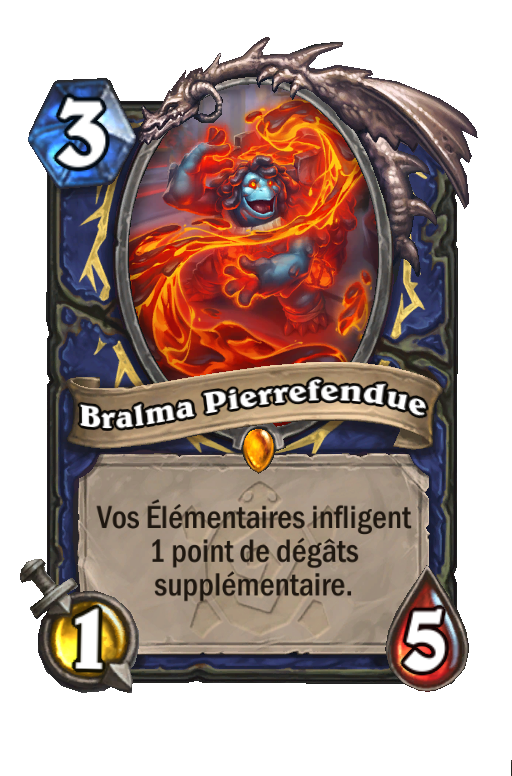
Bralma Pierrefendue (3 mana, 1/5, legendary) is the heart of the deck: "Your Elementals deal 1 extra damage." A single copy turns every trade into profit, and two Bralmas on the board double the stakes. It's the card your opponent needs to remove as a priority.
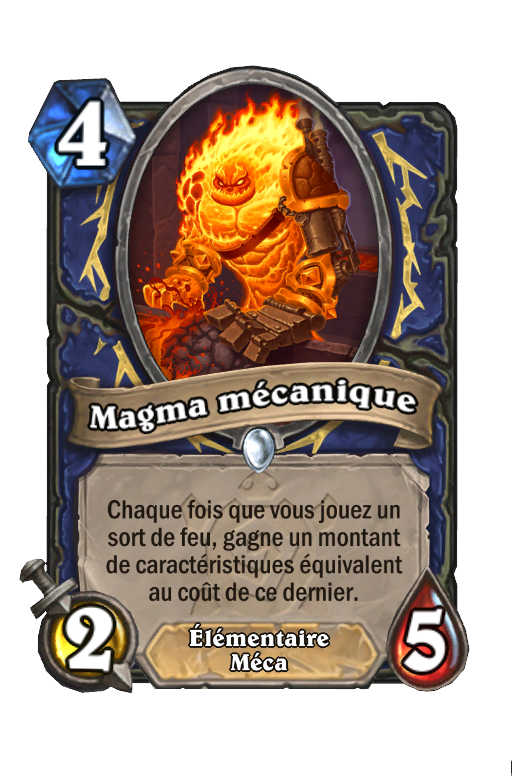
Magma mécanique (4 mana, 2/5) is your snowball card: "Whenever you cast a Fire spell, gain stats equal to its cost." Chain a Souffle incendiaire followed by a Coulée de lave onto it and you get an oversized threat that's impossible to ignore. This is also why you want to hold onto your fire spells once the Magma is already stuck on the board.
Batifoleuse volcanique (3 mana, 2/3, rare) draws a fire spell on Battlecry and, thanks to its Kinship, grants it "+2 spell damage" if another Elemental was played before it. It feeds both your hand and the power of your burns.
At the base of the curve, Wailing Vapor (1/3) gains +1 attack for every Elemental you play, and Gallagio Minion (1/3) grows whenever you play a minion with Battlecry. These two 1-drops played on turn 1 become massive threats by turn 4.
Fire spells and ignition: the second half of the plan
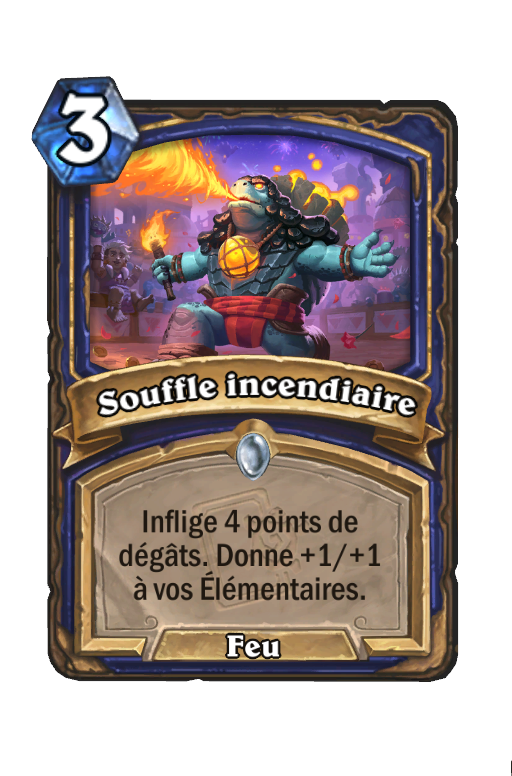
The spell package serves two purposes: clearing the opponent's board and turning your payoffs into war machines. Fire Breath (3 mana) deals 4 damage and gives +1/+1 to all your Elementals — a mini board buff paired with a removal answer. Lava Shock (3 mana, epic) hits the opponent hero with the lowest health three times for 2 damage each, with Overload (1), making it pure reach for finishing off a hero at 6 health. Crackling Swarm (6 mana) deals 3 damage and summons that many 2/1 Crackling Embers, an excellent board-catch-up tool.
For pure removal, Lightning Bolt (1 mana, 3 damage, Overload 1) and Lightning Storm (3 mana, 3 damage to all enemy minions) keep you in control against other aggro decks. Be careful managing Overload: playing a Lightning Bolt on turn 1 costs you a mana crystal on turn 2, which isn't always desirable.
The subtle point to grasp is the synergy between these spells and your two payoffs: every fire spell cast on a board where a Molten Rock stands grows it, and every burn spell gains reach once a Volcanic Drake has left its damage bonus behind. So the same Fire Breath can, in the right order, clear an enemy minion, feed your Molten Rock, and boost your next Lava Shock. It's this stacking of effects, more than the raw power of any single card, that makes the deck strong.
Little Sister: Fort Purpur's legendary weapon
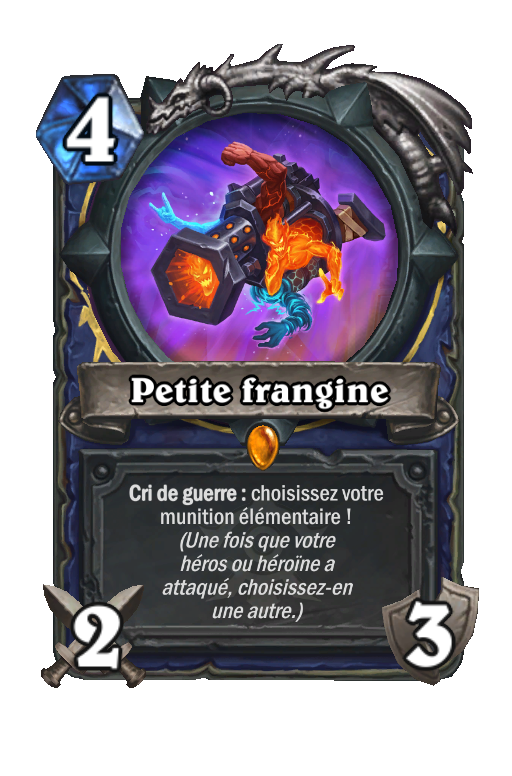
New in the expansion, Little Sister (4 mana, 2/3, legendary weapon) offers a Battlecry that lets you "choose your elemental ammo," with the option to change it after each attack by your hero. It's a flexible, recurring damage source that perfectly fills turns where you have no development. Against slow decks, it also lets you keep the initiative without overcommitting minions into board clears.
The top of the curve: Kalimos, Primal Lord and Al'Akir
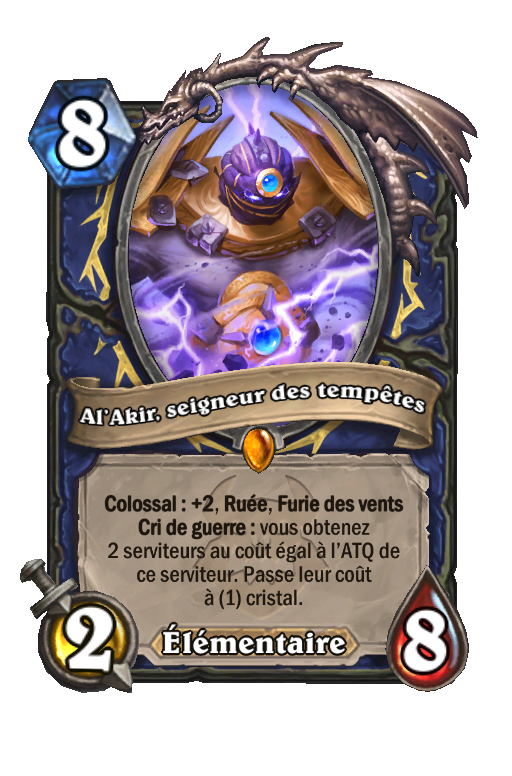
The end-game trio handles the closing. Fire Elemental (6 mana, 6/5) deals 4 damage on entry — a ping that kills a blocker or starts chipping away at the face. Lord Kalimos (7 mana, 7/7, legendary) triggers an elemental summon if you played an Elemental the previous turn, which is nearly always the case in this list. And Al'Akir the Windlord (8 mana, 2/8, Colossal +2, Windfury, Charge) remains the ultimate finisher: dropped on a developed board and boosted by Bru'kan, it deals monumental damage the very turn it lands.
Cinderclaw (5 mana, 3/4, epic) ties it together: it summons two 2/1 crackling embers and, with Kinship, triggers their Deathrattles. A card that fills the board and feeds both Moaning Vapor and the Gallagio Bruiser.
Mulligan: what to keep at the start
- Always keep: Moaning Vapor, Gallagio Bruiser, Ashfire and Volcanic Drake. These are your early tempo plays.
- Keep on the coin (second player): Bru'kan the Rockbreaker and Mechanical Magma, which speed up the snowball.
- Keep against aggro: Lightning Storm and Lightning Bolt to survive the early turns.
- Mulligan away: Al'Akir, Kalimos and Crackling Swarm, too expensive for the opening phase — unless your hand is already excellent on the low end of the curve.
Turn-by-turn game plan
- Turns 1-2: play your 1-drop Elementals and chain them to start building Moaning Vapor's counters.
- Turn 3: ideally Bru'kan the Rockbreaker, or Volcanic Drake to draw a fire spell.
- Turn 4: Mechanical Magma, then feed it fire spells over the following turns; otherwise, Little Sister to push the tempo.
- Turns 5-6: Cinderclaw and Crackling Swarm retake the board; start redirecting damage to the face.
- Turns 7-8: Kalimos then Al'Akir seal the game. Keep a Lava Shock in hand as reach for the last 6 HP.
Matchups: strengths and weaknesses
| Opponent | Verdict | Key to the matchup |
|---|---|---|
| Control Warrior | Favorable | Wear down their board clears, keep gas with Little Sister and use Al'Akir as the finisher. |
| Contraband Hunter | Close | Prioritize Lightning Storm and favorable trades, then stabilize with Crackling Swarm. |
| Fatigue Mage | Favorable | It's a race: go face, and Lava Shock closes out the game. |
| Thief Rogue | Unfavorable | Don't overcommit; play around their board clears and keep Bru'kan protected. |
Variants, flex slots and verdict
The most debatable slots are the second Lightning Storm and Crackling Swarm. In a very aggressive metagame, double up on your board clears and add a defensive Taunt minion if you have the Standard version. Against more control-oriented decks, cut one removal spell for a second finisher or for Lower Sub Wing (the Crimson Fort location), which generates a free shaman minion. The Bru'kan / Magma / Volcanic Drake backbone, however, stays untouched — it's what defines the archetype.
A « bigger » variant also exists, which lightens up on 1-drops in favor of one or two additional high-curve minions to better dominate board-based mirrors; it sacrifices speed for better inevitability in the late game. Conversely, an ultra-tempo version cuts Kalimos for a second early damage spike. Test both orientations depending on what you run into most on your server: the beauty of this archetype is that its core stays the same no matter which slider you choose.
In short, Fire Elemental Shaman isn't the flashiest deck of patch 36.0, but it's one of the most reliable for climbing: a clean curve, a passive upgrade engine with Bralma and Magma Mechanic, and a fearsome finishing plan between Lava Shock, Little Sister, and Al'Akir. If you're looking for a consistent, budget-friendly tempo list to chain wins up to Legend at Fort Pourpre, build up this swarm of embers and let the fire do the rest.
Share this article
Ready to grind this Elemental Shaman to Legend?
Frequently asked questions
Should I really hold onto my fire spells if I have a Living Lava on board?
Yes, absolutely. A Living Lava in play turns every fire spell into an automatic buff for your minion: a 3-mana Flamewaker's Fireball becomes +3/+3 for free. It's one of the most powerful synergies in the deck.
How many times do I need to tell myself I should play this deck before actually doing it?
Honestly, just once. It's not a hard deck to pilot compared to control decks, and it climbs consistently. If you're aiming for Legend without spending 200 hours fine-tuning, this one deserves a try.
Is Little Sister really necessary, or can I replace it?
It's not absolutely mandatory, but it fills a critical gap: the turns where you have nothing to play but can't pass without losing tempo. Trying to replace it usually costs more winrate than it seems.
Which fire spell should I cut first if I'm short on space?
Lightning Bolt (1 mana) or one of the two copies of Flamewaker's Fireball are the easiest to cut without weakening the list too much. Lava Flow and Lightning Storm are too central to your removal and reach plans.
Does this deck match up well against Rogue and Hunter?
Against Rogue, it's close: they develop faster on turns 2-3. Against Hunter, you hold up better thanks to your superior reach and scaling. Bru'kan and Living Lava remain your opponent's priority targets, though.
Key takeaways
- Bru'kan the Rockbreaker and Living Lava form the core of the deck: the former amplifies your Elementals, the latter literally explodes when you chain fire spells.
- The low curve (1 to 3 mana) fills the board as early as turn 1, while fire spells double as removal and board buffs.
- Little Sister, the Fractured Alliances legendary weapon, offers flexible reach without overcommitting into enemy board clears.
- The deck spikes between turns 4 and 7, exactly when control decks struggle to stabilize and rival aggro decks run out of resources.
- Its dust cost remains accessible: only Little Sister is exclusive to the expansion, while Al'Akir and Kalimos often already sit in players' collections.
Comments
No comments yet. Be the first to react!
Leave a comment
Similar guides



Latest articles






Your opinion counts
Rate Hearthstone
Click a star to rate