
 Fabian Lainé
Beginner's Guide
Hearthstone: complete beginner's guide to getting started in 2026
In brief
Hearthstone celebrates its twelfth anniversary with the Emerald Dream... wait, the Whizbang's Workshop... no — the Crimson Fort Escape expansion and welcomes a new wave of players. This guide walks you through everything from download to your first victory, covering core mechanics, card types, and the pitfalls to absolutely avoid.
Hearthstone celebrates its twelfth anniversary in 2026 and has just received its new major expansion, Escape from Purpleford Prison, released on July 7. The 135 new cards, the Preparation mechanic and the outlaw minions orchestrated by Vanessa VanCleef have reignited the community's interest — and many newcomers are joining Blizzard's card game as a result. If you've never dropped a minion on the board before, this guide will take you from download to your first victory.
Hearthstone in 2026: where does the game stand?
Released in March 2014, Hearthstone has become the world's benchmark digital collectible card game, with more than one hundred million cumulative players according to Blizzard. Twelve years after its debut, the title is now available in several distinct modes: the nerve-wracking and competitive Ranked mode, the Battlegrounds auto-battler, the Duo Brawl mode, the scripted Solo mode, and Arena's fast-paced draft. The arrival of Escape from Purpleford Prison on July 7, 2026 marks the second expansion of the Year of the Beetle. It introduces 135 cards, a brand-new keyword — Preparation — and a squad of legendary outlaws that shake up the game's fundamental rules.
Note: buying the new expansion is by no means required to discover Hearthstone. The game is entirely free and offers a generous set of basic cards, more than enough for your first weeks of getting to know it.
Installing Hearthstone and creating your account
Hearthstone is available on PC, Mac, iOS and Android. On computer, everything goes through the Battle.net launcher: download it from battle.net, create a free Blizzard account, then install the game from the Hearthstone tab. On mobile, a simple search on the App Store or Play Store is enough. Cross-progression has long been native: your collection, your gold and your progress follow you from one platform to another as long as you use the same Battle.net ID.
On first launch, choose your server carefully: Europe for geographically close opponents and minimal latency. This region can no longer be changed for the account in question afterward, as your progress is siloed by server.
The tutorial and your welcome gifts
The Hearthstone tutorial lasts about ten minutes and puts you in the shoes of the Mage, Jaina Proudmoore, facing a scripted AI. You'll learn the basic mechanics there: playing a card, attacking, using your hero power. Upon finishing the tutorial, the game showers you with gifts that immediately boost your collection:
- The ten unlockable classes, one by one, by winning your first games against the AI
- A free Classic deck for the class of your choice, ready to play online
- A welcome bundle that always includes a legendary card
- A generous selection of Basic Set cards automatically granted for each unlocked class
Tip: don't burn your first Arcane Dust (the crafting currency) on a whim. Wait until you have a clear idea of the deck you want to build — dust is the resource that takes the longest to accumulate and the most painful to waste.
Understanding the board and the fundamental rules
A game of Hearthstone pits two heroes against each other, each with 30 health points. Each side starts with a deck of 30 cards and draws a card every turn. You can only play a card if you have enough mana crystals: one crystal on the first turn, two on the second, and so on up to a maximum of ten.
The board can hold up to seven minions on your side. Each minion displays two numbers: its attack on the left and its health on the right. A minion cannot attack the turn it's played, unless stated otherwise — this delay is known as summoning sickness.
Finally, each class has a unique hero power, activatable for 2 mana. The Mage's deals 1 damage to a target, the Warrior's grants 2 armor, the Priest's heals. A precious release valve when you have leftover mana at the end of your turn.
Your first cards: minions, spells, weapons, and locations
Hearthstone has four main card types:
- Minions: the backbone of your decks, they stay on the board and attack turn after turn.
- Spells: one-time effects — damage, healing, card draw, board control…
- Weapons: they equip onto your hero and let them attack physically for a few turns.
- Locations: introduced in 2022, they sit on the side of the board and offer an effect that can be activated once per turn.
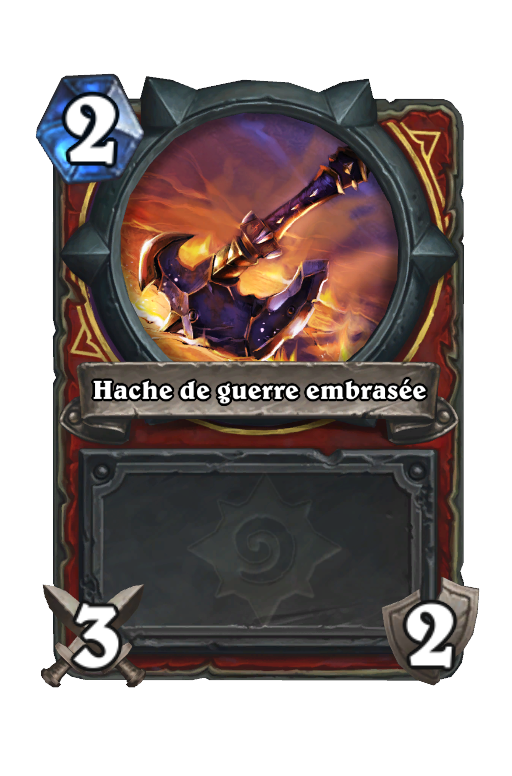
Three cards are enough to illustrate the essentials. The Fiery War Axe is the Warrior's iconic weapon — two swings at 3 damage for 3 mana, an unbeatable value ratio that has made the class's reputation for years.
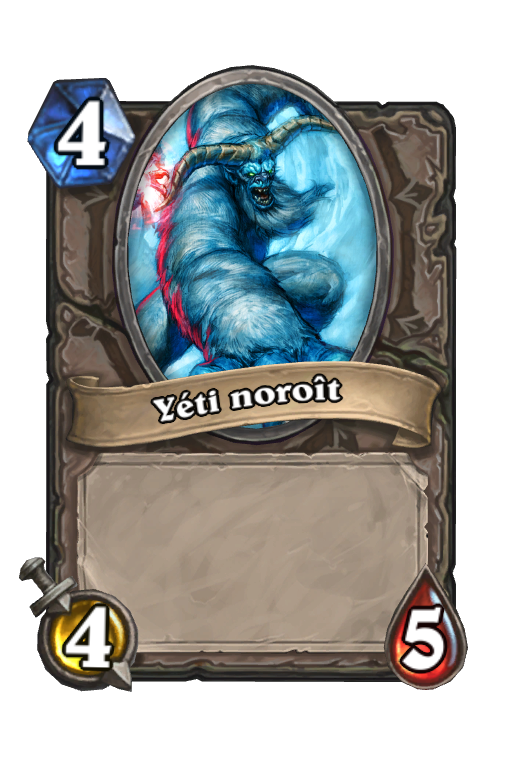
The Chillwind Yeti remains, twelve years on, the ultimate benchmark for a "vanilla" minion: 4 mana, 4 attack, 5 health, no special effect. Nothing flashy, but an excellent yardstick: an equivalent minion must have either higher stats or a compensating effect to justify its place in the deck.
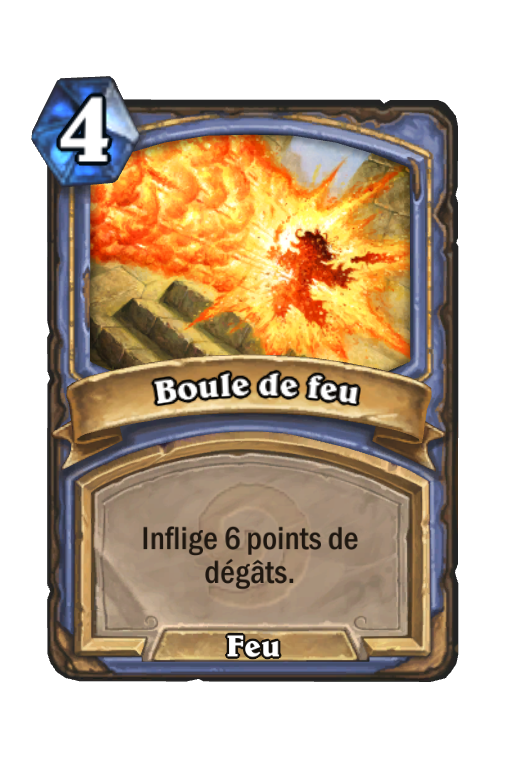
Finally, Fireball is the Mage's iconic spell: 4 mana for 6 damage, free targeting on a minion or the enemy hero. Simple, brutal, effective — and enough to close out plenty of games.
The basic keywords to know
Some cards have keywords written in bold in their text. The five essential ones to remember first:
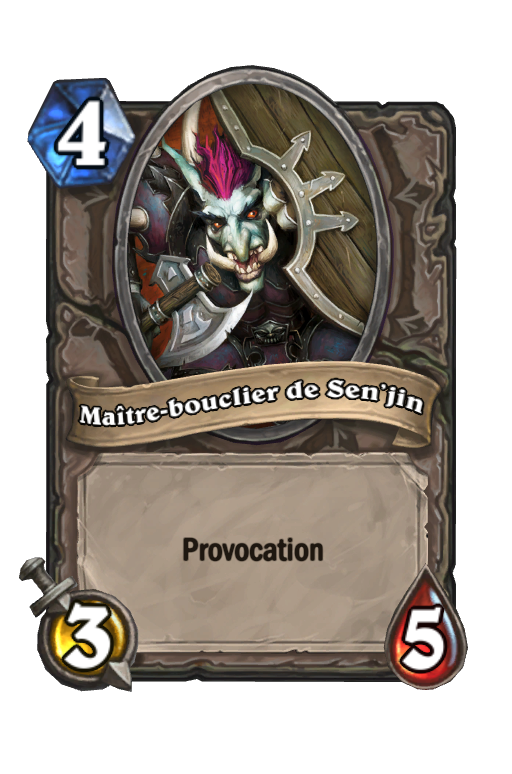
- Taunt: forces the opponent to attack this minion first. Sen'jin Shieldmasta is the perfect example — a 4-mana control wall that protects the rest of your board.
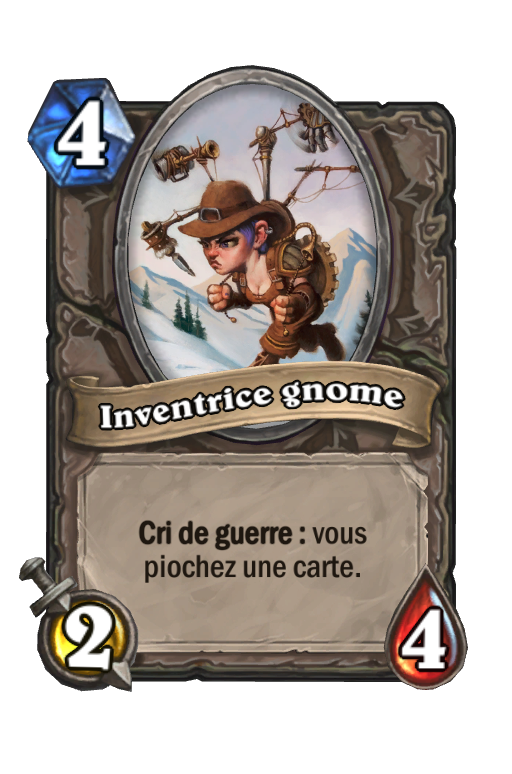
- Battlecry: an effect triggered when the minion is played. Gnomish Inventor lets you draw a card as soon as it enters play, an invaluable ratio for a beginner.
- Deathrattle: an effect triggered when the minion dies.
- Charge: the minion can attack an opponent as soon as it enters play.
- Stealth: the minion cannot be targeted until it has attacked at least once.
Tip: a large part of Hearthstone strategy lies in the order in which you chain your cards during a single turn. Always hover over your opponent's minions before each trade — their text is often the key to a correct calculation.
The essential modes for getting started
Only two modes deserve your attention during your first few hours:
- Casual mode, unranked 1v1 PvP, is your ideal training ground. There you'll face players of your own level, without ladder pressure and without risk of losing rank.
- Duels against the AI (Solo option → Practice Duels) let you calmly test a new deck against a predictable opponent, perfect for getting to grips with a class you don't yet know.
The other modes — Ranked, Arena, Battlegrounds, Tavern Brawl Duo, Mercenaries — are excellent content, but each deserves its own guide, and you risk feeling overwhelmed if you dive in too early. We cover each of them in our dedicated articles.
Classic beginner mistakes
- Burning through your Arcane Dust on flashy legendaries you won't know what to do with. Craft versatile rares and epics first.
- Passing your turn "just in case": in Hearthstone, spending all your mana every turn is the golden rule. An unused crystal is almost always wasted.
- Attacking the enemy hero too early: early in the game, targeting the opponent's minions is far more profitable. "Board first" is a classic rule of the game.
- Neglecting Solo mode: the free Adventures offer bonus cards, valuable lessons on advanced mechanics, and genuine rewards.
- Ignoring the daily quests: they are the main source of free gold and let you buy packs regularly, without ever pulling out your credit card.
Note: since the rewards overhaul, the seasonal Rewards Track (comparable to a free battle pass) earns you cards and dust just by playing. Never neglect it, even without the premium version.
Going further
Once you've secured your first wins, several avenues for progression open up to you. Our dedicated Battlegrounds guide will introduce you to the auto-battler built into Hearthstone, which has become a mode in its own right. The Arena guide covers the fast draft mode, ideal for testing your read on a game without a pre-built deck. And for those who want to climb the Ranked ladder, our tier list for the post-Fall of Duskwood meta details the archetypes currently dominating the Standard format.
Vanessa VanCleef and her outlaws are waiting for you behind the gates of Duskwood Keep. Good luck at the tables — and remember: when in doubt, Yeti it out.
Share this article
What's your main hesitation about starting Hearthstone in 2026?
Frequently asked questions
Is Hearthstone really free, or do you have to pay to progress?
Completely free. The game offers a generous set of basic cards, a welcome bundle including a legendary, and you earn gold regularly through daily quests to buy packs without ever reaching for your credit card. Optional purchases exist, but they're absolutely not required to get started.
Which server should I choose, and can I change it later?
Choose Europe for minimal latency if you're a French speaker. No, this choice is permanent and cannot be changed for your account — your progress is siloed by server. Think it through carefully at account creation.
How long before I can face other players without getting crushed?
The tutorial takes about ten minutes, and Classic Mode matches you with players at your level. You can start playing against humans as soon as you understand the basic mechanics — usually after 2-3 hours of solo play.
Do I need to buy the new Crimson Fort Escape expansion to get started?
No, not at all. The expansion is optional, and its 135 new cards gradually rotate into Standard mode. Play with the free basic cards first, and invest in packs later if you feel like it.
Why can't my minions attack the turn I play them?
That's Summoning Sickness, a mechanic that prevents overly obvious rushdowns and forces tactical thinking. Some cards (with the Charge keyword) bypass this rule, but it applies to the vast majority of vanilla minions.
Key takeaways
- Hearthstone is completely free-to-play and cross-platform: your collection follows you between PC, Mac, iOS and Android via your Battle.net account.
- The five priority keywords are Taunt, Battlecry, Deathrattle, Charge and Stealth — master these before moving on.
- Don't burn your Arcane Dust on flashy legendary cards: craft versatile rares and epics first.
- Classic Mode and Duels against the AI are your two best training grounds — the other modes can wait.
- Spend all your mana every turn and never skip your daily quests: these are the two costliest mistakes.
Comments
No comments yet. Be the first to react!
Leave a comment
Similar guides
Latest articles




Your opinion counts
Rate Hearthstone
Click a star to rate